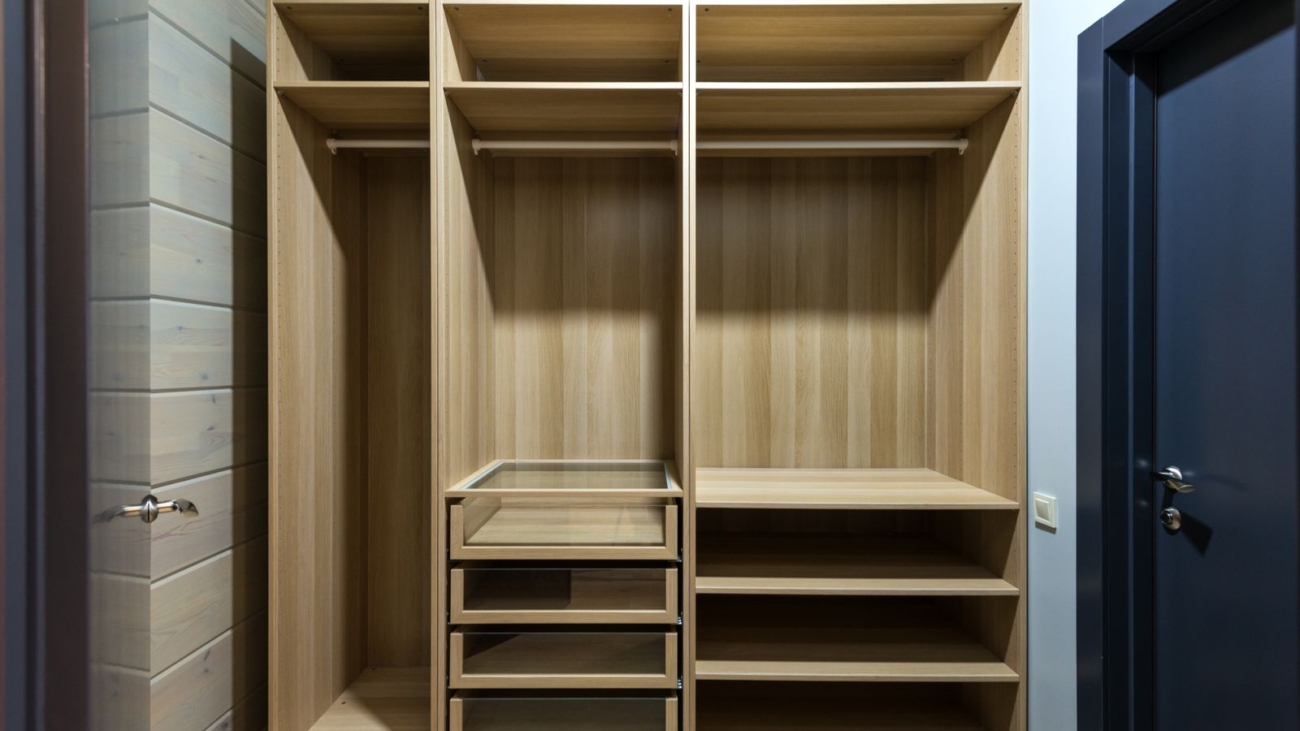
Open wardrobe carcass with shelves and hanging rods in a Bengaluru bedroom, 2026, showing cut edges and internal layout, by myNivasa

Is a Carpenter Wardrobe Cheaper Than Modular in Bengaluru?

Last Updated: August 2026 | Reading time: about 10 minutes

Yes, the site carpenter quote is genuinely lower, and almost every homeowner reads that number wrong. In Bengaluru in 2026 a site carpenter quotes roughly Rs. 1,050 to Rs. 1,250 per square foot of wardrobe shutter area for hinged laminate work. A factory modular wardrobe to the same specification runs Rs. 1,300 to Rs. 1,450. On a standard 6 foot by 7 foot wardrobe, 42 square feet of shutter, that is Rs. 44,100 to Rs. 52,500 against Rs. 54,600 to Rs. 60,900, a gap of about Rs. 8,000 to Rs. 10,000. What the gap buys is not margin. It is edge banding on all four sides instead of the front face, branded soft close hinges instead of Rs. 60 hinges, and a written warranty instead of a phone number. Six items outside the carpenter quote typically add Rs. 12,000 to Rs. 25,000 back.

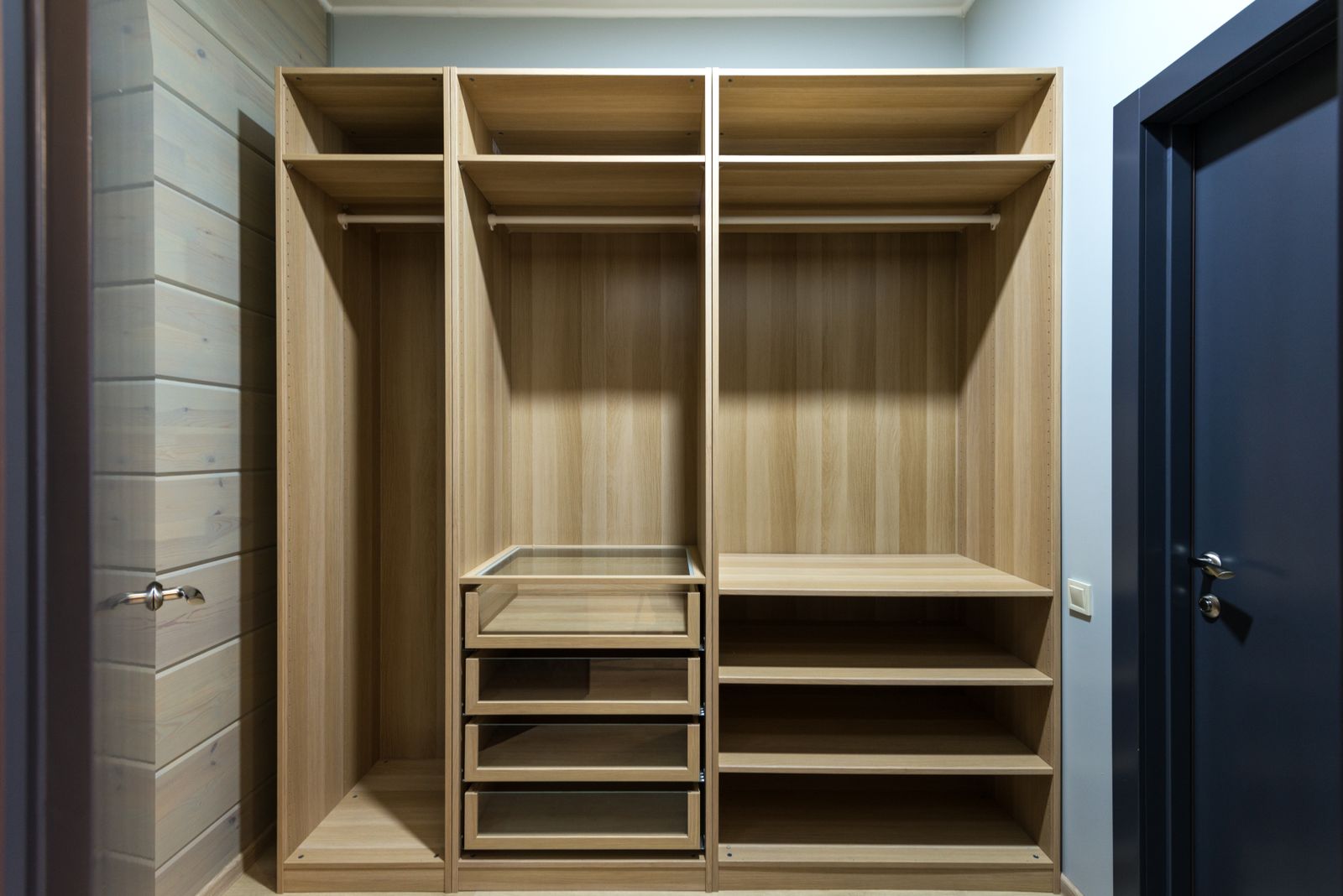
Open wardrobe carcass with shelves and hanging rods in a Bengaluru bedroom, 2026, showing cut edges and internal layout, by myNivasa
A wardrobe carcass before shutters go on. This is where the carpenter and factory routes actually diverge.

Carpenter or Modular Wardrobe: Where the Rs. 200 Per Sq Ft Gap Comes From

Wardrobes in Bengaluru are priced per square foot of shutter area, the visible face of the unit, width multiplied by height. A 6 foot wide, 7 foot tall wardrobe is 42 square feet. Every quote you receive is that number multiplied by a rate.

myNivasa's published 2026 rate for a hinged laminate wardrobe is Rs. 1,300 to Rs. 1,450 per square foot of shutter area, with sliding at Rs. 1,500 to Rs. 1,650 and acrylic or veneer at Rs. 1,500 to Rs. 1,700. Site carpenters across Bengaluru quote the same hinged laminate description at roughly Rs. 1,050 to Rs. 1,250, and some on site outfits advertise as low as Rs. 850. The headline gap is Rs. 150 to Rs. 300 per square foot, or 10 to 20 percent, matching what the wider Indian market reports for site carpentry against factory work.

Three things account for nearly all of that gap, and none is profit. Edge sealing: a factory presses PVC tape onto all four cut edges under heat, while a carpenter seals the front face with a hand iron and leaves the back and two vertical cuts raw. Hardware: a local hinge costs Rs. 60 to Rs. 150 against Rs. 180 to Rs. 700 for a branded soft close hinge, and a 7 foot shutter needs four. And the paper: a factory unit carries a written carcass warranty, commonly 5 years and occasionally 25, while site carpentry here typically carries nothing in writing.

A number from our own work. In a 2 BHK in Marathahalli the client wanted sliding shutters in the master bedroom for the look. We measured a comfortable 3 feet of clearance in front of the wardrobe wall, switched to hinged, saved the family close to Rs. 9,000 and gave them full view access to every shelf. In the child's room next door, where the bed sat tight against the wardrobe, we kept sliding. Same flat, two answers, decided by a tape measure.

In eight years of quoting wardrobes in Bengaluru I have never seen a carpenter quote and a factory quote that describe the same object. They describe the same dimensions. That is a different thing, and it is where the argument always starts.

  • Site carpentry quotes Rs. 1,050 to Rs. 1,250 per sq ft of shutter in Bengaluru in 2026; factory modular quotes Rs. 1,300 to Rs. 1,450 for hinged laminate.
  • On a 42 sq ft wardrobe that is Rs. 44,100 to Rs. 52,500 against Rs. 54,600 to Rs. 60,900.
  • Six commonly excluded items add Rs. 12,000 to Rs. 25,000 back to a carpenter quote before handover.
  • Branded soft close hinges are rated for 50,000 to 80,000 cycles; local hinges carry no cycle rating.
  • Three site built wardrobes take 18 to 25 days in an occupied flat against 6 to 9 days for factory units.

Get a Line-Item BOQ

Every hinge, plywood sheet, and wire, transparent quotation.

WhatsApp Us
Call +91 94499 00222

What Site Carpentry Costs Per Sq Ft of Wardrobe Shutter in Bengaluru

A site carpentry quote has two layers: the carpenter's labour and the materials you buy separately. Carpenter day rates in Bengaluru in 2026 run Rs. 600 to Rs. 800 for a fresher, Rs. 900 to Rs. 1,600 mid career and Rs. 1,600 to Rs. 2,200 for a senior hand, with metro rates 25 to 30 percent above the national benchmark.

Below is myNivasa's own published rate card set against what a carpenter quotes for the identical description.

myNivasa wardrobe rate card, Bengaluru 2026, per sq ft of shutter area
Wardrobe type or finish Factory modular rate Typical site carpenter quote
Hinged, laminate Rs. 1,300 to Rs. 1,450 Rs. 1,050 to Rs. 1,250
Sliding, laminate Rs. 1,500 to Rs. 1,650 Rs. 1,250 to Rs. 1,400

Six Costs the Carpenter Wardrobe Quote Leaves Out

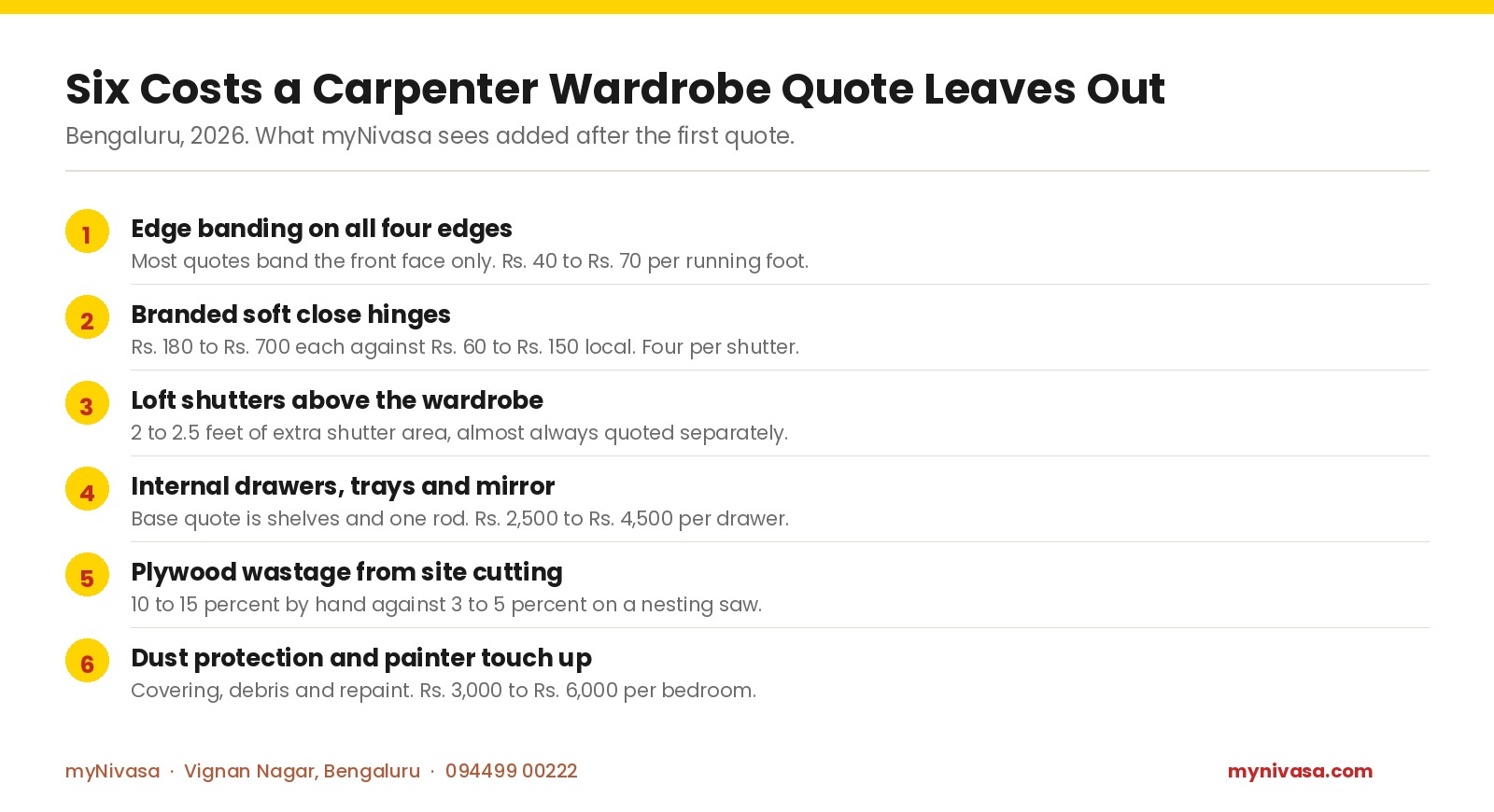
This is the part that turns a Rs. 8,000 saving into a Rs. 4,000 loss. None of these are dishonest omissions. A carpenter quotes what he was asked about, and most homeowners ask about the wardrobe, not about the edges of it.

Six costs a carpenter wardrobe quote leaves out in Bengaluru 2026: edge banding Rs. 40 to 70 per running foot, branded hinges Rs. 180 to 700 each, loft shutters, drawers Rs. 2,500 to 4,500 each, 10 to 15 percent plywood wastage, dust and repaint Rs. 3,000 to 6,000 per bedroom, by myNivasa
The six additions myNivasa most often sees after a carpentry quote is signed.
Six Costs a Carpenter Wardrobe Quote Leaves Out
# Cost item Typical range
1 Edge banding on all four edges Most quotes band the front face only. Rs. 40 to Rs. 70 per running foot.
2 Branded soft close hinges Rs. 180 to Rs. 700 each against Rs. 60 to Rs. 150 local. Four per shutter.
3 Loft shutters above the wardrobe 2 to 2.5 feet of extra shutter area, almost always quoted separately.
4 Internal drawers, trays and mirror Base quote is shelves and one rod. Rs. 2,500 to Rs. 4,500 per drawer.
5 Plywood wastage from site cutting 10 to 15 percent by hand against 3 to 5 percent on a nesting saw.
6 Dust protection and painter touch up Covering, debris and repaint. Rs. 3,000 to Rs. 6,000 per bedroom.

Add the middle of each range on a 42 square foot wardrobe with a loft and two drawers and you land between Rs. 12,000 and Rs. 25,000 of additions. That is the entire gap, and often more. The loft catches Bengaluru homeowners hardest: our flats run 9.5 to 10 feet floor to slab, almost every bedroom wall carries 2 to 2.5 feet of dead height above the wardrobe, and nobody prices it on day one.

Why a Site Made Shutter Bows and a Factory Pressed One Does Not

A wardrobe shutter is a sandwich: board in the middle, laminate on both faces, PVC tape on the cut edges. It stays flat only if both faces are under equal tension. In a factory the laminate goes on in a hot press, both faces at once under uniform pressure, then straight through an edge bander. On site the carpenter glues one face, weights it with whatever is heavy in the room, waits, then does the other. The two faces cure at different times under different pressure, and that imbalance pulls a shutter into a shallow curve over the first two Bengaluru monsoons.

The edges matter more than the faces. The Bureau of Indian Standards separates plywood into IS 303, the interior grade, and IS 710, the marine grade, and even an IS 710 sheet takes water through a raw cut edge. PVC edge banding is the seal. Missing on the back and side cuts, moisture enters at the base and around the hinge cups first, which is where swelling shows three to five years in. Our own Bengaluru observation matches: failure starts at the exposed cut edge, not across the face.

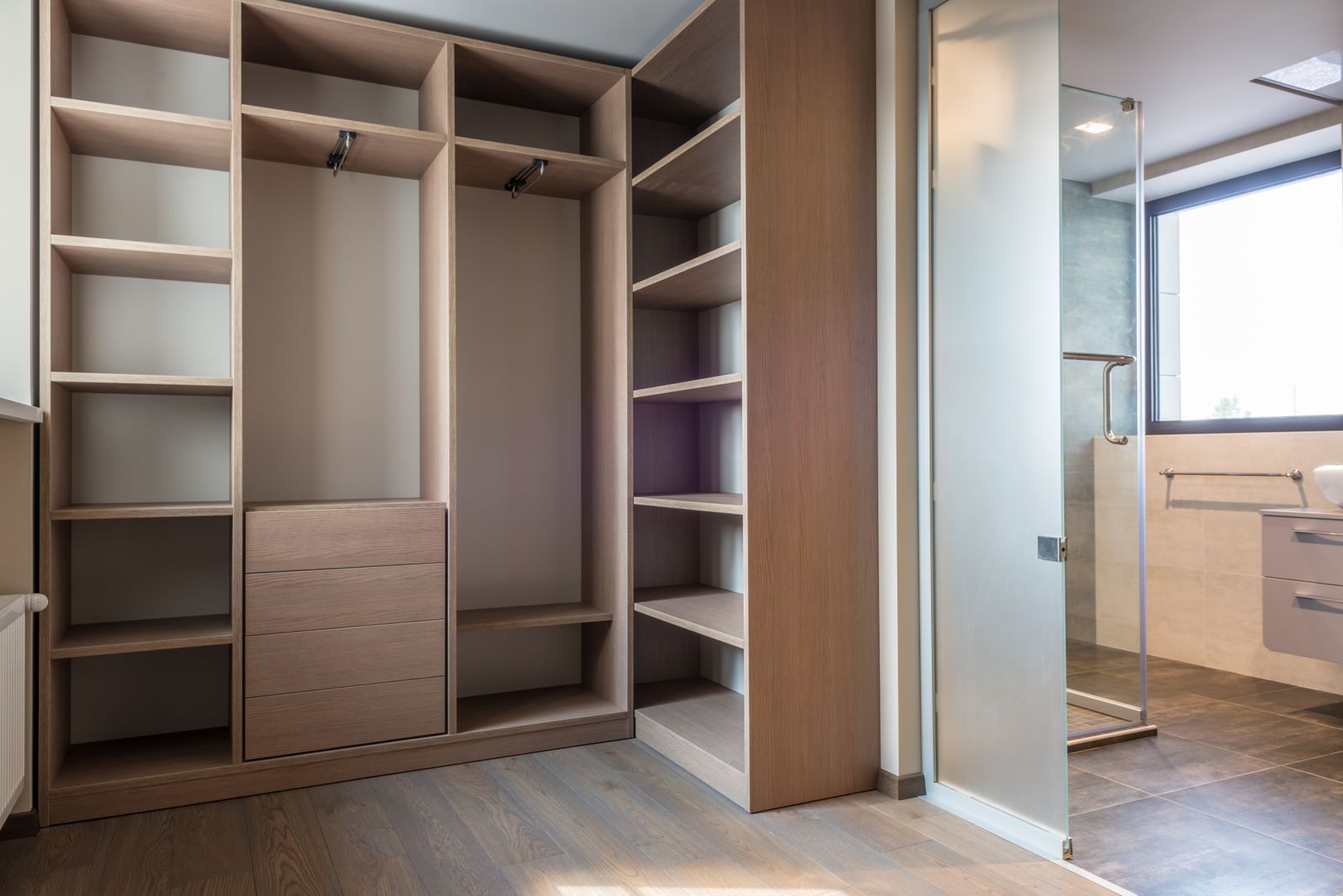
Built in wardrobe with open shelves and drawer stack in a Bengaluru apartment bedroom, 2026, by myNivasa
Drawer stacks, loft shelves and edge sealing separate the two quotes.
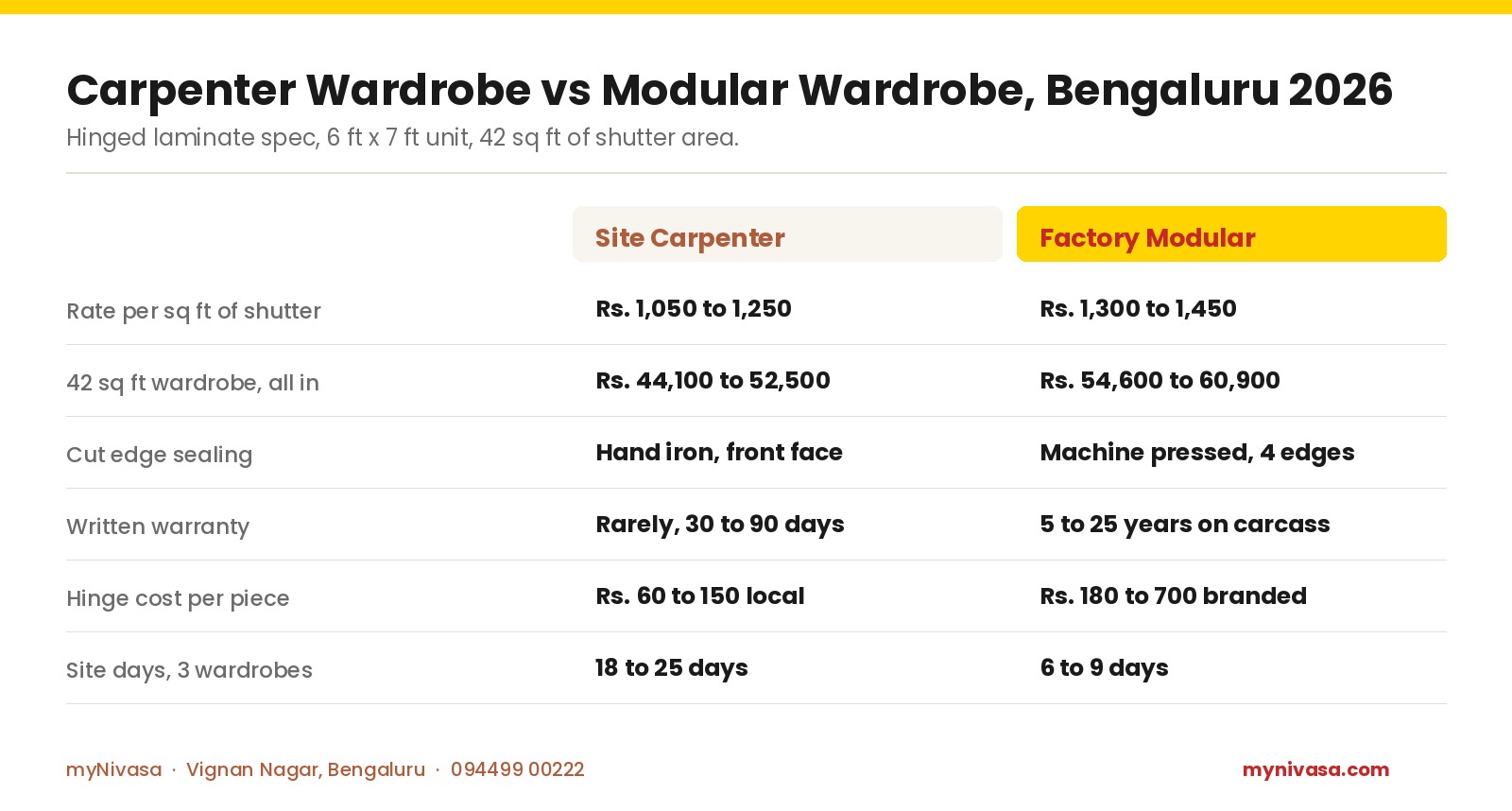
Carpenter vs modular wardrobe cost Bengaluru 2026: site carpenter Rs. 1,050 to 1,250 per sq ft against factory modular Rs. 1,300 to 1,450 per sq ft, 42 sq ft unit Rs. 44,100 to 52,500 against Rs. 54,600 to 60,900, by myNivasa
Same hinged laminate spec, two routes, 42 sq ft of shutter area.
Carpenter Wardrobe vs Modular Wardrobe, Bengaluru 2026
Criterion Site Carpenter Factory Modular
Rate per sq ft of shutter Rs. 1,050 to 1,250 Rs. 1,300 to 1,450
42 sq ft wardrobe, all in Rs. 44,100 to 52,500 Rs. 54,600 to 60,900
Cut edge sealing Hand iron, front face Machine pressed, 4 edges
Written warranty Rarely, 30 to 90 days 5 to 25 years on carcass
Hinge cost per piece Rs. 60 to 150 local Rs. 180 to 700 branded
Site days, 3 wardrobes 18 to 25 days 6 to 9 days

Book a Free Site Visit

We measure your space and confirm feasibility on the same visit.

WhatsApp Us
Call +91 94499 00222

When Site Carpentry Wins: Wardrobe Lofts, Sloped Walls and Odd Bedroom Corners

I quote factory modular for most bedrooms and still send a carpenter to some. Three situations make site carpentry the correct answer rather than the cheap one.

The loft. Bengaluru bedrooms carry 2 to 2.5 feet of dead height above the wardrobe and the slab is rarely level across a 6 foot run. A factory loft box arrives at one fixed height and you fill the mismatch with a filler strip. A carpenter scribes the top panel to follow the slab, and on a 10 foot ceiling in an older Marathahalli block that difference is visible from the doorway.

A genuinely odd wall. A duct chase in the corner, a beam dropping across the wardrobe line, or a wall out of plumb by more than about 25 millimetres over 7 feet. Factory modules are built square; a carpenter tapers a side panel and nobody knows.

One handover test applies whichever route you take. Open every shutter to 90 degrees and let go. If it drifts closed or open, the unit is not plumb or the hinges are loaded unevenly, and that is the moment to raise it.

Outside those three, the honest picture is the comparison table above. For a plain rectangular wardrobe wall in a reasonably new Bengaluru apartment, the factory route costs Rs. 8,000 to Rs. 10,000 more and returns sealed edges, rated hardware, a warranty document and about two weeks of your life. The related clearance decision sits in our guide to sliding versus hinged wardrobes in Bengaluru.

Visit Our Vignan Nagar Studio

See real samples, hardware, and finished-project photos at our office.

WhatsApp Us
Call +91 94499 00222

Frequently Asked Questions

How much cheaper is a carpenter wardrobe than a modular wardrobe in Bengaluru?

In Bengaluru in 2026 a site carpenter quotes about Rs. 1,050 to Rs. 1,250 per square foot of wardrobe shutter area against Rs. 1,300 to Rs. 1,450 for a factory modular unit in hinged laminate. That is 10 to 20 percent, or Rs. 8,000 to Rs. 10,000 on a 42 square foot wardrobe. Six commonly excluded items add Rs. 12,000 to Rs. 25,000 back before handover, so the finished cost usually lands close to level.

Does a carpenter made wardrobe come with any warranty in Bengaluru?

Almost never in writing. Site carpentry in Bengaluru carries a verbal assurance only, and the carpentry platforms operating here publish service warranties of 30 to 90 days on workmanship. Factory modular wardrobes carry a written carcass warranty, commonly 5 years and sometimes 25. Ask for it as a document before comparing rates.

How long does a carpenter take to build three wardrobes in an occupied Bengaluru flat?

Plan for 18 to 25 working days for three wardrobes built on site against 6 to 9 days for factory modules, which arrive cut and only need assembly and levelling. The gap matters most if you are living in the flat, because site cutting puts plywood dust in every room.

Is IS 710 marine plywood necessary for a bedroom wardrobe?

Usually not for the internal panels. IS 303 boiling water resistant grade is adequate for bedroom shelving and side panels. IS 710 marine grade earns its cost on the bottom panel, the panel against an external wall, and anywhere near a bathroom. What matters more than the grade is that every cut edge is banded, because water enters through raw edges, not through the face of the board.

Limitations and Sources

A note on limits. Every rate here is for Bengaluru in August 2026 and for hinged laminate work unless stated otherwise. Carpenter quotes vary by individual more than by locality, so treat Rs. 1,050 to Rs. 1,250 as a centre of gravity, not a ceiling. The Rs. 12,000 to Rs. 25,000 range is what myNivasa observes on quotes brought to us for a second opinion, not a survey figure.

Sources for the external figures here: the Bureau of Indian Standards for the IS 303 and IS 710 plywood classifications, Hettich India for hinge cycle ratings and soft close specifications, NoBroker for published Bengaluru carpentry service warranty terms, and Housing.com for pan India wardrobe cost benchmarks. All myNivasa rate card figures are our own.

Final Word on Paying the Modular Premium

The carpenter is cheaper on the day you sign and level by the day you move in. So stop comparing the two rates and start comparing the two descriptions: how many edges are banded, which hinge is named, how many hinges per shutter, whether the loft is inside the number, and what happens in writing if a shutter bows in the second monsoon. If both quotes answer those five the same way, take the cheaper one. They almost never do.

If you want that comparison on one sheet, send us the wardrobe wall measurements for each bedroom. We will price the factory route line by line and say plainly which rooms are better served by a carpenter. Room by room numbers sit in our bedroom interior design cost guide for Bengaluru, the material side in our breakdown of what BWP marine plywood actually costs, and payment staging in our note on the interior payment schedule in Bengaluru.

myNivasa, 2nd Floor, Sapthagiri Complex, 265/1, Kaggadasapura Main Rd, Vignan Nagar, Bengaluru, Karnataka 560075. Phone 094499 00222, email [email protected]. We work across Marathahalli, Whitefield, HSR Layout, Sarjapur Road, Indiranagar, Koramangala, JP Nagar, Bellandur, Hebbal, Yelahanka, Electronic City and Bommanahalli.

Get Your Project Timeline in 48 Hours

Milestone-by-milestone plan from measurement to handover.

WhatsApp Us
Call +91 94499 00222

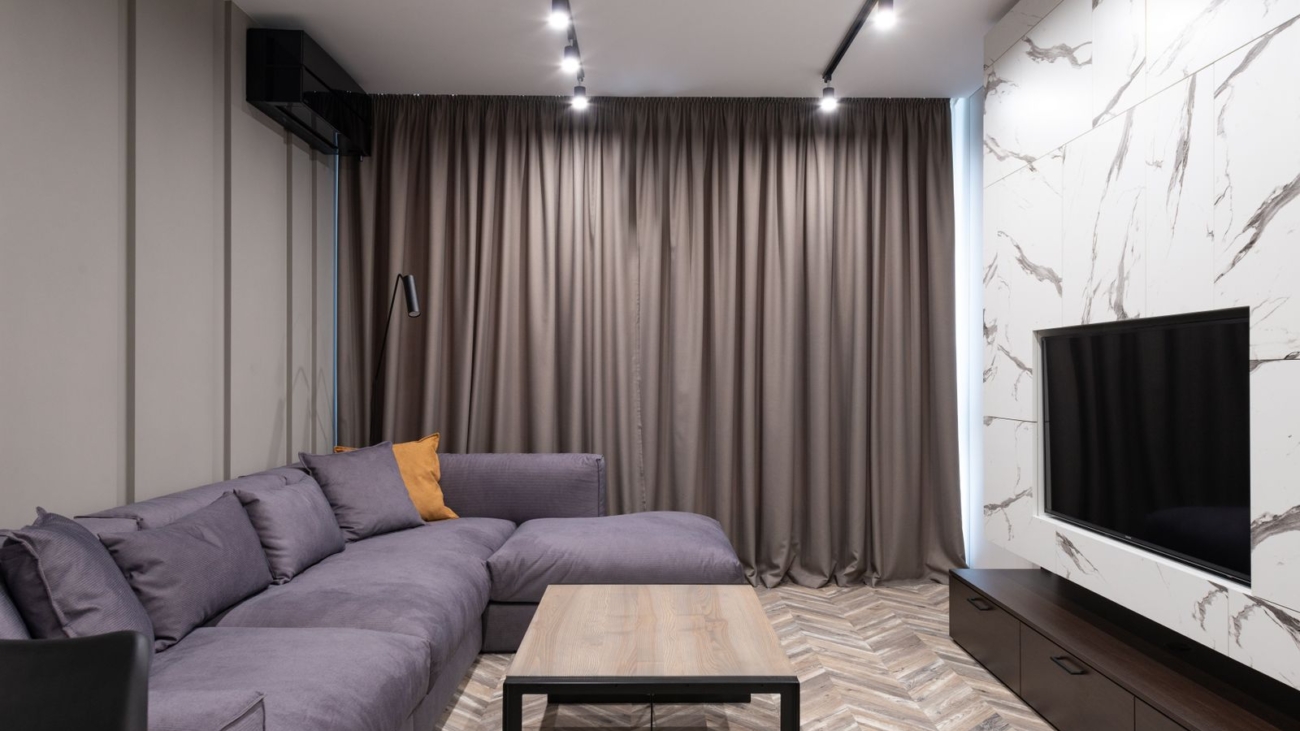
Finished modern apartment living room with corner sofa and TV panel in Bengaluru, illustrating interior payment schedule milestones 2026, by myNivasa

How Should You Pay an Interior Contractor in Bengaluru?

Last Updated: August 2026 | Reading time: about 9 minutes

What you should pay an interior contractor upfront in Bengaluru depends on three things: whether a signed drawing set exists, who buys the materials, and whether the schedule runs against deliveries or against dates. Once those are settled the answer is narrow. Pay 10 percent at design sign-off, release 30 percent only when the material purchase order is placed, and hold 5 percent for 30 days after handover. On a Rs. 6 lakh 2BHK contract that is Rs. 60,000 before anything is cut and Rs. 30,000 retained after you move in. A payment schedule is a quality instrument, not a finance formality: money released ahead of delivered work removes your leverage. Ask for the milestone list in writing alongside the quotation.

What a Fair Interior Payment Schedule Looks Like in Bengaluru

A Bengaluru interior contract in 2026 typically runs Rs. 1,200 to Rs. 3,500 per square foot, putting a 2BHK fit-out between Rs. 3.5 lakh and Rs. 8 lakh. Across that range the schedule we recommend does not change, because it is built on what has physically arrived on site, not on contract size.

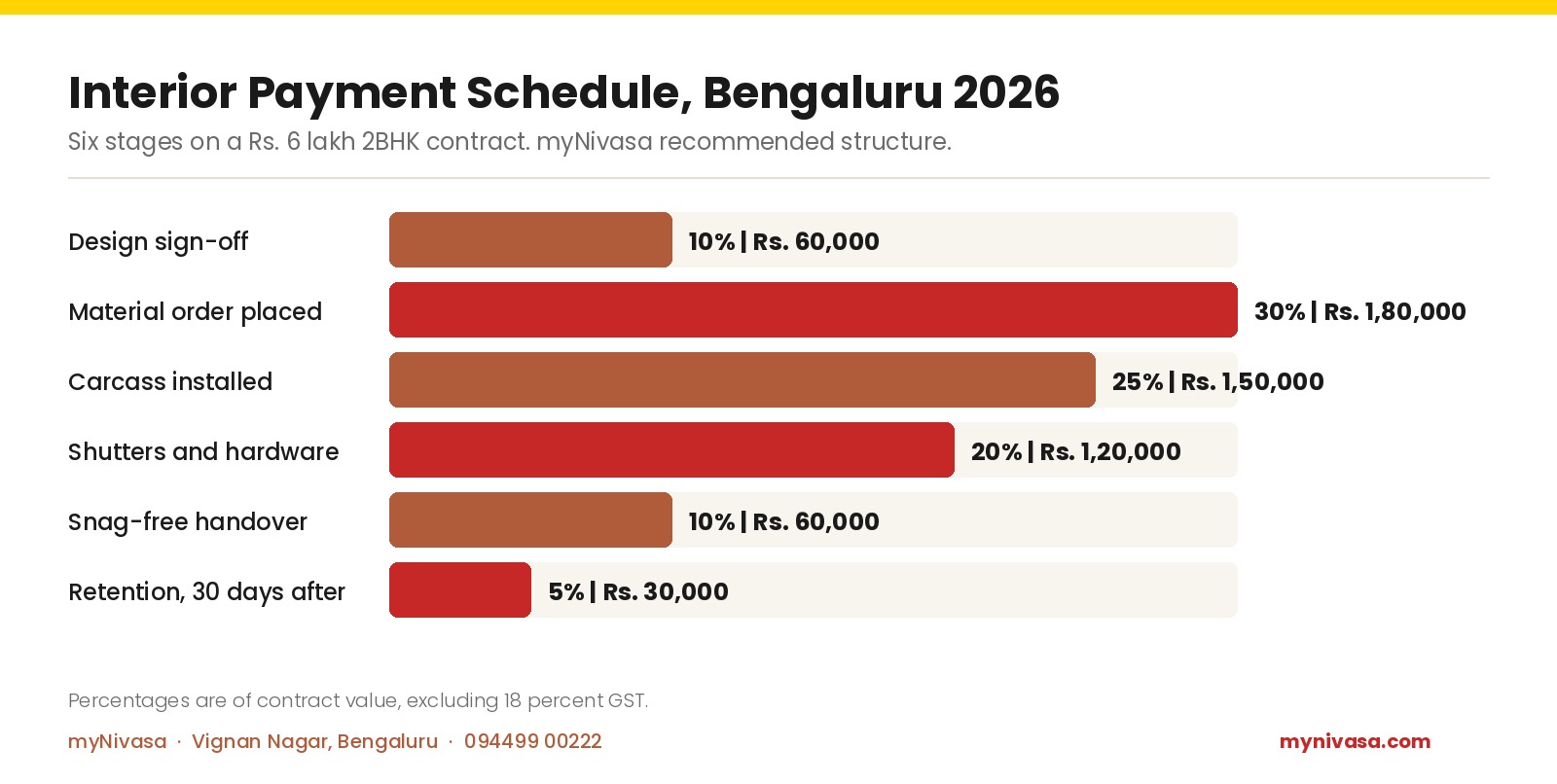
Six stages carry the money. Design sign-off takes 10 percent, released only when drawings are signed and a line-item bill of quantities exists. The material purchase order takes 30 percent, the moment plywood, hardware and shutters are bought. Carcass installation takes 25 percent, payable when carcasses stand in your flat. Shutters and hardware take 20 percent, payable when hinges and channels work. Handover takes 10 percent after the snag list clears. The last 5 percent is retention, released 30 days after you move in.

On a Rs. 6 lakh contract those stages are Rs. 60,000, Rs. 1,80,000, Rs. 1,50,000, Rs. 1,20,000, Rs. 60,000 and Rs. 30,000. Note that 40 percent leaves your hands before a carcass stands. That is not a flaw, because materials must be bought before they are installed. What matters is that the 30 percent is triggered by a purchase order you can read, not a calendar date.

Our published Marathahalli project shows why the structure matters. A family of four asked us in February 2026 to renovate a 12 year old 1450 square foot 3BHK. Budget was Rs. 9 lakh, and our bill of quantities came to Rs. 8.65 lakh including society charges and debris removal. Work ran 5 March to 20 April, exactly 46 working days. Midway the family added a study table, taking the final figure to Rs. 9.10 lakh, billed as a separate variation against a separate approval. A schedule with no variation clause is where mid-project additions turn into disputes.

The families who run into trouble are almost never the ones who paid too much. They are the ones who paid too early. Once half the contract value has left your account with nothing installed, every conversation after that is one you are having from behind.

One structural point. If your contractor buys materials, the 30 percent stage is theirs to justify with purchase orders. If you buy directly, that stage should not exist, and the contract becomes a labour and supervision contract.

  • Pay no more than 10 percent, or Rs. 60,000 on a Rs. 6 lakh contract, before a signed drawing set and a line-item bill of quantities exist.
  • The largest stage is the material purchase order at 30 percent, Rs. 1,80,000 on Rs. 6 lakh. Ask to see the order before releasing it.
  • Hold 5 percent retention for 30 days after handover. Rs. 30,000 on Rs. 6 lakh is usually enough to get a snag list finished.
  • Livspace publishes a booking amount of 10 percent of the quote or Rs. 25,000, whichever is higher, then 60 percent cumulative at design finalisation.
  • The District Consumer Commission hears claims up to Rs. 50 lakh, and e-Daakhil filing costs nothing up to Rs. 5 lakh. GST is 18 percent under SAC 9954.
Interior payment schedule Bengaluru 2026: design sign-off 10 percent Rs. 60,000, material order 30 percent Rs. 1,80,000, carcass 25 percent Rs. 1,50,000, shutters 20 percent Rs. 1,20,000, handover 10 percent Rs. 60,000, retention 5 percent Rs. 30,000, by myNivasa
Six-stage interior payment schedule, Rs. 6 lakh 2BHK, Bengaluru 2026.
Interior Payment Schedule, Bengaluru 2026
Payment stageShare of contract
Design sign-off10% | Rs. 60,000
Material order placed30% | Rs. 1,80,000
Carcass installed25% | Rs. 1,50,000
Shutters and hardware20% | Rs. 1,20,000
Snag-free handover10% | Rs. 60,000
Retention, 30 days after5% | Rs. 30,000

Get a Line-Item BOQ

Every hinge, plywood sheet, and wire, transparent quotation.

WhatsApp Us Call +91 94499 00222

Why Contractors Ask for 50 Percent Upfront, and What It Actually Funds

The request is not automatically dishonest, and it is worth knowing what a genuine 50 percent pays for. A contractor carries two cash burdens at the start. Material, which on a Rs. 6 lakh project runs Rs. 2.5 lakh to Rs. 3.5 lakh. And labour, paid weekly whatever you release. Bengaluru daily rates in 2026 run from Rs. 400 for a helper to Rs. 900 for a carpenter or painter, against a central minimum wage from 1 April 2026 of Rs. 1,008 skilled and Rs. 827 unskilled for metro labour. A six person crew running four weeks is Rs. 1.1 lakh in wages before a shutter is hung.

What is not justified is collecting it before the purchase order exists. A contractor asking 40 percent at the point of ordering, with order documents shared, is funding your project. One asking 50 percent at signing, with no drawings and no bill of quantities, is funding something else. Livspace, for comparison, collects 10 percent of the quote or Rs. 25,000 as booking, moves to 60 percent cumulative at design finalisation, and takes the balance when materials are ready for dispatch.

Get Your Project Timeline in 48 Hours

Milestone-by-milestone plan from measurement to handover.

WhatsApp Us Call +91 94499 00222
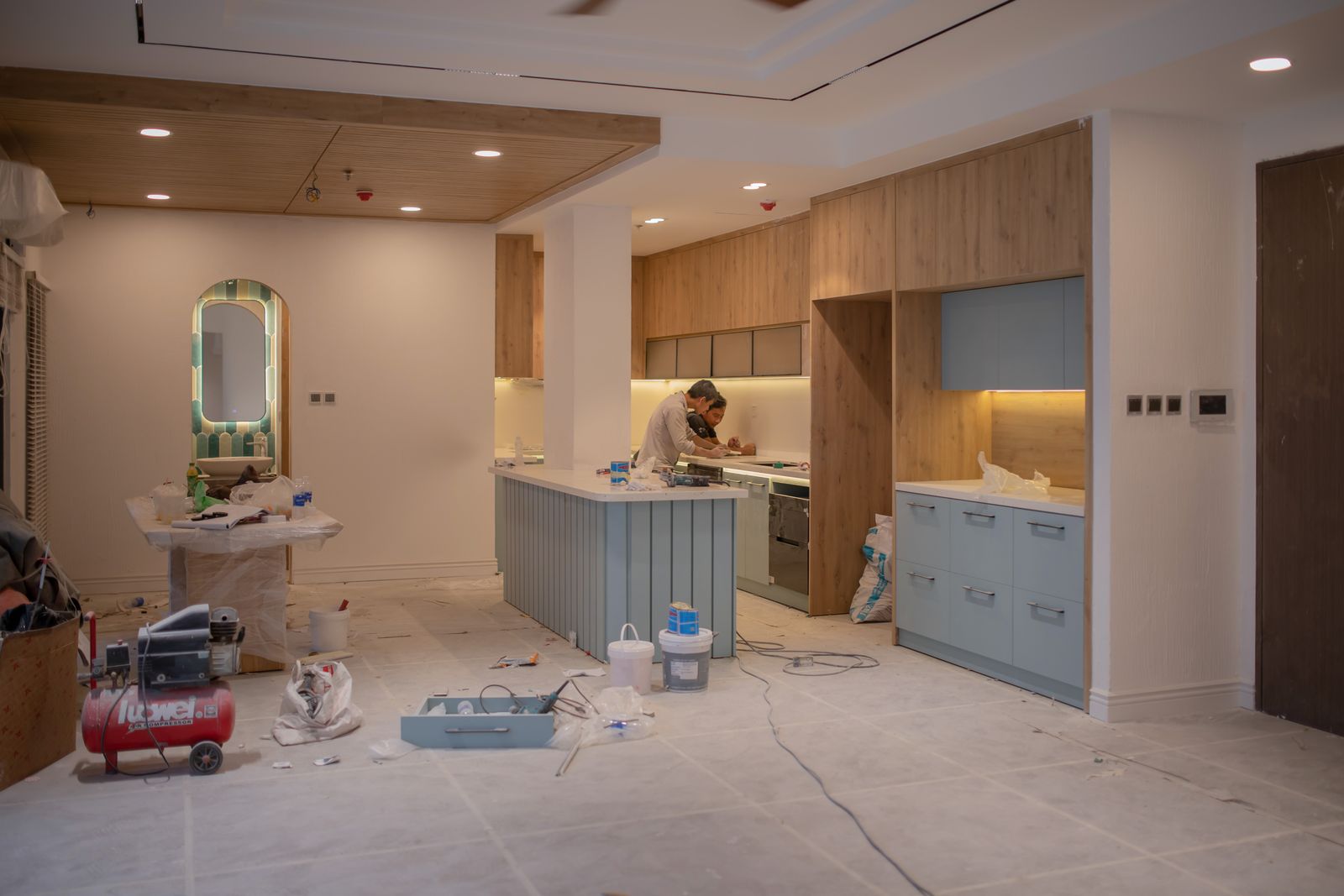
Kitchen interior work in progress with carcasses and shutters being installed, the carcass milestone stage of a Bengaluru interior payment schedule 2026, by myNivasa
The carcass milestone, which should trigger the 25 percent payment rather than a calendar date.

Which Payments Should Be Tied to a Delivery, Not a Date

This clause decides whether the rest of the schedule means anything. A date based trigger reads: second instalment due 30 days from signing. A delivery based trigger reads: second instalment due on placement of the material purchase order, copy shared. The first pays regardless of progress. The second cannot be claimed until something has happened.

Three stages must be delivery based. Material names the purchase order. Carcass names the carcasses standing in the flat, verifiable on a walk-through. Handover names a cleared snag list, not a declaration that work is finished.

Two smaller clauses are usually agreed without argument. A variation clause, so any addition to scope is quoted, approved in writing and billed separately, as the study table was in Marathahalli. And a retention clause fixing 5 percent released 30 days after handover, because a month of use surfaces the drawer that catches and the hinge that drops.

If a contractor resists writing any trigger down, that is useful to know before parting with a rupee.

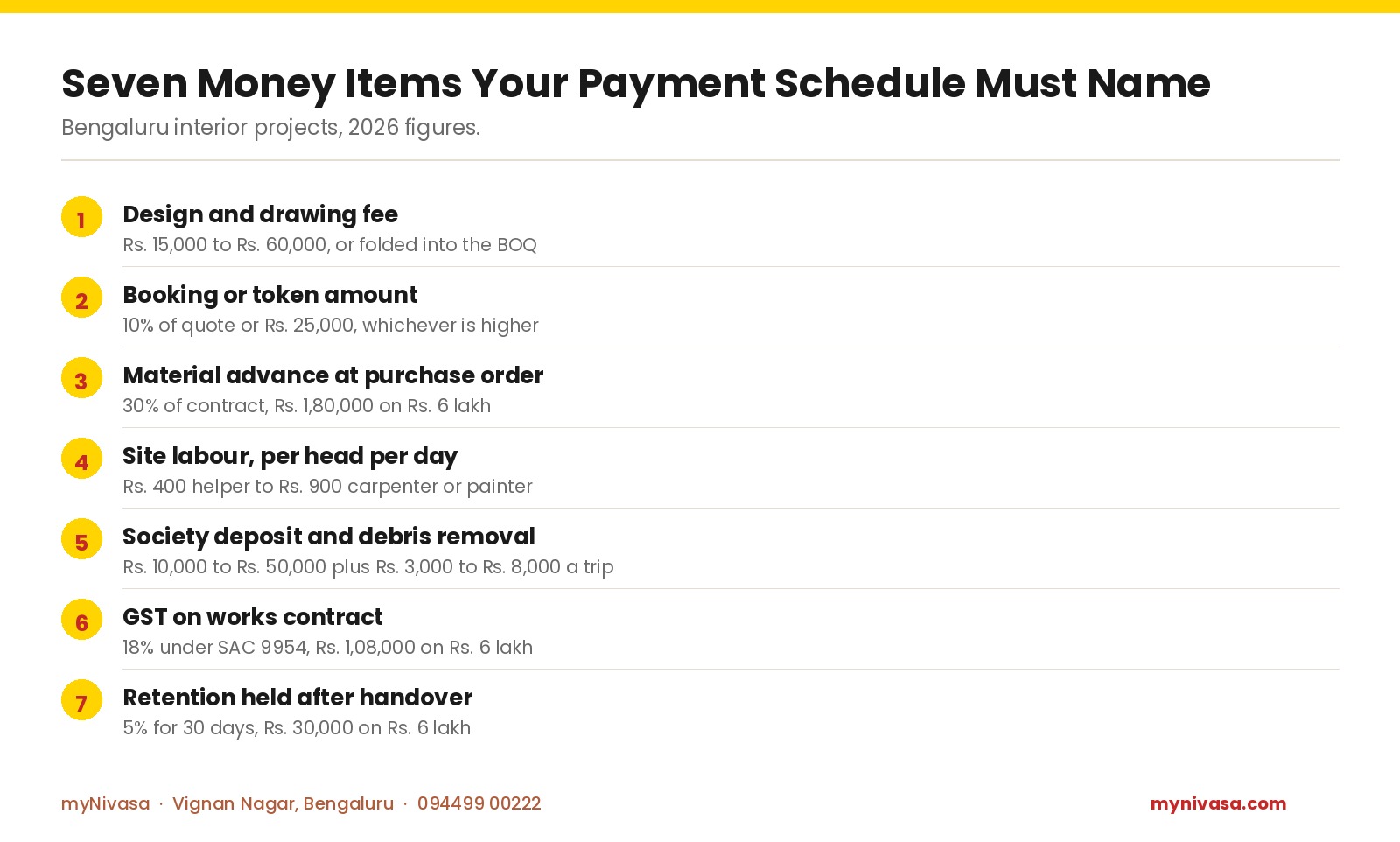
Seven money items in a Bengaluru interior payment schedule 2026: design fee Rs. 15,000 to Rs. 60,000, booking 10 percent or Rs. 25,000, material advance 30 percent, labour Rs. 400 to Rs. 900 a day, society deposit Rs. 10,000 to Rs. 50,000, GST 18 percent, retention 5 percent, by myNivasa
Seven cost heads a Bengaluru payment schedule should name, 2026 ranges.
Seven Money Items Your Payment Schedule Must Name
#Cost itemTypical range
1Design and drawing feeRs. 15,000 to Rs. 60,000, or folded into the BOQ
2Booking or token amount10% of quote or Rs. 25,000, whichever is higher
3Material advance at purchase order30% of contract, Rs. 1,80,000 on Rs. 6 lakh
4Site labour, per head per dayRs. 400 helper to Rs. 900 carpenter or painter
5Society deposit and debris removalRs. 10,000 to Rs. 50,000 plus Rs. 3,000 to Rs. 8,000 a trip
6GST on works contract18% under SAC 9954, Rs. 1,08,000 on Rs. 6 lakh
7Retention held after handover5% for 30 days, Rs. 30,000 on Rs. 6 lakh

Book Your 2026 Slot Now

Calendar is filling. Reserve with a refundable Rs. 5,000.

WhatsApp Us Call +91 94499 00222

When GST Falls Due on Each Interior Payment You Make

Interior work is taxed as a works contract when design, material, labour and installation are billed together. The rate is 18 percent under SAC 9954, and modular furniture under HSN 9403 also attracts 18 percent, so a turnkey quotation carries a single 18 percent figure rather than a mix.

What surprises families is the timing, not the rate. GST is charged on each invoice, so it accompanies each milestone rather than arriving at the end. On a Rs. 6 lakh contract the 30 percent material stage of Rs. 1,80,000 carries Rs. 32,400 of GST, so Rs. 2,12,400 leaves your account at that stage. Across the contract the tax adds Rs. 1,08,000, taking Rs. 6 lakh to Rs. 7.08 lakh.

So when comparing quotations, confirm whether each is inclusive or exclusive of GST, because an 18 percent gap is larger than most material choices you will agonise over. And check the contractor is GST registered, because an unregistered one cannot issue a tax invoice, and an invoice trail is exactly what you need if the project goes wrong.

What Happens to Your Money When a Bengaluru Interior Job Stalls

Most stalled projects involve no fraud, just a contractor who took on too much work and is using your material advance to finish somebody else's kitchen. Your first instrument is the schedule itself. On a delivery based schedule, a stall at the carcass stage means 40 percent has gone and 60 percent is still yours. Pay 50 percent at signing and 30 percent a month later, and the same stall means 80 percent is gone.

Your second instrument is the Consumer Protection Act, 2019, under which a contractor who takes payment and fails to deliver commits a deficiency of service. The District Consumer Disputes Redressal Commission hears claims where the consideration paid does not exceed Rs. 50 lakh, a limit fixed by the Consumer Protection Jurisdiction Rules notified on 30 December 2021. Complaints are filed online through e-Daakhil, with no fee up to Rs. 5 lakh and Rs. 1,000 up to Rs. 50 lakh.

What makes such a complaint work is documentation: a signed contract, a bill of quantities, dated GST invoices per milestone, and site photographs from the dates you paid. Every one is produced naturally by a proper payment schedule and by nothing else. That is the real argument for writing it down. Not that it prevents a dispute, but that it leaves you holding evidence.

Frequently Asked Questions About Interior Payment Schedules in Bengaluru

Is a 50 percent advance ever acceptable for interior work in Bengaluru?

Only when split, not as a single payment at signing. A cumulative 40 percent by the time the material purchase order is placed is normal, because materials on a Rs. 6 lakh project cost Rs. 2.5 lakh to Rs. 3.5 lakh. A single 50 percent before any drawing is signed is different, because nothing has been ordered and no document shows where it went.

How much retention should I hold after an interior handover?

5 percent of contract value, released 30 days after handover. On a Rs. 6 lakh 2BHK that is Rs. 30,000. Thirty days of normal use reveals drawer slides that catch and shutters that drop out of line. Retention is not a penalty, it is the reason a contractor returns your call in week three.

Does GST apply on the booking amount I pay before work starts?

Yes, if the contractor is GST registered and issues an invoice against it. Interior works contracts attract 18 percent under SAC 9954, applied to each invoice rather than as one bill at the end. On a Rs. 6 lakh contract the tax totals Rs. 1,08,000, taking your all-in outgo to Rs. 7.08 lakh.

What should I do if my interior contractor stops work after taking an advance?

Send a written notice recording the milestone paid and the deliverable not met, then file with the District Consumer Disputes Redressal Commission if unresolved. It hears claims up to Rs. 50 lakh, and filing through e-Daakhil costs nothing up to Rs. 5 lakh. Your contract, bill of quantities, dated GST invoices and site photographs carry the complaint.

How should mid-project additions be billed in Bengaluru?

As a separate variation, quoted and approved in writing before work begins, never folded into an existing milestone. On our Marathahalli 3BHK the family added a study table midway, moving a Rs. 8.65 lakh bill of quantities to Rs. 9.10 lakh, still inside their Rs. 9 lakh budget because it was priced openly rather than absorbed.

Limitations and Sources

The six stage schedule here is myNivasa's recommended structure, not a statutory requirement, and contractors will reasonably propose variations. The Rs. 6 lakh example is arithmetic applied to our published band of Rs. 1,200 to Rs. 3,500 per square foot, not a quotation. Labour rates move with season and locality. Confirm tax positions with your accountant.

Sources used for the external figures in this article:

Visit Our Vignan Nagar Studio

See real samples, hardware, and finished-project photos at our office.

WhatsApp Us Call +91 94499 00222

Final Word on Paying for Interior Work in Bengaluru

The families who finish calmly are rarely the ones who negotiated hardest on price. They are the ones who spent 20 minutes on the payment schedule before signing, and never let their exposure run ahead of what stood in the flat. Ten percent at design sign-off, 30 percent against a purchase order you have seen, and 5 percent held for a month after handover will do more than any material upgrade.

To see how these milestones map onto real numbers, read our breakdown of interior design cost in Bangalore for 2026 by locality, our note on what a modular kitchen quotation usually leaves out, and our guide to home renovation cost in Bengaluru by BHK, which carries the full Marathahalli case record, and our piece on what BWP marine plywood costs in Bengaluru, the largest line in most bills of quantities.

For a line-item bill of quantities and a written milestone schedule, call myNivasa on +91 94499 00222 or write to [email protected]. Our studio is at 2nd Floor, Sapthagiri Complex, 265/1, Kaggadasapura Main Road, Vignan Nagar, Bengaluru, Karnataka 560075, and we work across Marathahalli, Whitefield, HSR Layout, Sarjapur Road, Indiranagar, Koramangala, JP Nagar, Bellandur, Hebbal, Yelahanka, Electronic City and Bommanahalli.