
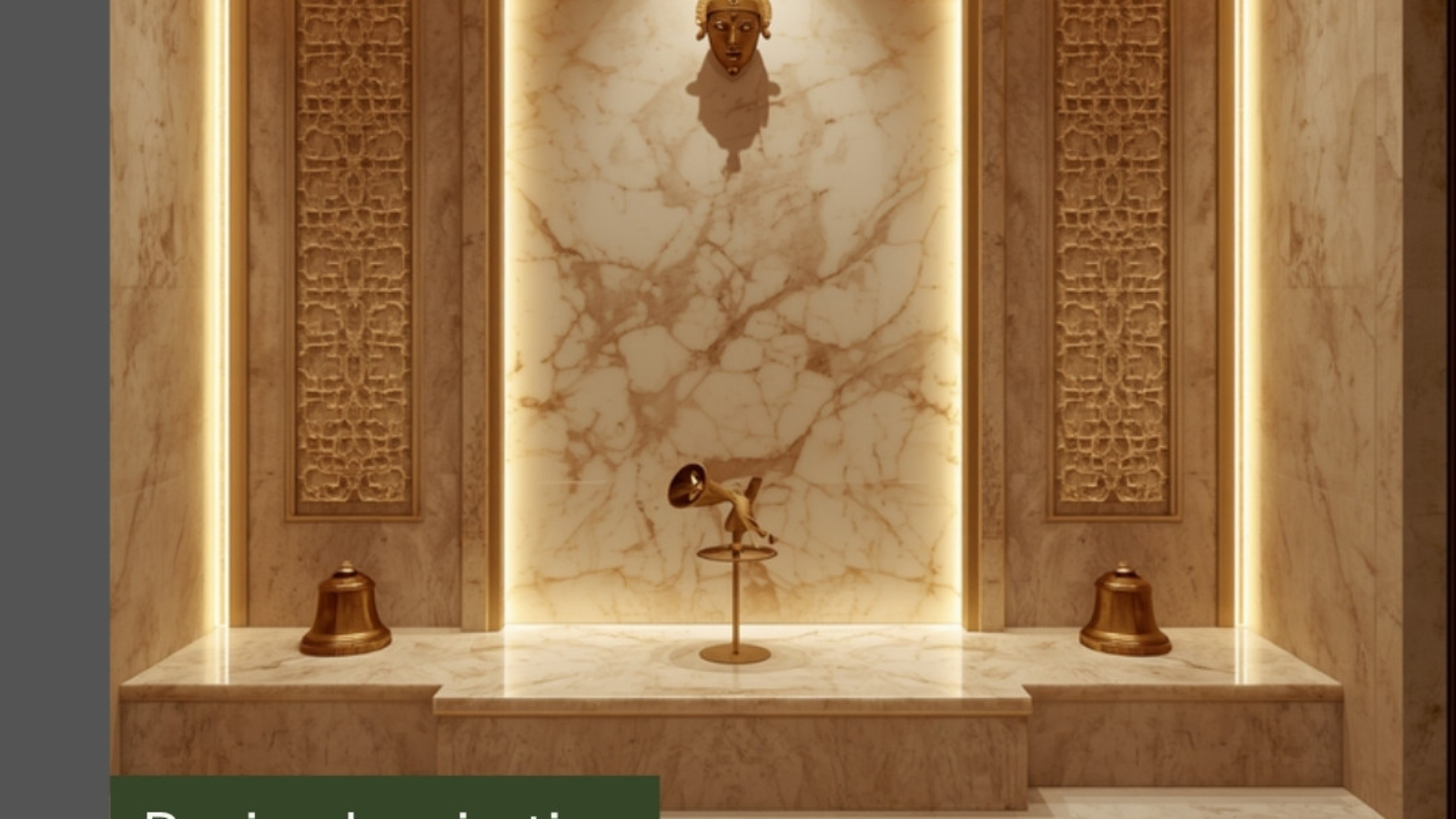
Looking for the most authentic, current, and locality-tested pooja room design ideas in Koramangala 2026 ideas in Koramangala? You are in the right place. At myNivasa, we have crafted over 60 dedicated pooja units across Koramangala apartments and villas in the last 18 months, from compact wall-mounted mandirs in 2 BHK Sobha and Prestige towers to floor-to-ceiling marble pooja rooms in 4 BHK duplexes near Jakkasandra Extension. This 2026 guide combines real project costs, the latest design trends, Vastu principles, material specifications, and locality-specific insights so Koramangala homeowners can plan a sacred space that feels both timeless and beautifully modern.
Koramangala homeowners in 2026 are not choosing between traditional and contemporary anymore. They are choosing both, in one unified pooja room design ideas in Koramangala 2026 that respects Ishan Kona Vastu, integrates laser-cut jaali panels, uses warm LED back-lighting behind a marble or Corian backdrop, and features either an etched glass sliding door or a brass-accented teak frame. The cost for a complete pooja room design ideas in Koramangala 2026 in Koramangala 2026 typically lands between ₹35,000 for a basic wall-mounted unit and ₹4.5 lakh for a fully built standalone room with custom jaali, marble cladding, and concealed lighting. This is the most current, complete, and Koramangala-specific guide you will find anywhere on the web.
Quick Takeaways: Pooja Room Design Ideas in Koramangala 2026
- Vastu first, always. Place the pooja room in the North-East (Ishan Kona). If not possible, East or North are the next best directions in 2026 Koramangala apartments.
- Cost range: Basic wall-mounted mandir ₹25,000 to ₹55,000. Mid-range corner pooja unit ₹65,000 to ₹1,80,000. Premium standalone pooja room ₹2,00,000 to ₹5,50,000.
- Trending material in 2026: Marble or Corian backdrop with teak or walnut veneer frame, finished with antique brass bell accents and integrated 2700K warm LED back-lighting.
- Door of choice: Etched glass sliding doors with brass jaali borders for 2 BHK apartments. Solid teak double doors with carved Om motifs for 3 BHK and 4 BHK villas.
- Color palette 2026: Warm beige plus muted gold, sage green plus white, charcoal plus brushed brass, terracotta plus natural teak.
- Timeline: Wall-mounted unit 2 to 3 weeks. Built-in pooja corner 3 to 5 weeks. Full standalone pooja room 5 to 8 weeks (design to handover).
- Koramangala premium: Pooja unit prices in Koramangala run 20 to 35 percent higher than Whitefield or Marathahalli, due to logistics, premium material expectations, and skilled labor charges.
Table of Contents
- What is the Pooja Room Style Trend in Koramangala 2026?
- What is the Cost of pooja room design ideas in Koramangala 2026 in Koramangala 2026?
- Which Pooja Room Layout and Design Options Work Best for Koramangala Apartments?
- What Materials and Finishes Should You Choose for a 2026 Pooja Room?
- How to Optimize Space for Pooja Room in Koramangala Apartment Living?
- What Color Palette Works for pooja room design ideas in Koramangala 2026 in 2026?
- What Lighting Should You Use for pooja room design ideas in Koramangala 2026 in 2026?
- How Long Does pooja room design ideas in Koramangala 2026 and Execution Take in Koramangala?
- What are the Common Mistakes in pooja room design ideas in Koramangala 2026 (and How to Avoid Them)?
- How to Choose the Best pooja room design ideas in Koramangala 2026er in Koramangala?
- What are the 2026 Trends Defining pooja room design ideas in Koramangala 2026 in Koramangala?
- Vastu Deep Dive: The Detailed Rules for pooja room design ideas in Koramangala 2026
- FAQs and Final Word
Voice search note: If you ask, "What is the best pooja room design ideas in Koramangala 2026 in Koramangala in 2026?" the honest answer is a North-East corner Vastu-aligned mandir built in marble and teak veneer with jaali back panel and warm 2700K LED back-light, costing roughly ₹1,20,000 to ₹2,50,000 in a typical 2 BHK or 3 BHK Koramangala apartment. The complete guide with options at every budget follows below.
What is the Pooja Room Style Trend in Koramangala 2026?
Related design guide: See our 2026 guide on Master Bedroom Design Ideas in JP Nagar for layout, wardrobe, lighting and vastu choices specific to JP Nagar apartments.
The defining shift in Koramangala pooja room design ideas in Koramangala 2026 is the move from heavy, ornate, fully carved wooden mandirs of the 2010s to refined, minimal, light-filled sacred spaces that feel like a temple but also belong inside a contemporary apartment. Koramangala apartments built between 2018 and 2026, especially in Sobha Infinia, Prestige Acropolis, Brigade Cosmopolis, and Salarpuria Sattva Magnus, typically have carpet areas of 1,250 to 2,800 sqft and ceiling heights of 9.5 to 10 feet. This compact-yet-tall envelope shapes how 2026 pooja rooms are designed.
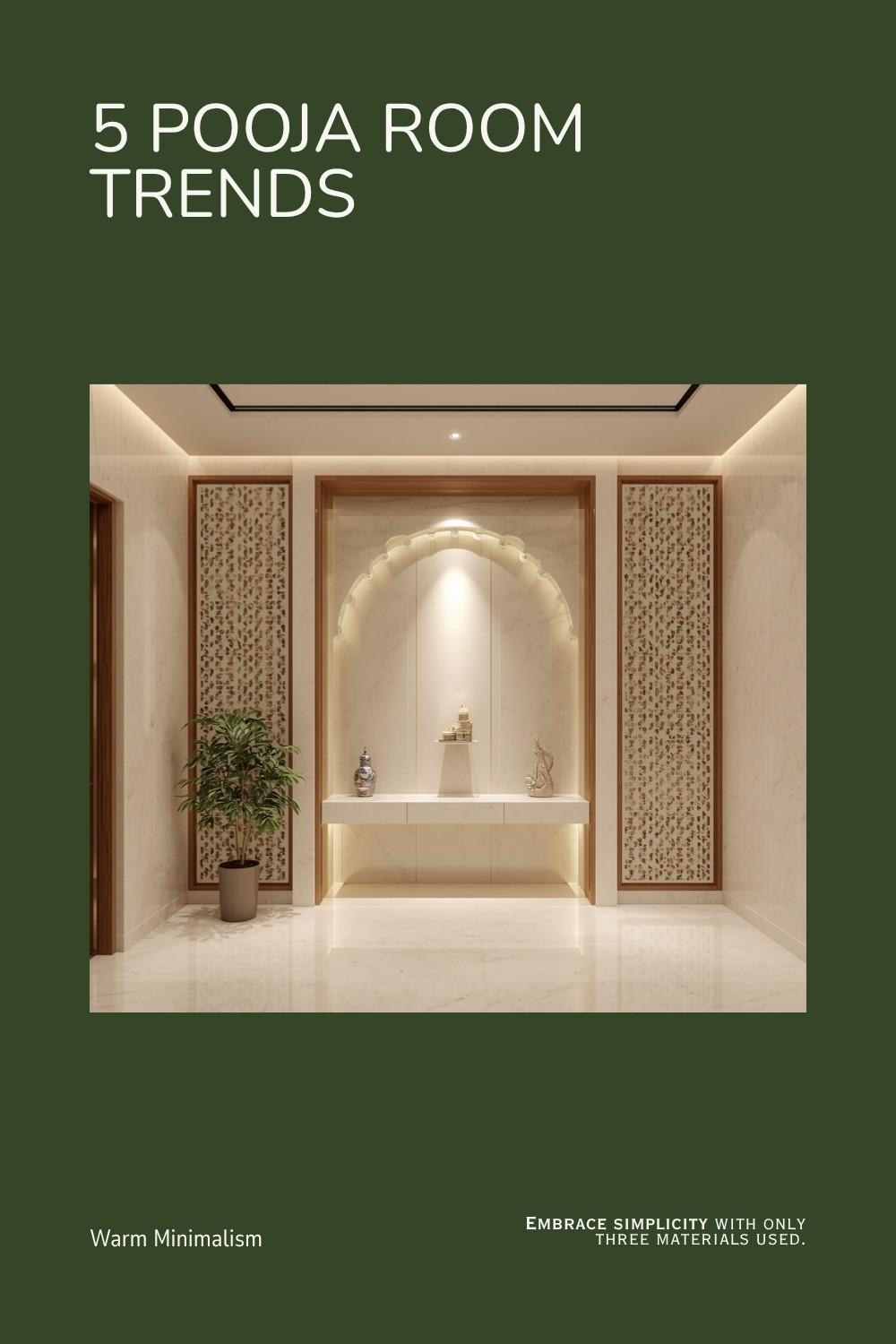
Five clear style trends are dominating pooja room design ideas in Koramangala 2026 and shaping client briefs pooja room design ideas in Koramangala 2026. First, warm minimalism, where simple straight-line teak veneer frames hold a single floating shelf for the deity, with all visual weight handled by lighting and a marble back panel. Second, jaali-driven sacred design, where laser-cut MDF, plywood, brass, or Corian jaali panels form either the back wall or the door, casting soft shadow patterns that feel devotional and artistic.
Third, biophilic temple corners, where a small indoor plant niche, real teak, natural stone, and earthy tones connect the pooja space to nature, in line with the broader 2026 wellness design movement. Fourth, smart sacred spaces, where homeowners integrate a Tuya or Google-connected warm dimmable LED, an automatic diya timer, and a discreet exhaust for camphor smoke. Fifth, fusion luxury, where Koramangala homeowners commission pure marble mandirs (Makrana or Statuario), brass deity stands, and antique-finish hanging bells, often paired with a custom Tanjore or Mysore painting in the niche above.
What is genuinely new in pooja room design ideas in Koramangala 2026 versus 2024 designs is material restraint. Where earlier Koramangala pooja units used four to six materials in one design, the 2026 units typically use only two or three: a primary stone or solid surface (marble or Corian), a primary wood (teak, walnut veneer, or oak), and one accent metal (antique brass or matte gold). This restraint makes the pooja room feel premium without looking cluttered.
Across all the pooja room design ideas in Koramangala 2026 we have executed, the pattern is consistent: pooja room design ideas in Koramangala 2026 that follow the warm minimalism approach age the best, please clients the longest, and photograph beautifully even after 4 to 5 years of daily use. This is the single most important takeaway when planning pooja room design ideas in Koramangala 2026 for a Koramangala home.
What is the Cost of pooja room design ideas in Koramangala 2026 in Koramangala 2026?
The honest cost of pooja room design ideas in Koramangala 2026 and broader Koramangala pooja unit depends on five variables: the type (wall-mounted, corner, niche, or standalone room), the material grade, the door treatment, the lighting complexity, and the size of the deity collection. Based on the 60+ pooja units myNivasa has executed across Koramangala in the last 18 months, here is the working price reference for 2026.
| Type of Pooja Unit | Size Range | Material Grade | Cost Range (Koramangala 2026) | Timeline |
|---|---|---|---|---|
| Wall-Mounted Mandir (Basic) | 2 ft x 3 ft | Plywood + laminate + LED strip | ₹25,000 to ₹55,000 | 2 to 3 weeks |
| Wall-Mounted Mandir (Premium) | 2.5 ft x 3.5 ft | Teak veneer + Corian backdrop + brass | ₹55,000 to ₹95,000 | 3 weeks |
| Corner Built-in Pooja Unit | 3 ft x 6 ft | BWP plywood + marble back + jaali | ₹95,000 to ₹1,80,000 | 3 to 5 weeks |
| Niche Style (Recessed in Wall) | 4 ft x 6 ft | Marble cladding + teak frame + LED cove | ₹1,40,000 to ₹2,40,000 | 4 to 5 weeks |
| Walk-in Standalone Pooja Room | 5 ft x 6 ft to 6 ft x 8 ft | Full marble + teak doors + carved jaali | ₹2,50,000 to ₹4,50,000 | 6 to 8 weeks |
| Premium Standalone Pooja Room | 6 ft x 8 ft+ | Statuario marble + solid teak + brass bells | ₹4,50,000 to ₹5,50,000+ | 7 to 9 weeks |
The pooja room design ideas in Koramangala 2026 Koramangala premium of 20 to 35 percent over Whitefield or Marathahalli applies across all tiers. The reasons are well documented: skilled carpenters and installers in inner-city Koramangala charge higher day rates, premium clientele in Sobha Infinia or Prestige Acropolis demand branded hardware (Hettich runners, Hafele lights), logistics into 12th Block or 6th Block requires smaller batched material movement (which raises labor cost per sqft), and material wastage is higher in tighter site conditions.
For a typical 2 BHK Koramangala apartment of 1,250 sqft, a thoughtful corner built-in pooja unit with marble back and brass jaali, including warm LED, two storage drawers below, and an etched glass sliding door, lands at ₹1,30,000 to ₹1,70,000 in 2026. For a 3 BHK of 1,800 sqft with a dedicated 4 ft x 6 ft niche, expect ₹1,80,000 to ₹2,80,000. For a 4 BHK premium villa or duplex with a walk-in pooja room, ₹3,50,000 to ₹5,50,000 is the realistic range.
Which Pooja Room Layout and Design Options Work Best for Koramangala Apartments?
The right layout for pooja room design ideas in Koramangala 2026 and broader Bengaluru pooja room design ideas in Koramangala 2026 depends primarily on the apartment configuration, the orientation of the flat with respect to the cardinal directions, and the family's daily ritual needs. Koramangala has six dominant apartment layouts: 1 BHK studios in older blocks, compact 2 BHK in 1st to 5th Blocks, premium 2 BHK and 3 BHK in 6th to 8th Blocks, luxury 3 BHK and 4 BHK in Jakkasandra Extension and EJIPURA side, duplex penthouses in Sobha Infinia, and standalone villas around 80 Feet Road. Each layout has a different ideal pooja design.
| Apartment Type | Best Pooja Layout | Typical Location | Recommended Door | Design Feature |
|---|---|---|---|---|
| 1 BHK / Studio (under 700 sqft) | Wall-mounted floating mandir | NE corner of living room or kitchen alcove | None (open) or fluted glass shutter | Single-shelf with backlit Corian panel |
| Compact 2 BHK (900 to 1,150 sqft) | Niche cut into living-dining wall | Between living and dining, NE wall | Sliding etched glass with brass border | Marble back with concealed cove LED |
| Premium 2 BHK (1,200 to 1,450 sqft) | Dedicated corner unit floor to ceiling | NE corner of living room | Bi-fold teak door with jaali insert | Carved teak frame with brass bell row |
| 3 BHK Standard (1,500 to 1,900 sqft) | Recessed walk-in cubby (4 x 5 ft) | Off the foyer or near dining, NE | Double doors with etched glass top | Full marble back with deity niche |
| Luxury 3 / 4 BHK (2,000 to 3,200 sqft) | Standalone walk-in pooja room | Dedicated NE room near foyer | Solid teak double door, carved Om motif | Marble flooring + jaali ceiling |
| Duplex / Villa (3,000+ sqft) | Floor-to-ceiling sacred chamber | NE wing, dedicated 6 x 8 ft room | Tall double teak doors with brass studs | Statuario marble + custom Tanjore wall |
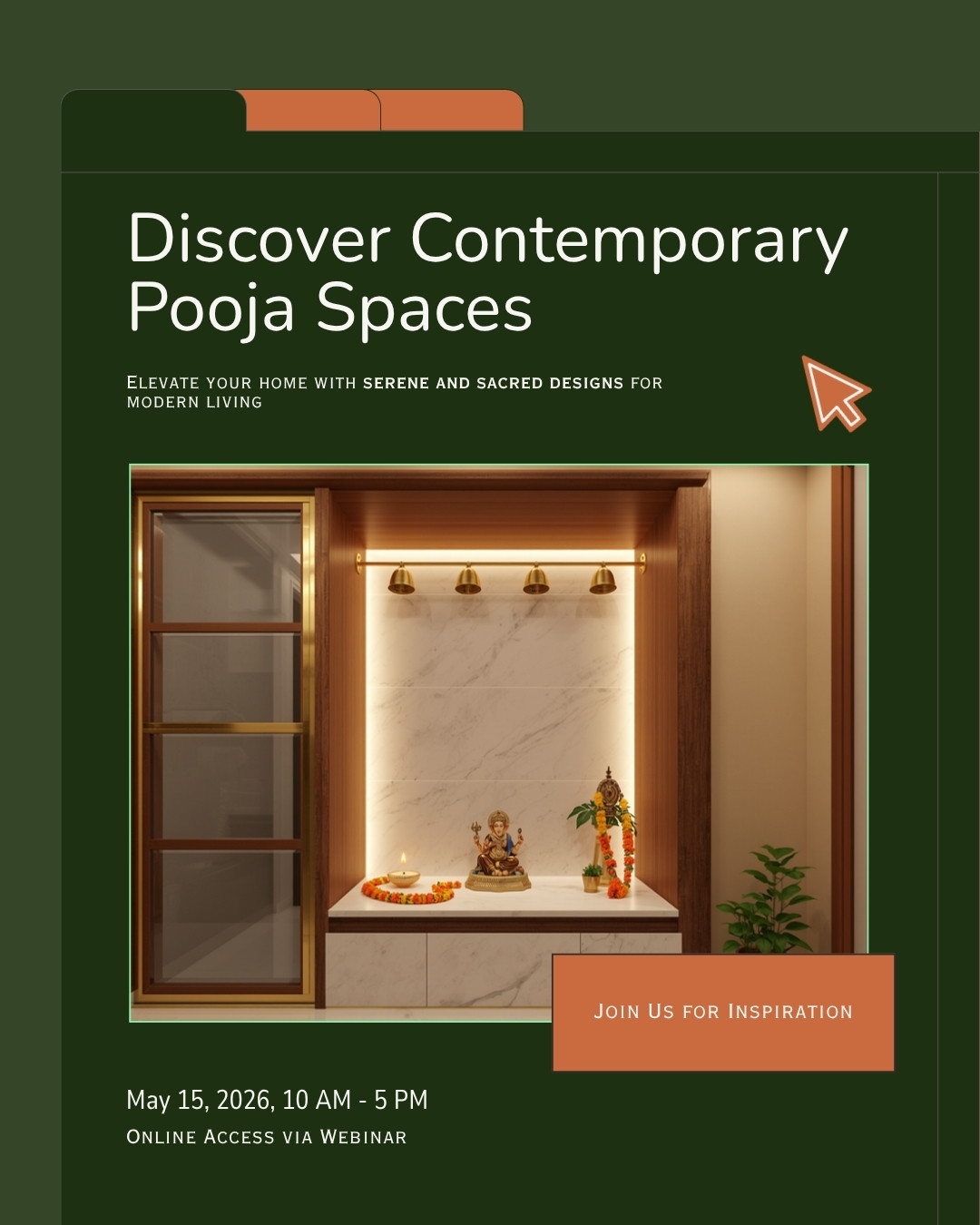
The most underrated layout in pooja room design ideas in Koramangala 2026 pooja room design ideas in Koramangala 2026 is the niche cut into the dining or living wall in compact 2 BHK apartments. Builders rarely provide a dedicated pooja space in 2 BHK plans, but a recessed niche of 12 to 15 inches deep, framed in teak veneer with a marble back, costs less than a built-in unit and feels architecturally intentional. The myNivasa team has executed this layout in over 22 Sobha and Prestige 2 BHK flats in Koramangala in 2025 and 2026, with strong client satisfaction.
For 3 BHK and 4 BHK flats, the recessed walk-in cubby is the sweet spot. It offers enough room for the homeowner to sit cross-legged for ten to twenty minutes of daily pooja, can fit two to three deity statues plus a small puja thali platform, and can be closed off with a double door when not in use. Premium clients often add a low pull-out drawer below for storing puja items, agarbatti, camphor, kumkum, and the daily oil lamp.
For Bengaluru families specifically searching for pooja room design ideas in Koramangala 2026 in 2026, the key takeaway is that the cost matrix is more layered than it looks online. The right pooja room design ideas in Koramangala 2026 budget for your apartment depends on the type, size, materials, lighting layers, door treatment, and brass detailing combined — not on a generic per-sqft rate.
What Materials and Finishes Should You Choose for a 2026 Pooja Room?
Material selection for any pooja room design ideas in Koramangala 2026 is where most pooja room design ideas in Koramangala 2026 succeed or quietly fail. The deity stays in this space for years, oil lamps burn nearby, camphor is lit during evening aarti, and incense smoke rises constantly. The materials must be aesthetically beautiful but also performance-oriented under heat, smoke, and humidity. Here is the 2026 material reference based on what works in Koramangala apartments.
| Component | Recommended Material 2026 | Why It Works | Cost Indication | Brand Suggestion |
|---|---|---|---|---|
| Pooja Frame Carcass | BWP Grade Plywood (19 mm) | Marine grade, resists heat and humidity from oil lamps | ₹140 to ₹180 per sqft | Greenply, Centuryply |
| Front Frame and Shutters | Teak veneer or Walnut veneer | Premium grain, ages beautifully, holds carving | ₹350 to ₹650 per sqft | Greenlam, Merino, Centuryply Mikasa |
| Back Panel (Backdrop) | White Italian Marble or Corian Solid Surface | Reflects warm LED beautifully, smoke wipes off | ₹450 to ₹1,400 per sqft | Statuario, Makrana, Corian by DuPont |
| Jaali Panel | CNC-cut MDF or brass sheet (3 mm) | Crisp pattern, casts soft shadows | ₹320 to ₹550 per sqft (MDF), ₹1,800 to ₹3,500 per sqft (brass) | Custom CNC vendors, Indiamart |
| Lighting | 2700K warm white LED strip + spot | Mimics diya glow, flattering on idols | ₹350 to ₹900 per running ft | Philips, Wipro, Syska |
| Door Glass | 10 mm tempered etched or fluted glass | Diffuses light, easy to clean, durable | ₹650 to ₹1,200 per sqft | Saint-Gobain, Modi Guard |
| Hardware | Soft-close hinges and runners | Silent operation, premium feel | ₹450 to ₹1,800 per piece | Hettich, Hafele, Ebco |
| Brass Accents | Cast brass bells, kalash, pillars | Traditional symbol, durable | ₹350 to ₹2,500 per piece | Local Channapatna, Etsy India |
| Flooring (if walk-in) | Marble or polished granite | Cool underfoot, easy to clean | ₹220 to ₹650 per sqft | Statuario, Black Galaxy, Kashmir White |
| Paint Finish | Asian Paints Royale Aspira (Off-White or Beige) | Low VOC, easy to wipe, premium sheen | ₹35 to ₹65 per sqft (with labor) | Asian Paints, Berger, Dulux |
The most important material decision is the back panel. White Italian marble (Statuario or Makrana grade) is the gold standard, but Corian solid surface from DuPont is a smart 2026 alternative because it can be back-lit through (translucent grade), allowing the entire panel to glow when the LED strip is on. Several Koramangala homeowners in Brigade Cosmopolis and Salarpuria Sattva Magnus chose translucent Corian back panels in 2025 and reported the glow effect being far more dramatic than marble at slightly lower cost.
For the frame, teak veneer remains the 2026 favourite for pooja room design ideas in Koramangala 2026 because of its tight grain, durability under heat, and the rich golden-brown tone that complements brass accents. Walnut veneer is the runner-up for clients who prefer a darker, more contemporary palette. Avoid laminate-only finishes for premium pooja units in Koramangala, since clients expect a tactile, natural surface.
For homeowners researching pooja room design ideas in Koramangala 2026 on a budget, the material substitution most worth considering is translucent Corian instead of natural marble for the back panel. This single swap reduces the pooja room design ideas in Koramangala 2026 project cost by 18 to 28 percent without compromising the glow effect.
How to Optimize Space for Pooja Room in Koramangala Apartment Living?
Koramangala apartments are notorious for tight floor plans. Even premium 3 BHK flats in Sobha Infinia, Prestige Acropolis, and Brigade Cosmopolis rarely give you more than 25 to 35 sqft of dedicated pooja space, which means every inch of design has to work hard. Here are the seven space-saving principles that the myNivasa design team uses for pooja room design ideas in Koramangala 2026.
First, go vertical. The ceiling in Koramangala flats is typically 9.5 to 10 feet tall, so design floor-to-ceiling instead of low-and-wide. A 2 ft x 7.5 ft floor-to-ceiling pooja unit holds the deity at the right eye level for a seated pooja, has a tall jaali back panel, and includes storage drawers below. Second, use the corner. The North-East corner is Vastu-ideal and also dead space in most floor plans, perfect for a 90-degree corner pooja unit. Third, recess into the wall instead of projecting out. A 12 to 15 inch deep niche cut into a non-structural partition wall steals zero usable floor area.
Fourth, sliding doors instead of swing doors. A sliding etched glass door saves 6 to 8 sqft of clearance compared to a swing door. Fifth, multi-function the base. The bottom 18 to 24 inches of every Koramangala pooja unit should be storage, with two pull-out drawers for puja items. Sixth, integrate lighting into the design. Cove LEDs concealed in the top edge of the unit eliminate the need for a separate lamp. Seventh, use a foldable seating ledge or a rolling pooja stool that tucks under the unit when not in use.
For 1 BHK and compact 2 BHK in Koramangala 1st to 5th Blocks, the smartest hack is the kitchen-alcove pooja unit. Many old Koramangala apartments have a small alcove or breakfast counter recess in the kitchen wall facing North-East. Converting this into a wall-mounted Corian pooja niche with a fluted glass shutter takes only 2 sqft of wall and zero usable floor area, costing ₹35,000 to ₹65,000 fully done.
| Space Hack | Sqft Saved | Best For | Cost Add-on | Difficulty |
|---|---|---|---|---|
| Floor-to-ceiling vertical layout | 3 to 5 sqft saved (vs low-wide) | All apartment types | +₹4,000 to ₹8,000 | Low |
| Corner 90-degree unit | 4 to 6 sqft saved | 2 BHK and 3 BHK | +₹6,000 to ₹12,000 (custom angle) | Medium |
| Recessed wall niche | 5 to 8 sqft saved (zero projection) | 2 BHK with non-load wall | Saves ₹15,000 to ₹25,000 | Medium |
| Sliding etched glass door | 6 to 8 sqft of clearance saved | Niche or built-in unit | +₹8,000 to ₹14,000 vs swing | Low |
| Pull-out base drawers | 0 sqft saved (gains storage) | All built-in units | +₹5,000 to ₹9,000 | Low |
| Concealed cove LED only | 1 to 2 sqft saved (no lamp) | All units | +₹2,500 to ₹6,000 | Low |
| Foldable seating ledge | 4 to 6 sqft when folded | Walk-in pooja rooms | +₹4,500 to ₹8,500 | Medium |
Once the layout and materials are finalised for your pooja room design ideas in Koramangala 2026, the color palette decision becomes the next pivotal step. Done right, the palette in your pooja room design ideas in Koramangala 2026 reinforces the meditative state and complements the brass and marble tones beautifully.
What Color Palette Works for pooja room design ideas in Koramangala 2026 in 2026?
The 2026 color palette for pooja room design ideas in Koramangala 2026 has shifted decisively away from heavy maroon, dark wood brown, and gold-on-gold combinations of the previous decade, towards lighter, more meditative, and warmer earthy tones. The science is simple: lighter, warmer hues calm the nervous system and support the meditative state that prayer requires. The myNivasa team draws on principles from NeuroInterior Design (a separate Vishwas Anegundi practice that studies how spaces affect the brain) when recommending pooja room palettes in 2026.
| Palette Name | Primary Color | Accent Color | Asian Paints Code | Best Mood | Suits Apartment Type |
|---|---|---|---|---|---|
| Warm Beige plus Brushed Brass | Warm Beige (off-white) | Brushed Brass / Antique Gold | Cream Glow 8536 | Calm, traditional | All Koramangala 2 BHK and 3 BHK |
| Sage Green plus Ivory White | Sage Green | Ivory White, light teak | Pale Mint 9402 | Fresh, restorative | Premium 3 BHK and 4 BHK |
| Charcoal plus Brass | Charcoal Grey | Antique Brass | Iron Mountain 7556 | Moody, contemporary | Luxury duplexes, villas |
| Terracotta plus Natural Teak | Terracotta Clay | Natural Teak grain | Spanish Tile 8108 | Earthy, biophilic | 3 BHK and villas |
| Soft White plus Marble Veining | Pure White | Marble grey vein | Brilliant White W101 | Pure, minimal | Compact 2 BHK |
| Pale Yellow plus Walnut | Pale Buttercream | Walnut Brown | Sunny Skies 7898 | Joyful, traditional | 1 BHK and 2 BHK |
The most popular 2026 choice in Koramangala is the Warm Beige plus Brushed Brass palette. It pairs beautifully with the off-white walls that builders provide as standard, complements both gold and brass deity stands, photographs well, and has broad multi-generational appeal. The Sage Green plus Ivory White palette is the rising star, especially among younger Koramangala homeowners under 40 who want something fresh, calming, and contemporary without losing the sacred tone.
Avoid pure black, deep maroon, and bright red as the dominant pooja room color in 2026. These colors trigger higher visual alertness, which works against the meditative mood the space is trying to create. Reserve red and maroon for accent items only, such as a small kalash or the velvet cloth under the deity, never for the back wall or door.
Color and lighting work together. In every pooja room design ideas in Koramangala 2026 executed by myNivasa in 2025-2026, the palette is finalised before the lighting design is locked in, since color reflectance affects how warm the LED needs to be. This sequence keeps pooja room design ideas in Koramangala 2026 aesthetic harmony intact.
What Lighting Should You Use for pooja room design ideas in Koramangala 2026 in 2026?
Lighting in pooja room design ideas in Koramangala 2026 is the single most powerful element in any 2026 pooja room. Done well, it transforms a basic teak unit into a glowing sacred shrine. Done badly, it makes even a marble pooja room feel like a hospital corner. The 2026 lighting playbook for pooja room design ideas in Koramangala 2026 rests on three layers: ambient, accent, and task.
Ambient lighting is the baseline glow that fills the entire pooja niche. Use a 2700K to 3000K warm white LED strip, concealed in the top edge or behind the back panel. The warm color temperature is critical because it mimics the natural glow of a diya flame and flatters skin tones, brass, and gold equally. Stay away from cool white (4000K+) and definitely avoid daylight (5000K+) in any sacred space, since these temperatures kill the meditative mood.
Accent lighting is the focused glow on the deity itself. Use a small adjustable spot, ideally a 2W to 3W warm white LED puck, mounted at the top of the niche and angled at 30 to 45 degrees onto the main idol. This creates a subtle halo effect on the deity. Some Koramangala homeowners take this further by placing a back-lit Corian or onyx panel directly behind the deity, so the silhouette of the deity glows from behind, an effect borrowed from temple architecture and adapted for apartment scale.
Task lighting is the practical light for reading the daily pooja sloka or arranging the puja thali. A discreet 4W warm LED strip under the lowest shelf provides this without disrupting the ambient glow. For premium pooja rooms, the entire lighting system should be on a single Tuya, Wipro, or Philips Hue controller, dimmable from 10 percent to 100 percent, with a preset for morning aarti, evening aarti, and continuous low-glow night mode.
| Lighting Layer | Type | Color Temperature | Wattage | Position | Cost (with labor) |
|---|---|---|---|---|---|
| Ambient | LED strip (concealed cove) | 2700K warm | 5W to 8W per running ft | Top edge or behind back panel | ₹450 to ₹900 per ft |
| Accent (deity) | Mini puck spotlight | 2700K warm | 2W to 3W | Top of niche, angled 30 to 45 degrees | ₹650 to ₹1,400 per piece |
| Back panel glow | LED strip behind translucent Corian or onyx | 2700K warm | 6W to 10W per running ft | Concealed behind panel | ₹1,200 to ₹2,200 per ft (with panel) |
| Task | Under-shelf LED strip | 3000K warm | 4W per ft | Below lowest shelf | ₹350 to ₹650 per ft |
| Smart control | Tuya / Wipro / Hue dimmer | n/a | n/a | Wall-mounted near unit | ₹2,500 to ₹6,500 (system) |
| Optional decorative | String diya lights (Diwali) | 2200K very warm | 0.5W per bulb | Around door frame | ₹450 to ₹1,200 per string |
With color and lighting locked in, the next planning question for pooja room design ideas in Koramangala 2026 is timeline. Setting realistic timeline expectations early prevents disappointment, especially for pooja room design ideas in Koramangala 2026 projects targeted to a specific Diwali, Ugadi, or Ganesha Chaturthi deadline.
How Long Does pooja room design ideas in Koramangala 2026 and Execution Take in Koramangala?
Most Koramangala homeowners planning pooja room design ideas in Koramangala 2026 underestimate the timeline for pooja room design ideas in Koramangala 2026 because the unit looks small. In reality, custom pooja units involve more decisions per square foot than almost any other room: deity placement, Vastu alignment, jaali pattern, marble selection, brass casting, lighting design, door type, glass etching, and storage. Here is the realistic 2026 timeline based on myNivasa's recent Koramangala project history.
For more on this, see Living Room Design for Bangalore Apartments 2026.
| Project Stage | Wall-Mounted Mandir | Built-in Corner / Niche | Walk-in Standalone Pooja Room |
|---|---|---|---|
| Discovery and brief | 1 day | 2 to 3 days | 3 to 5 days |
| Vastu consultation | 1 day | 1 day | 1 to 2 days |
| Concept design and 3D render | 2 to 4 days | 5 to 8 days | 8 to 12 days |
| Material selection (marble, veneer, brass) | 2 days | 4 to 6 days | 6 to 10 days |
| BOQ approval and contract | 1 day | 2 days | 2 to 4 days |
| Carpentry fabrication (workshop) | 5 to 8 days | 10 to 14 days | 15 to 21 days |
| Marble cutting and polishing | n/a or 2 to 3 days | 5 to 8 days | 8 to 12 days |
| Site installation | 1 to 2 days | 3 to 5 days | 5 to 10 days |
| Electrical and lighting integration | 1 day | 2 days | 3 to 4 days |
| Finishing and snag list | 1 day | 2 to 3 days | 3 to 5 days |
| Total Timeline | 2 to 3 weeks | 3 to 5 weeks | 6 to 9 weeks |
Plan early. The biggest delay in any Koramangala pooja project is marble selection, which often takes longer than expected because clients want to physically see the slab before approval. myNivasa always books the marble selection trip to the yard within the first week of contract, ideally before the carpentry workshop starts cutting the carcass. The second common delay is brass casting for custom bell rows, which requires a 10 to 14 day lead time at Channapatna or Mysuru artisan workshops.
If you want the pooja room ready in time for Diwali, Akshaya Tritiya, Ganesha Chaturthi, or Ugadi, count back from the festival date and add 14 days as buffer. For example, if Diwali falls on a Saturday, finalise the contract at least 8 weeks before for a built-in unit and at least 11 weeks before for a walk-in standalone room.
Even with a clear timeline and budget, the success of pooja room design ideas in Koramangala 2026 rests heavily on avoiding common mistakes that homeowners (and inexperienced designers) make. The list below is drawn from 60+ pooja room design ideas in Koramangala 2026 projects executed by myNivasa across Koramangala in the last 18 months.
What are the Common Mistakes in pooja room design ideas in Koramangala 2026 (and How to Avoid Them)?

Even high-budget pooja room design ideas in Koramangala 2026 projects fail when these eleven mistakes go uncaught. Most of these errors come from rushing the design phase, skipping Vastu, or copying Pinterest images without adjusting for the actual apartment layout. Here is the myNivasa list of the most common pooja room design ideas in Koramangala 2026 mistakes and how to avoid each.
One: ignoring the North-East rule. Placing the pooja unit (part of pooja room design ideas in Koramangala 2026 planning) (part of pooja room design ideas in Koramangala 2026 planning) (part of pooja room design ideas in Koramangala 2026 planning) (part of pooja room design ideas in Koramangala 2026 planning) (part of pooja room design ideas in Koramangala 2026 planning) (part of pooja room design ideas in Koramangala 2026 planning) (part of pooja room design ideas in Koramangala 2026 planning) in the South or South-West breaks Vastu and is the single most regretted decision homeowners report afterwards. If North-East is impossible, North or East are acceptable substitutes.
Two: facing the deity towards South. Idols should face East or West, meaning the worshipper faces East or West while seated. Three: oversized deity for the niche. A 14-inch tall deity needs at least an 18 to 20 inch tall niche to look proportionate, with breathing space above. Four: placing the pooja directly under a beam. Vastu and structural design both discourage this since it compresses the energy and disrupts visual lines. Five: pooja unit sharing a wall with a toilet. This is a strong Vastu violation and must be avoided regardless of layout convenience. Six: cool white LED inside the niche. Use only 2700K to 3000K warm white.
Seven: glass shelves for the deity. Heavy idols on glass shelves are a safety risk; use 18 mm BWP plywood with a marble or stone top. Eight: no storage below the pooja unit. Daily puja items need a dedicated drawer. Nine: skipping a smoke vent. Camphor and incense smoke needs at least a small exhaust slit or a discreet ceiling vent in walk-in pooja rooms. Ten: over-decorating. The 2026 trend is restraint. One main marble back, one teak frame, one brass accent. Stop there. Eleven: fixing the deity stand permanently. Use a moveable brass or marble platform so the deity can be cleaned and the niche dusted easily.
| Mistake | Why It Goes Wrong | Fix |
|---|---|---|
| Pooja unit in South or SW corner | Vastu violation | Place in NE; if impossible, N or E |
| Deity facing South | Worshipper faces wrong direction | Face deity to W or E (worshipper to E or W) |
| Oversized deity in tiny niche | Looks crammed, disrespectful | Allow 4 to 6 inch headspace above deity |
| Pooja under structural beam | Vastu and visual error | Shift away from beam line |
| Shared wall with toilet | Major Vastu violation | Pick a different wall, even if costlier |
| Cool white LED | Kills mood, harsh on idols | Use 2700K to 3000K warm white only |
| Glass shelves for deity | Safety risk under load | Use plywood with marble top |
| No storage drawer | Puja items scatter on floor | Add 18 to 24 inch base with pull-out drawer |
| No smoke vent | Walls and ceiling stain | Add discreet vent or exhaust slit |
| Over-decorated multi-material design | Looks cluttered, dated quickly | Limit to 3 materials max |
| Fixed deity platform | Hard to clean | Use moveable brass or marble base |
If you have followed everything so far, the final step in planning pooja room design ideas in Koramangala 2026 is choosing the right designer. The wrong designer for pooja room design ideas in Koramangala 2026 will cost you twice: once in money, once in regret 18 months later when the unit looks dated or the lighting fails.
How to Choose the Best pooja room design ideas in Koramangala 2026er in Koramangala?
The pooja room design ideas in Koramangala 2026 is the most personal space in any Indian home. Choosing the right designer for your pooja room design ideas in Koramangala 2026 matters more than choosing the carpenter or material vendor. Use this six-point evaluation checklist when shortlisting a designer or interior firm.
One: ask for at least 5 photos and 1 video walkthrough of recently completed pooja units. Genuine designers have a portfolio. Two: confirm Vastu literacy. The designer should be able to explain Ishan Kona placement, the worshipper-facing direction, and how to handle non-NE apartments without prompting. Three: ask about material grade transparency. Are they quoting BWP plywood (correct for moisture and heat) or just commercial plywood (cheaper, fails earlier)? Are they specifying Statuario or Makrana marble grade, or just generic "white marble"? Four: ask about lighting design separately. If the designer treats lighting as an afterthought, the pooja room will not glow correctly.
Five: confirm the timeline in writing, with milestone dates. A serious Koramangala pooja project is a 4 to 8 week commitment, not a "we will see" arrangement. Six: ask for the full BOQ in line-item form. Hidden charges in the pooja category usually appear in marble cutting, brass procurement, electrical, and door glass. Make sure all five categories are itemised in the contract.
Local Koramangala specifics: pick a designer who has worked in your specific apartment community before, since the watchman, lift access, working hour rules, and material movement protocol vary across Sobha Infinia, Prestige Acropolis, Brigade Cosmopolis, Salarpuria Sattva Magnus, and the older 1st to 5th Block buildings. A designer with prior experience in your tower will save you 3 to 7 days of execution time. myNivasa has executed pooja units in 14 distinct Koramangala apartment communities since 2018, with full builder coordination on file.
Across the pooja room design ideas in Koramangala 2026 brief that Koramangala homeowners share with myNivasa in 2026, eight specific design trends keep showing up. Knowing these trends helps you brief any designer with confidence and ensure your pooja room design ideas in Koramangala 2026 feels modern in 2030 too.
What are the 2026 Trends Defining pooja room design ideas in Koramangala 2026 in Koramangala?
Eight clear macro-trends are shaping pooja room design ideas in Koramangala 2026 pooja room design ideas in Koramangala 2026 based on what myNivasa is seeing in client briefs, what is trending on Indian design publications, and what international Indian-diaspora homes are demanding. Each trend has a Koramangala-specific implementation note.
| Trend | What It Means | Koramangala Implementation | Cost Impact |
|---|---|---|---|
| 1. Warm Minimalism | 3 materials max, no carving overload | Marble + teak veneer + brass; nothing else | -10 to -15% (less labor) |
| 2. Biophilic Sacred | Live plants, real wood, natural stone | Tulsi pot ledge inside the niche, real teak frame | +5 to +8% (live plant care add-on) |
| 3. Smart Pooja | App-controlled dimming, auto diya timer | Wipro Garnet or Philips Hue strip + hub | +₹4,500 to ₹8,500 |
| 4. Translucent Back Panel | Back-lit Corian or onyx for halo glow | DuPont Corian (translucent grade) + LED behind | +₹15,000 to ₹40,000 |
| 5. Brass Bell Row | Cast brass bells in horizontal row above | Channapatna or Mysuru artisan brass | +₹6,000 to ₹22,000 per row |
| 6. Etched Glass Sliding Door | Replaces traditional teak swing door | 10 mm tempered etched glass with brass border | +₹14,000 to ₹28,000 |
| 7. Custom Tanjore Painting | One painting in or above the niche | Mysuru or Tanjore artisans; 18 x 24 inches | +₹18,000 to ₹65,000 |
| 8. Sage Green Palette | Soft green replaces white as wall color | Asian Paints Pale Mint 9402 + ivory trim | Neutral, no add-on |
Koramangala Apartment Wise Pooja Room Cost Comparison 2026
Because pooja room design ideas in Koramangala 2026 pricing is not one homogeneous market, the cost of pooja room design ideas in Koramangala 2026 varies meaningfully by apartment community, sub-locality, and even floor (high-floor units have logistics premium for material lift access). Here is the working comparison from myNivasa project data of the last 18 months.
| Apartment Community | Sub-Locality | Typical Layout | Wall-Mounted Cost | Built-in Niche Cost | Walk-in Standalone Cost |
|---|---|---|---|---|---|
| Sobha Infinia | Jakkasandra Extension (off Sarjapur Rd) | 3 BHK and 4 BHK luxury | ₹65,000 to ₹95,000 | ₹1,80,000 to ₹2,80,000 | ₹3,80,000 to ₹5,50,000 |
| Prestige Acropolis | Hosur Road, Koramangala | 3 BHK premium | ₹55,000 to ₹85,000 | ₹1,50,000 to ₹2,40,000 | ₹2,80,000 to ₹4,50,000 |
| Brigade Cosmopolis | HSR connecting road | 2 BHK and 3 BHK | ₹45,000 to ₹75,000 | ₹1,30,000 to ₹2,10,000 | ₹2,40,000 to ₹3,80,000 |
| Salarpuria Sattva Magnus | 4th Block Koramangala | 3 BHK | ₹50,000 to ₹80,000 | ₹1,40,000 to ₹2,20,000 | ₹2,60,000 to ₹4,00,000 |
| 1st to 3rd Block (older builds) | Inner Koramangala | 2 BHK compact | ₹35,000 to ₹65,000 | ₹1,00,000 to ₹1,75,000 | n/a (rarely possible) |
| 5th to 8th Block (mid-rise) | Central Koramangala | 2 BHK and 3 BHK | ₹45,000 to ₹75,000 | ₹1,20,000 to ₹2,00,000 | ₹2,30,000 to ₹3,50,000 |
| Standalone villas (80 Feet Rd) | HAL side | 4 BHK villa | n/a (too small for villa) | ₹1,80,000 to ₹2,80,000 | ₹3,50,000 to ₹5,50,000+ |
The pricing band for Sobha Infinia is the highest in Koramangala because of the gated community premium, the high-rise material lift access fee, and the higher client expectation around finish quality. The 1st to 3rd Block older buildings have the lowest band because most are walk-up apartments where logistics are simpler, but their compact layouts limit you to wall-mounted or small niche units.
Why Koramangala Homeowners Choose myNivasa for pooja room design ideas in Koramangala 2026
Since 2018, myNivasa has been one of Bengaluru's most trusted firms for pooja room design ideas in Koramangala 2026 and broader interior services of Bengaluru's most trusted interior design and home construction firms, with over 500 completed projects across the city. For pooja room design ideas in Koramangala 2026, the myNivasa proposition rests on five pillars.
One: Vastu-literate design. Every myNivasa pooja project starts with a Vastu mapping of the apartment, free of cost, executed during the first site visit. We do not move forward until the deity placement, worshipper facing direction, and energy flow are confirmed correct. Two: material transparency. Our BOQ is fully line-itemised, with brand names (Greenply, Greenlam, Hettich, Philips, Asian Paints Royale Aspira) specified upfront. There are no hidden upgrades or surprise change-orders. Three: end-to-end execution. From the first 3D render to the marble selection trip, from the carpentry workshop to the brass casting at Channapatna, from electrical integration to the snag list closing, you have one project manager throughout.
Four: Koramangala-tested logistics. Our team has worked in 14 distinct Koramangala apartment communities and knows the lift restrictions, security protocols, and noise hour rules of each. Five: post-handover support. Every myNivasa pooja unit comes with a 12-month workmanship warranty and a free re-polish at the 6-month mark.
For 2026 specifically, myNivasa has launched a fixed-price Pooja Room Package starting at ₹65,000 (wall-mounted teak veneer mandir with marble back and 2700K LED) and going up to ₹4,80,000 (full walk-in marble pooja room with custom jaali, brass bells, and Tanjore painting). The fixed-price packages remove cost surprises, making them ideal for first-time Koramangala homeowners.
For broader interior design, you can also explore our complete Interior Design Cost in Bangalore 2026 guide, our No.1 Interior Designers in Bangalore page, and our 2 BHK Interior Design Cost Calculator for instant estimates. For full BOQ-style transparency on any room, see our BOQ Interiors page.
Pooja Room Door Design Options for Koramangala Apartments 2026
The door is the visual gateway in any pooja room design ideas in Koramangala 2026 to the sacred space, and in 2026 it carries more design weight than the back wall in many pooja room design ideas in Koramangala 2026. Here are the eight door options most often specified in Koramangala apartments, with cost and use-case notes.
| Door Type | Material | Best For | Cost (Koramangala 2026) | Lead Time |
|---|---|---|---|---|
| Sliding Etched Glass | 10 mm tempered glass + brass border | Compact 2 BHK, niche style | ₹14,000 to ₹28,000 | 2 to 3 weeks |
| Sliding Fluted Glass | 10 mm tempered fluted glass | 2 BHK, contemporary look | ₹16,000 to ₹26,000 | 2 to 3 weeks |
| Sliding Jaali Door | CNC-cut MDF or plywood with backlight | 3 BHK walk-in, dramatic effect | ₹22,000 to ₹42,000 | 3 to 4 weeks |
| Bi-fold Teak with Glass Insert | Solid teak frame + etched glass center | Premium 2 BHK and 3 BHK | ₹32,000 to ₹55,000 | 3 to 4 weeks |
| Solid Teak Double Door (Carved Om) | Solid teak with hand-carved Om motif | Walk-in pooja room, villas | ₹65,000 to ₹1,20,000 | 4 to 6 weeks |
| Solid Teak with Brass Studs | Solid teak + cast brass studs row | Luxury duplexes, villas | ₹85,000 to ₹1,80,000 | 5 to 7 weeks |
| Frameless Etched Glass | 10 mm tempered, edge-polished | Minimal modern, niche style | ₹18,000 to ₹32,000 | 2 to 3 weeks |
| Open Niche (No Door) | Curtain rod + saree drape (festival) | 1 BHK, kitchen alcove style | ₹0 to ₹4,500 (rod only) | 1 day |
The sliding etched glass door is the 2026 best-seller in Koramangala 2 BHK apartments because it saves clearance space, lets the warm LED glow filter through subtly, and is far easier to clean than carved teak. The frameless edge-polished tempered glass version is rising fast among minimalist clients in Sobha and Brigade towers. For walk-in pooja rooms in 4 BHK villas, the solid teak double door with carved Om motif remains the timeless choice, often paired with cast brass kalash door knobs from Mysuru artisan workshops.
Vastu Deep Dive: The Detailed Rules for pooja room design ideas in Koramangala 2026 in Koramangala 2026
Vastu Shastra sits at the heart of every authentic pooja room design ideas in Koramangala 2026 and is not superstition. It is a 5,000-year-old Indian architectural science that connects the layout of a home to the flow of natural light, ventilation, magnetic fields, and human energy. For pooja room design ideas in Koramangala 2026, eleven specific Vastu rules apply directly to apartment-scale design. Following them is what separates a properly designed pooja room from a merely decorated one.
For more on this, see Pooja Room Design Ideas for Bengaluru Homes in 2026.
Rule one: the North-East corner (Ishan Kona) is the ideal direction. This corner receives the first soft sunlight of the morning and is energetically the purest zone in any home. Rule two: if Ishan Kona is occupied by a toilet, kitchen, or staircase (common in Koramangala apartments where layout is fixed by the builder), the East wall is the next best, followed by the North wall. Never use the South-West, South, or West for the pooja room. Rule three: the deity faces East or West, never North or South. The worshipper sits facing East (preferred) or West.
Rule four: the deity should be at chest height when the worshipper is seated, roughly 36 to 42 inches from the floor for an average adult. Rule five: never place the pooja room directly under a structural beam, since beams compress energy flow according to Vastu. Rule six: never share a wall with a toilet, even if the toilet is on the other side. Rule seven: never share a wall with a bedroom headboard, since the rhythm of sleep can interrupt the calm of the pooja zone. Rule eight: do not store garbage, brooms, or footwear in or near the pooja unit.
Rule nine: keep the pooja room cleaner and brighter than any other space in the home. Rule ten: avoid placing photos of deceased family members in the pooja unit; they belong in a separate memorial corner. Rule eleven: keep the floor of the pooja zone slightly higher than the surrounding floor (even by half an inch) as a symbolic elevation of the sacred space.
For Koramangala apartments where the North-East corner falls in the kitchen or master bedroom, two layout adjustments work well. First, design the pooja unit on the East wall of the living room, with the deity facing West so the worshipper faces East. Second, if the East wall is also blocked, use the North wall and orient the deity to face West, with the worshipper facing East. Both options preserve the spiritual integrity even when the ideal Ishan Kona is unavailable.
Biophilic and NeuroInterior Influences on Pooja Room Design Ideas in Koramangala 2026
Biophilic touches in the pooja room include a tulsi plant ledge inside or beside the niche, real teak rather than laminate, natural stone (Statuario or Makrana marble), terracotta accents in the palette, and a small water feature (a tiny brass urli with rose petals) for premium walk-in pooja rooms. The combination of natural materials, warm light, and soft fragrance creates a pre-meditative environment that lowers heart rate within minutes of entering, which is exactly the state the homeowner needs for daily prayer.
From a sensory design perspective, the pooja room design ideas in Koramangala 2026 approach ideas in Koramangala 2026 approach ideas in Koramangala 2026 approach ideas in Koramangala 2026 approach ideas in Koramangala 2026 approach ideas in Koramangala 2026 approach ideas in Koramangala 2026 approach ideas in Koramangala 2026 engages all five senses intentionally. Sight is handled by warm 2700K LED. Sound is managed by acoustic dampening (a small 9 mm acoustic panel behind the marble back panel reduces ambient noise). Smell is delivered by sandalwood incense and camphor. Touch comes through the texture of natural teak and brass. Taste returns through prasad.
Designing for all five senses is what makes a 2026 Koramangala pooja room feel sacred rather than just decorated.
Festival Readiness: Designing Your Pooja Room for Diwali, Ugadi, and Ganesha Chaturthi
A well-designed pooja room design ideas in Koramangala 2026 setup is festival-ready year-round, not just visually but functionally. Diwali demands extra string light access points, a flat ledge for the Lakshmi-Ganesha installation, and storage for the silver coins and the ornate puja thali. Ugadi (the Karnataka new year) calls for a small platform for the Bevu-Bella mix and a turmeric-kumkum thali. Ganesha Chaturthi, the most important Bengaluru festival, requires a wider deity platform of at least 18 inches to accommodate the eco-friendly clay Ganesha installation, plus a rear ventilation slit for the camphor and naivedyam aroma.
The myNivasa 2026 design checklist for festival readiness includes: at least one concealed wall socket inside the pooja niche for plugging in seasonal light strings, a removable deity platform that can be replaced with a wider seasonal one, two pull-out drawers for the festival-specific puja kit, a hook strip for hanging garlands and toran, and a discreet camphor smoke vent for daily and festival aarti smoke. These small functional details are exactly what separate a 2026 Koramangala pooja room from a 2018 one.
Maintenance and Long-Term Care of Your Koramangala Pooja Room
A premium pooja room design ideas in Koramangala 2026 setup is an investment of ₹65,000 to ₹5,50,000. Treating it with the right maintenance routine ensures it looks new for the next 10 to 15 years. Here is the myNivasa-recommended care schedule for pooja room design ideas in Koramangala 2026.
| Maintenance Task | Frequency | Recommended Method | Common Mistake to Avoid |
|---|---|---|---|
| Marble back panel cleaning | Weekly | Damp microfibre cloth + pH-neutral marble cleaner | Never use vinegar or lemon (etches marble) |
| Teak veneer wiping | Weekly | Dry microfibre cloth followed by a damp wipe | Avoid soaking veneer in water |
| Brass bell polishing | Monthly | Brasso cleaner or lemon-salt-flour paste | Skipping leads to dark patina (sometimes desirable) |
| LED strip dust removal | Monthly | Soft brush attachment of vacuum on low setting | Avoid wet wiping live LED strips |
| Etched glass door cleaning | Weekly | Glass cleaner spray + lint-free cloth | Avoid abrasive scrubbers (scratches etching) |
| Soft-close hinge re-tightening | Every 6 months | Quick screwdriver tightening | Letting hinges loosen damages door alignment |
| Marble re-polishing | Every 18 to 24 months | Professional polishing service | DIY polish damages the gloss |
| Re-painting (walls around niche) | Every 4 to 5 years | Asian Paints Royale Aspira touch-up | Mismatched batch causes patchy color |
| Smoke vent dust clean | Quarterly | Vacuum brush attachment | Clogged vent causes wall staining |
| Drawer runner lubrication | Yearly | Silicone spray on Hettich runners | Avoid oil (attracts dust) |
For Koramangala apartments specifically, dust accumulation is a real maintenance concern because of the inner-city pollution. Weekly dry dusting of the entire pooja unit is non-negotiable. Adding an air purifier in the same room (especially for walk-in pooja rooms) can extend the gap between deep cleans by roughly 30 percent. myNivasa offers an annual maintenance contract for ₹4,500 covering quarterly professional cleaning and minor touch-ups.
Pooja Room Renovation: Updating an Older Koramangala Pooja Unit to 2026 Standards
Many homeowners researching pooja room design ideas in Koramangala 2026 in 1st to 5th Block live in apartments where the original pooja unit is 8 to 15 years old, typically a heavy carved teak or rosewood unit with cool white tube lighting and minimal storage. Renovating this to 2026 standards is one of the most cost-effective upgrades a Bengaluru homeowner can make.
The myNivasa 2026 renovation playbook for an existing pooja unit involves five steps. Step one: keep the carcass if it is structurally sound, replace only the front frame and the back panel. Step two: replace cool white tube lighting with concealed 2700K warm LED strips. Step three: replace the existing painted backdrop with marble cladding or back-lit Corian. Step four: add a row of cast brass bells above the deity for instant 2026 character. Step five: replace the swing teak door (if any) with a sliding etched glass door for clearance and light filtering.
The total cost for this five-step refresh is ₹55,000 to ₹1,40,000 depending on the existing unit size and material grade. The visual transformation looks like a full new build at one-third the cost.
Frequently Asked Questions: Pooja Room Design Ideas in Koramangala 2026
1. What is the average cost of a pooja room in Koramangala in 2026?
For a typical 2 BHK or 3 BHK Koramangala apartment, the average cost of a complete pooja room design ideas in Koramangala 2026 in Koramangala 2026 ranges from ₹95,000 for a basic built-in corner unit to ₹2,80,000 for a premium niche with marble back, brass jaali, etched glass sliding door, and integrated warm LED. Walk-in standalone pooja rooms in 4 BHK villas typically cost ₹3,50,000 to ₹5,50,000.
2. Which direction is best for pooja room as per Vastu in 2026?
The North-East corner (Ishan Kona) of the apartment remains the best Vastu direction for the pooja room in 2026. If North-East is not available due to layout constraints, the East or North walls are acceptable substitutes. Idols should face East or West, meaning the worshipper sits facing East or West during prayer. Avoid placing the pooja room in the South or South-West and never share a wall with a toilet.
3. Can I have a pooja room in a 1 BHK apartment in Koramangala?
Yes. The most practical solution for 1 BHK Koramangala apartments is a wall-mounted floating mandir in the North-East corner of the living room or a small Corian niche in the kitchen alcove facing North-East. These compact units cost ₹25,000 to ₹65,000 and take roughly 2 to 3 weeks to design and execute.
4. What is the most trending pooja room design ideas in Koramangala 2026 in Koramangala 2026?
The most popular 2026 design is the warm minimalist niche style: marble or translucent Corian back panel with concealed 2700K warm white LED, teak veneer frame, etched glass sliding door, and a single horizontal row of cast brass bells above. The palette is warm beige plus brushed brass, with a base storage drawer for puja items.
5. How much time does it take to design and install a pooja room in Koramangala?
A wall-mounted mandir takes 2 to 3 weeks. A built-in corner or niche pooja unit takes 3 to 5 weeks. A walk-in standalone pooja room takes 6 to 9 weeks from contract to handover. The biggest delay variables are marble selection (book early) and brass casting at Channapatna or Mysuru workshops (10 to 14 day lead time).
6. Should I use marble or Corian for the pooja room back panel?
Both work beautifully. White Italian Marble (Statuario or Makrana) is the timeless premium choice with natural veining and unmatched feel, costing ₹650 to ₹1,400 per sqft. Translucent Corian by DuPont is the smart 2026 alternative because it can be back-lit through, creating a glowing halo effect, costing roughly ₹450 to ₹950 per sqft. For a 2 BHK Koramangala apartment, Corian gives more visual drama at lower cost.
7. What lighting color temperature should I use in the pooja room?
Use only 2700K to 3000K warm white LED in any 2026 pooja room. This warm color mimics the natural glow of a diya flame, flatters skin tones, brass, and gold equally, and supports the meditative mood. Strictly avoid cool white (4000K+) and daylight (5000K+) which kill the sacred ambience.
8. Does myNivasa offer fixed-price pooja room packages in Koramangala?
Yes. myNivasa offers four fixed-price 2026 packages: Wall-Mounted Teak Veneer Mandir starting at ₹65,000, Built-in Corner Niche with Marble Back at ₹1,40,000, Premium Recessed Niche with Brass Jaali and Etched Glass Door at ₹2,40,000, and Walk-in Standalone Marble Pooja Room with Custom Jaali and Brass Bells at ₹4,80,000. All packages include free Vastu consultation, 3D render, full BOQ, branded hardware, and a 12-month workmanship warranty.
9. Can I add a pooja unit during a home renovation, or only during initial fit-out?
You can add a pooja unit at any stage. Roughly 35 percent of all pooja room design ideas in Koramangala 2026 projects executed by myNivasa in 2025-2026 were retrofit installations into already-occupied apartments. The renovation cost is comparable to a fresh installation, but the timeline is shorter (2 to 4 weeks) since most of the apartment is undisturbed. The myNivasa team handles all dust containment, schedules carpentry work in the workshop (not on site), and limits on-site activity to installation only.
10. What is the warranty on a myNivasa pooja unit in 2026?
Every myNivasa pooja unit comes with a 12-month workmanship warranty covering carpentry alignment, hinge function, LED operation, and finish quality. Premium fixed-price packages include a free re-polish at the 6-month mark and an extended 24-month warranty option for an additional ₹4,500. Marble and Corian come with their respective manufacturer warranties (typically 10 years for Corian, lifetime for natural marble against material defects).
11. Should the pooja room have a separate fan or only natural ventilation?
For wall-mounted and corner pooja units, natural ventilation through the apartment is sufficient. For walk-in standalone pooja rooms in 3 BHK and 4 BHK Koramangala flats, install a small 4-inch silent exhaust fan on a ceiling vent. This is critical for managing camphor and incense smoke, especially during festival days when multiple lamps burn for extended hours. The fan should be 25 dB or quieter so it does not disturb the prayer ambience.
12. What is the resale value impact of a premium pooja room in Koramangala?
Based on Koramangala broker feedback aggregated by myNivasa in 2025-2026, a well-designed pooja room (₹1,50,000 to ₹3,00,000 range) typically adds ₹2,00,000 to ₹4,50,000 to the perceived market value of a 2 BHK or 3 BHK Koramangala apartment, especially when buyers from traditional families are evaluating the unit. The pooja room is one of the few interior elements that almost always returns more than the spend.
The future of pooja room design ideas in Koramangala 2026 in Bengaluru looks brighter, calmer, and more refined than ever. Smart materials, NeuroInterior-inspired calm, and Vastu integrity are converging to make pooja room design ideas in Koramangala 2026 more meaningful than they have been in any previous decade.
Final Word: Designing Your Pooja Room in Koramangala the Right Way in 2026
A pooja room design ideas in Koramangala 2026 is not just another room in the apartment. It is the energetic and emotional anchor of the home, the space where the family gathers for daily aarti, where the children learn shlokas, where the elders find peace, and where the diya glow becomes the household's first morning light. Designing it well is therefore not a question of style alone but a question of intention, Vastu alignment, material honesty, and craftsmanship.
The 2026 best practices for pooja room design ideas in Koramangala 2026 are clear: respect the North-East rule, use restrained materials (marble or Corian, teak veneer, brass), light it with 2700K warm white in three layers, design it floor-to-ceiling to save floor area, give it sliding etched glass doors in 2 BHK and solid teak in larger villas, and finish in a warm beige or sage green palette. Keep the deity facing East or West, give every puja item a dedicated drawer, and add a small smoke vent if you light camphor daily.
Above all, choose a designer who understands both the spiritual significance and the apartment-scale execution challenges of Koramangala. The right pooja room is one that feels timeless, looks contemporary, and holds the soul of your home for the next twenty-five years and beyond.
Ready to plan your 2026 pooja room in Koramangala? Get a free Vastu consultation and a fixed-price 3D design proposal from the myNivasa team. Call +91 9449900222 or visit www.mynivasa.com to book a no-obligation site visit. Built since 2018. 100+ projects delivered. 14 Koramangala apartment communities served.