
About myNivasa. myNivasa is a Bengaluru-based holistic home construction and interior design brand. We help families plan, design and build modern homes with end-to-end turnkey services. Sharing practical knowledge on home planning, vastu, materials, modular kitchens, interior design and renovation. We work across Bengaluru, with a focused execution capability in south Bengaluru locality clusters including JP Nagar, Bannerghatta Road, Banashankari, Kanakapura Road and the Outer Ring Road belt.
Updated: 14 May 2026 | Author: Team myNivasa | Reviewed by senior project leads, JP Nagar zone.
Master Bedroom Design Ideas in JP Nagar 2026: A Real, Practical Guide for Families
Looking for master bedroom design ideas in JP Nagar that go beyond inspiration boards and actually fit a Bengaluru apartment or independent house. This guide covers layout planning, wardrobe configurations, color and finish choices, lighting plans, vastu considerations, and family-specific adaptations. The recommendations reflect what our project teams have observed in JP Nagar Phase 1 to Phase 9 homes in 2025 and early 2026, including older builder-floor apartments and newer Sobha, Brigade, Mantri and Salarpuria towers.
Quick Takeaways
- JP Nagar master bedrooms typically range from 120 sqft (older 2BHK apartments) to 220 sqft (newer 3BHK and independent houses); plan the layout around the actual room depth before picking furniture.
- Wall-to-wall floor-to-ceiling sliding wardrobes are the most reported request in 2026, observed by us across builder apartments where ceiling height is around 9.5 feet to 10 feet.
- Material budgets in JP Nagar master bedrooms commonly range from Rs 1.4 lakh (essentials only) to Rs 4.8 lakh (full design with wardrobe, false ceiling, lighting, paint, blinds, bed and side units).
- Traditional vastu principles, especially bed placement and head direction, remain a strong preference among JP Nagar homeowners; we plan around these without over-claiming benefits.
- Lighting plans now typically use 3 layers (ambient, task, accent) instead of a single ceiling light; this is the easiest upgrade to add depth and a calmer evening feel.
- Color choices in 2026 lean towards muted, layered palettes: warm whites, soft beiges, dusty greens, terracotta tones, with one feature wall for character.
A Quick Voice Friendly Answer
For homeowners asking how to design a master bedroom in JP Nagar in 2026, the practical answer is: start with the room shape (rectangular versus near-square), lock the wardrobe wall first (usually the longest wall opposite the bed), fix the bed orientation per the family's vastu preference, then layer the lighting (3 layers), and only at the end pick paint and decor. Material budgets typically sit between Rs 1.4 lakh and Rs 4.8 lakh, with execution timelines of 25 to 40 working days for an apartment master bedroom under a turnkey contract.
Master Bedroom Style Tiers for JP Nagar in 2026
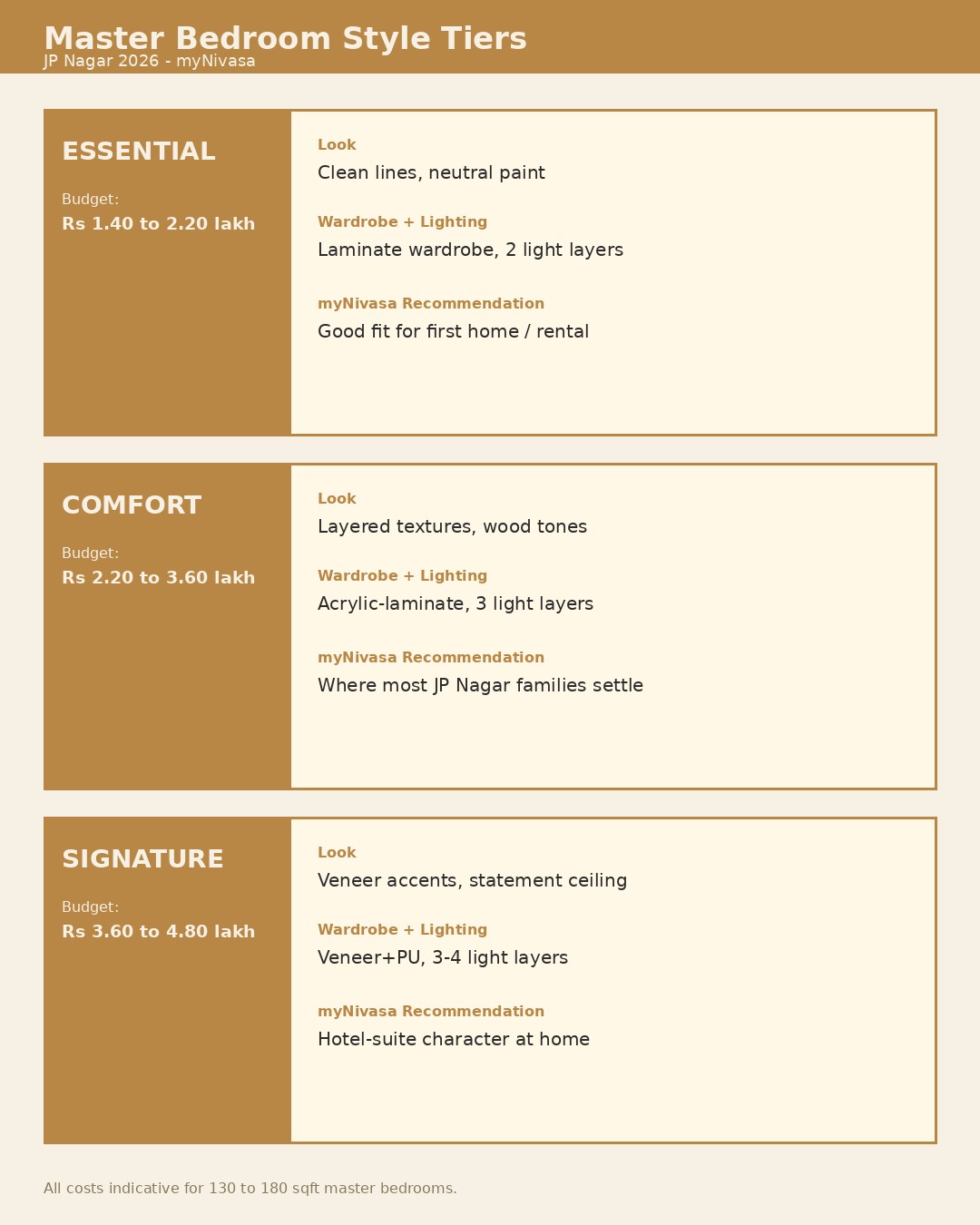
Most JP Nagar master bedroom projects we plan in 2026 fall into one of three style tiers. The tier sets the material grade, the wardrobe finish, the lighting density, and the typical budget band. The table below reflects observed costs from JP Nagar Phase 4 to Phase 8 apartment projects between October 2025 and April 2026. Costs are indicative and depend on actual room area, ceiling height, and the family's brand preferences.
| Style Tier | Typical Look | Wardrobe Finish | Lighting Layers | Indicative Budget (Material + Labour) | myNivasa Recommendation |
|---|---|---|---|---|---|
| Essential | Clean lines, neutral paint, simple wardrobe, single feature wall | Laminate, edge banding, push-to-open | 2 layers (ambient + task) | Rs 1.40 to 2.20 lakh | Good fit for first home or rental-friendly upgrades; protects resale value. |
| Comfort | Layered textures, warm wood tones, accent headboard, soft blinds | Acrylic + laminate mix, soft-close drawers | 3 layers (ambient + task + accent) | Rs 2.20 to 3.60 lakh | Most JP Nagar families settle here; best balance of look, function, and 10-year durability. |
| Signature | Veneer accents, fluted panels, statement ceiling, integrated dressing unit | Veneer + PU, dressing unit with mirror | 3 to 4 layers (cove, ambient, task, accent) | Rs 3.60 to 4.80 lakh | Suited for owners planning to stay 10+ years and wanting a hotel-suite character at home. |
Costs above assume a 130 to 180 sqft master bedroom with a standard rectangular layout, 9.5 to 10 feet ceiling, and one wall reserved for wardrobe. Add Rs 25,000 to Rs 60,000 for a study nook or larger bay window seating. Add Rs 35,000 to Rs 75,000 if an existing false ceiling has to be dismantled.
In our JP Nagar projects in 2025, families who locked the wardrobe wall and bed direction first, then finalized paint and decor at the end, reported 30 to 40 percent fewer change requests during execution. Decisions made in the right order save both money and weeks of revision time.
Why JP Nagar Master Bedrooms Need a Different Approach
JP Nagar is one of the older, more settled parts of south Bengaluru. The locality runs from Phase 1 (closer to Banashankari) all the way to Phase 9 (towards Konanakunte and Kanakapura Road). The housing stock is unusually mixed. You will find 1980s and 1990s independent houses, 2000s builder-floor apartments, 2010s mid-rise apartments by Sobha, Brigade, Mantri and Salarpuria, and post-2020 premium towers near the Outer Ring Road belt. This mix means there is no single floor plan template to design against.
In older JP Nagar Phase 1 to Phase 3 builder apartments, master bedrooms tend to be on the smaller side, typically 110 to 140 sqft, with windows on one wall and an attached toilet on another. The bed wall is often a constraint because windows or wardrobes from the original layout sit on the long wall. The challenge here is to plan storage without choking the room.
In mid-tier apartments in Phase 4, Phase 5 and Phase 7, master bedrooms commonly fall in the 140 to 180 sqft band, with cleaner rectangular shapes. These rooms allow a wall-to-wall wardrobe on one full wall, a queen or king bed centered on the opposite wall, and a side accent like a bay window seating or a small reading corner.
In newer Phase 8 and Phase 9 towers, and in projects along Bannerghatta Road feeder lanes, master bedrooms can stretch to 190 to 230 sqft. These rooms allow a walk-in wardrobe option, a dressing zone, and even a private balcony connected to the bedroom. The challenge here flips: too much space without a plan can feel hollow rather than restful.
Across all these clusters, JP Nagar families share a few common requests. They want practical storage that survives daily use for 10 years. They want enough natural light during the day, especially since most master bedrooms have at least one window facing the inner courtyard or the road. They prefer a calm, slightly traditional finish, often with one feature wall and a layered ceiling rather than a flat slab. And in nearly every project we plan, vastu placement of the bed is discussed at length before the layout is finalized.
What Makes JP Nagar Different as a Locality
JP Nagar sits in the south-east quadrant of Bengaluru, sandwiched between Banashankari, Jayanagar, BTM Layout, and the newer Kanakapura Road belt. The Outer Ring Road cuts across the southern edge of the locality, giving fast access to Electronic City, Bommanahalli, and Sarjapur Road. The Bannerghatta Road feeder lane on the eastern edge connects to Jayadeva Hospital, Bilekahalli, and IIM Bangalore. To the west, Kanakapura Road runs through Konanakunte Cross and Vasanthapura, opening into newer apartment clusters in Phase 8 and Phase 9.
The locality has matured over four decades. JP Nagar Phase 1 dates back to the early 1980s, with mostly independent houses and older builder floors. Phase 4, Phase 5, and Phase 6 were developed in the 1990s and 2000s, with a mix of 2BHK and 3BHK apartments. Phase 7, Phase 8, and Phase 9 saw the bigger Sobha, Brigade, Mantri, and Salarpuria developments through the 2010s. The Outer Ring Road belt added newer premium high-rises between 2018 and 2024.
This staggered development creates a layered customer base. Established families who have owned a JP Nagar Phase 4 apartment for 15 to 20 years are now renovating the master bedroom for the next decade. Younger couples are moving into newer Phase 8 towers and planning their first master bedroom interior. Senior parents in independent houses on JP Nagar 24th Main or 9th Block are adapting older bedrooms for easier daily use. The same locality therefore needs four or five different master bedroom design approaches, not one.
Local landmarks shape daily routines and influence design choices. Sarakki Lake on the eastern edge and Puttenahalli Lake on the south are quieter walking zones, often visible from west-facing or south-facing master bedrooms in higher floors of Phase 6 and Phase 7. The Jayadeva metro station and Konanakunte Cross station on the green line have reshaped commute patterns; many families now prefer slightly smaller but better-organized master bedrooms in apartments closer to metro, rather than larger rooms farther away. Daily access to Madivala market, Banashankari shopping clusters, and the BDA complex on Outer Ring Road influences storage planning, especially in wardrobes and under-bed units.
Microclimate matters too. JP Nagar sits at an elevation of roughly 900 metres, with comfortable temperatures most of the year. South-west and west-facing master bedrooms can warm up in the late afternoons between February and May, which influences blind and curtain choices. North-facing and east-facing bedrooms stay cooler but receive less direct light, which influences ambient lighting density. We adjust the design plan based on the actual orientation of each apartment, observed on a site visit before the wardrobe wall is fixed.
Master Bedroom Layout Options for JP Nagar Apartments
Before any wardrobe or color decision, the layout of the master bedroom must be locked. A wrong wardrobe wall can mean an awkward bed position for the next 10 years. The four most reported JP Nagar layouts are described below, with the trade-offs we have observed in actual project execution.
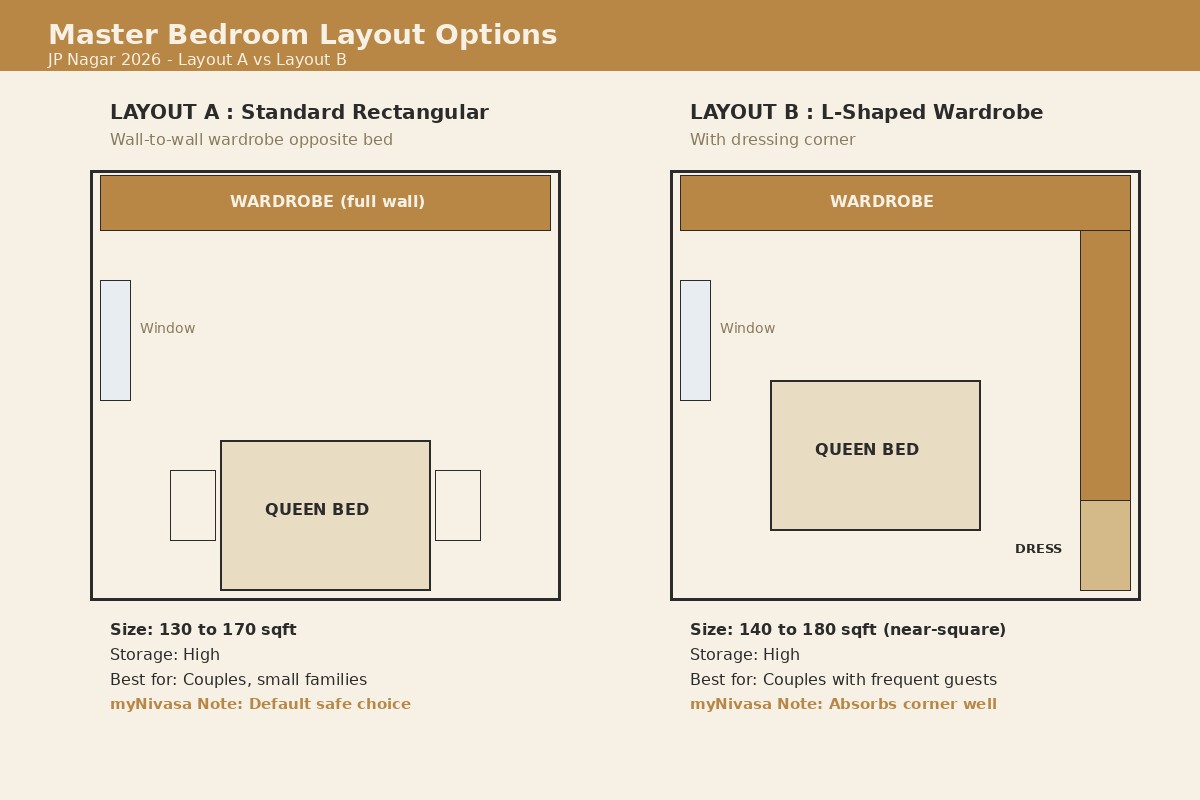
Layout 1: Standard Rectangular with Wall-to-Wall Wardrobe
This is the most common layout we plan in JP Nagar 2BHK and 3BHK apartments. The longest wall is reserved for a wall-to-wall, floor-to-ceiling wardrobe. The bed sits centered on the opposite wall. Side tables flank the bed. A single dresser or bench sits at the foot of the bed if space allows. This layout works well in rooms from 130 to 170 sqft. It maximizes storage without crowding the bed.
Layout 2: L-shaped Wardrobe with Dressing Corner
When the master bedroom is closer to square (15 ft by 13 ft or similar), an L-shaped wardrobe along two adjacent walls works better than a single long wall. One arm holds the hanging units; the other arm holds shelves, drawers, and a built-in dressing top with a mirror. This is a popular choice in newer Sobha and Brigade towers in JP Nagar Phase 7 and Phase 8.
Layout 3: Walk-in Wardrobe Behind the Bed Wall
For master bedrooms above 190 sqft, a small walk-in wardrobe behind the headboard wall is becoming a frequent request in 2026. The walk-in zone is roughly 5 ft by 7 ft, with double-hanging on one side, full-height storage on the other, and a vanity at the end. The sleeping zone remains uncluttered, and the dressing function moves out of the main bedroom space. This is best suited for owners who plan to stay 10 years or more.
Layout 4: Bay Window with Reading Nook
Several Brigade Petunia, Mantri Espana and Sobha Magnificia apartments in JP Nagar have bay windows in the master bedroom. We typically convert these into a low platform with cushioned seating, hidden drawer storage below, and warm lighting above. This creates a quiet reading corner without sacrificing wardrobe space elsewhere in the room.
| Layout | Room Size Suited | Storage Capacity | Best Family Type | myNivasa Recommendation |
|---|---|---|---|---|
| Standard Rectangular | 130 to 170 sqft | High | Couples, small families | Default choice in JP Nagar apartments; lowest risk, best resale value. |
| L-shaped Wardrobe | 140 to 180 sqft (near-square) | High | Couples with frequent guests or relatives staying over | Useful when one wall has a window; the L absorbs the corner. |
| Walk-in Wardrobe | 190 sqft and above | Very High | Established families, long-term owners | Premium feel; budget for Rs 1.0 to 1.5 lakh extra over standard wall wardrobe. |
| Bay Window Reading Nook | Any size with bay window | Moderate (supplementary) | Readers, hybrid work-from-home users | Adds character without cost-heavy wardrobe rework. |
Wardrobe Design for JP Nagar Master Bedrooms
The wardrobe is the largest single piece of carpentry in any master bedroom. It also drives the cost and the visual character of the room more than any other element. In JP Nagar 2026 projects, we plan wardrobe systems around four decisions: shutter type, internal layout, finish, and hardware grade. Each of these decisions affects daily usability for the next 10 years.
Shutter Type: Sliding vs Hinged
In older JP Nagar Phase 1 to Phase 4 apartments where ceiling heights are 9.0 to 9.5 feet, sliding wardrobes are the practical default. They do not need swing clearance in front, which matters when the bed is close to the wardrobe wall. In newer Phase 7 to Phase 9 towers with 10 to 11 feet ceilings, hinged wardrobes with full-height shutters look more elegant but need at least 24 inches of clearance for the shutter to open. We recommend sliding when the floor plan is tight, hinged when the room allows full clearance and a more traditional look is preferred.
Internal Layout: The Real Daily Usability Driver
A wardrobe that looks beautiful from outside but is poorly planned inside is the most common regret families report after one year of use. A good JP Nagar master bedroom wardrobe typically has the following zones: a long-hanging bay for sarees and gowns, a double-hanging stack for shirts and trousers, three to four pull-out drawers for innerwear and accessories, a shelf bay for folded clothes, and an upper loft for luggage and seasonal storage. Drawer slides should be soft-close. Internal lights should switch on automatically when a shutter opens.
Finish Choices
In 2026, JP Nagar wardrobe finishes lean towards layered, calm surfaces rather than glossy bright colors. Matte laminate in warm wood tones, fluted panels in linen white, soft-touch acrylic in muted greens or beiges, and veneer accents in the Signature tier are the most asked finishes. Mirror panels are now smaller, used as a strip rather than a full shutter, often integrated near the dressing zone.
| Wardrobe Finish | Typical Cost per Sqft | Look | 10-Year Durability | myNivasa Recommendation |
|---|---|---|---|---|
| Membrane laminate | Rs 1,100 to 1,400 | Solid color, clean | Good | Essential tier; good for rentals or first homes. |
| Matte laminate | Rs 1,400 to 1,800 | Premium feel, low maintenance | Very good | Comfort tier; most popular 2026 choice in JP Nagar. |
| Acrylic (high-gloss) | Rs 1,800 to 2,400 | Bright, light-reflecting | Good but shows scratches | Use only on upper bays, not on heavy-use lower shutters. |
| PU paint | Rs 2,200 to 2,800 | Smooth, hotel-grade | Excellent if touched up every 4 years | Signature tier only; budget the touch-up cycle. |
| Veneer + PU | Rs 2,800 to 3,800 | Natural grain, hotel suite feel | Excellent | Reserve for accent areas like dressing wall, not full wardrobe. |
Hardware Grade: The Often Skipped Detail
Hardware is where corners are most often cut by budget vendors, and it shows up as a complaint within 18 months. We strongly recommend branded hardware: Hettich, Hafele, or Ebco for drawer slides, hinges, and sliding tracks. The cost addition over generic hardware is roughly Rs 8,000 to Rs 14,000 for a full wardrobe, which works out to less than 5 percent of total wardrobe cost. Over a 10-year life, this is the single best return on a small line item.
Color Schemes That Work in JP Nagar Master Bedrooms
Color in the master bedroom is a long term commitment. Repainting an occupied bedroom is a 4 to 6 day disruption every time, so the choice should hold up for at least 4 to 5 years without feeling dated. The 2026 color direction in JP Nagar master bedrooms is firmly towards muted, layered palettes rather than bright accent colors.
Palette 1: Warm White and Wood
This is the most flexible and most often recommended palette in JP Nagar 2026 projects. Walls in a warm white shade such as Asian Paints Lily White, Berger Ivory Cream, or Dulux Magnolia. Wardrobe in matte wood tone. Curtains in dusty cream. Bedding in soft taupe or off-white. The palette feels cozy without being heavy, and it suits both north-facing and south-facing rooms.
Palette 2: Sage Green and Linen
Sage and dusty green tones gained strong traction through 2025 and remain a popular 2026 choice. The wall behind the bed is painted in a muted sage tone such as Asian Paints Sage Green or Royale Aspira Soft Sage. The other walls stay in linen white. Wardrobe finish is matte laminate in a complementary muted tone. The room feels fresh and unhurried.
Palette 3: Terracotta and Off-White
Terracotta tones are gaining ground in 2026, especially for couples who want a warmer, slightly traditional feel. The feature wall is painted in a soft terracotta such as Dulux Spiced Honey or Asian Paints Terra Bloom. Bedding moves to cream and rust accents. The wardrobe stays in light wood or off-white. The palette feels grounded and works well in evening light.
Palette 4: Charcoal Accent on Warm Beige
For couples with a more contemporary preference, a charcoal accent on a warm beige base works well. Three walls stay in soft beige (Berger Almond Cream or similar). The headboard wall is in charcoal grey paint or fluted charcoal panels. Bedding stays light. The wardrobe is in matte off-white. This palette photographs well and suits Signature tier projects.
| Palette | Best Suited For | Light Direction | 10-Year Timelessness | myNivasa Recommendation |
|---|---|---|---|---|
| Warm White and Wood | Any orientation, any age group | North or South facing | Excellent | Safest default; never feels dated. |
| Sage Green and Linen | Couples in their thirties, young families | East or South facing | Very good | Adds character without commitment to a bright color. |
| Terracotta and Off-White | Traditional aesthetics, evening users | South or West facing | Good | Match terracotta to the warmth of evening light. |
| Charcoal on Warm Beige | Contemporary preference, premium tier | East or North facing (avoid dark rooms) | Good | Use charcoal only on one feature wall, never two. |
Color names are indicative shade families. Final shade should be sampled on a 2 ft by 2 ft patch on the actual wall and viewed in both morning and evening light before final purchase. This sampling step costs nothing extra and prevents the most common color regrets.
Lighting Plans for Master Bedrooms
Lighting is the second-largest character driver in a master bedroom, after the wardrobe. In JP Nagar 2026 projects, the shift from a single ceiling tube light to a layered 3-tier plan is the most consistent upgrade families request. A good lighting plan typically uses three layers, sometimes four, each serving a separate purpose.
Layer 1: Ambient Light
Ambient lighting is the base layer that fills the room evenly. In 2026 JP Nagar master bedrooms, ambient lighting is usually delivered through a peripheral cove in the false ceiling, with warm white LED strip (3000K to 3500K). The cove gives a gentle wash on the ceiling and avoids harsh downward glare. For families who do not want a false ceiling, a flush surface luminaire in the centre with a wide diffuser works as the alternative ambient source.
Layer 2: Task Light
Task lighting is focused light for specific activities: reading in bed, dressing in front of a mirror, writing at a small desk. The most common task fixtures in 2026 are bedside wall-mounted swing arm lamps with adjustable head, recessed lights inside the wardrobe that come on with shutter movement, and vertical sconces flanking a dressing mirror. The wattage should be moderate; the role is to focus light on a small zone, not to flood the room.
Layer 3: Accent Light
Accent lighting is the layer that gives the room its character in the evening. This is typically a wall light over a piece of art, a slim LED strip behind a fluted headboard panel, or a small wash light under a floating side console. Accent lights are usually on a dimmer and on a separate switch from the ambient layer, so the evening mood can be set without having all the lights on.
Layer 4 (Optional): Decorative Light
In Signature tier projects, families often add a fourth decorative layer, typically a pendant or a chandelier centered above the bed. This is a styling choice rather than a functional one. We recommend keeping the decorative fixture small and low in lumen output, so that it adds character without dominating the room.
| Lighting Layer | Typical Fixture | Indicative Cost (Material) | Wattage Guideline | myNivasa Recommendation |
|---|---|---|---|---|
| Ambient (Cove) | Warm white LED strip, 8W per running ft | Rs 14,000 to 22,000 | 3000K to 3500K | Default for any tier above Essential. |
| Ambient (Flush) | Surface luminaire with diffuser | Rs 3,500 to 6,500 | 18W to 24W | Use if false ceiling is not in scope. |
| Task (Bedside) | Wall-mounted swing arm lamp | Rs 2,500 to 5,500 per side | 5W to 7W LED | Symmetric pair on either side of bed. |
| Task (Wardrobe) | Recessed LED with shutter sensor | Rs 1,800 to 3,200 per bay | 4W to 6W per bay | Pays for itself in daily usability. |
| Accent (Headboard) | Slim LED strip behind fluted panel | Rs 4,500 to 7,500 | 2700K dimmable | Single most effective evening upgrade. |
| Decorative (Pendant) | Small ceiling pendant or chandelier | Rs 6,000 to 24,000 | 15W to 25W total | Optional, Signature tier only. |
Flooring, Wall, and Ceiling Choices
Most JP Nagar apartments come with vitrified tile flooring in master bedrooms as standard. Owners rarely tear up tile floors during interior projects because of cost and disruption. The interior plan therefore has to work around the existing flooring color and grain. A warm beige or cream tile floor pairs well with most 2026 palettes. A grey tile floor narrows the wall and wardrobe palette towards beige, taupe, and off-white tones to avoid the room reading too cold.
Wood-look laminate flooring overlays are an option in some Signature tier projects where the existing tile is in poor condition or the owners want a warmer underfoot feel. Laminate overlay adds around Rs 100 to Rs 160 per sqft and 3 to 4 days to the project schedule. Vinyl plank is a cheaper alternative at Rs 60 to Rs 110 per sqft. We do not recommend solid wood flooring for JP Nagar master bedrooms because of humidity swings and the disruption of replacing damaged planks later.
Walls in 2026 lean towards painted finishes with one feature wall in a textured material. The feature wall might be fluted MDF panels, slim vertical wood battens, hand-textured Italian finish, or a wallpaper panel. The feature wall is usually behind the bed because it is the visual anchor of the room.
Ceilings in JP Nagar master bedrooms are commonly designed with a peripheral cove (a step-down rectangle around the room edge) leaving the central ceiling flat. This gives space for the cove light strip without lowering the entire ceiling height. In rooms with 9 feet ceilings, a full false ceiling can make the room feel low; the peripheral cove avoids that compression while still giving the lighting layer.
| Surface | Common 2026 Choice | Indicative Cost | Maintenance | myNivasa Recommendation |
|---|---|---|---|---|
| Floor (existing tile) | Keep as-is, work palette around it | Nil | Routine cleaning | Best for most owners; avoid the tear-up cost. |
| Floor (laminate overlay) | 8mm AC4 wood-look laminate | Rs 100 to 160 per sqft | Avoid water spills | Worth it only if existing tile is damaged. |
| Walls (paint) | Premium emulsion, 2 coats over primer | Rs 32 to 48 per sqft | Touch-up every 4 years | Asian Paints Royale, Berger Silk, or Dulux Velvet Touch are observed favorites. |
| Feature wall (fluted MDF) | 15 mm fluted MDF, PU or veneer | Rs 580 to 950 per sqft | Dust weekly | Single feature wall behind bed is the safest bet. |
| Ceiling (peripheral cove) | Gypsum cove with LED strip channel | Rs 110 to 160 per sqft (cove area) | Periodic dusting | Adds ambient light without compressing ceiling. |
Window Treatments, Blinds, and Curtain Choices
Window treatments are usually the last major spend in a JP Nagar master bedroom project, and the one that gets the least planning attention. Done well, they improve afternoon light control, evening privacy, and the visual softness of the room. Done poorly, they show their flaws every single morning. In 2026, three options dominate JP Nagar master bedroom projects.
Option one is layered curtains with a sheer plus blackout combination. The sheer layer filters daytime light and gives privacy without darkening the room. The blackout layer pulls across for early mornings, afternoon naps, or family members on shift work. Rod placement is critical; we extend the rod 6 to 8 inches beyond the window on each side, so that the curtain stack does not block any window glass when drawn back. Curtain length should be floor-touching, not pooling, to keep the line clean.
Option two is Roman blinds in linen or cotton blend. Roman blinds give a tailored, slightly traditional look and work well in rooms that already have a busy headboard or wardrobe finish. They are best in west-facing rooms where afternoon glare needs to be cut without losing the entire view. Roman blinds are typically Rs 1,200 to Rs 2,400 per square foot of window area in JP Nagar 2026 pricing.
Option three is roller blinds with a side-tracked blackout. This is a clean, contemporary choice for newer Phase 8 and Phase 9 apartments. The side track stops the light bleed at the edges, which makes the room properly dark for sleep when needed. Roller blinds also work well behind curtains, giving full light control without compromising the soft fabric look of curtains during the day.
| Treatment | Light Control | Look | Indicative Cost (Window 5 ft x 5 ft) | myNivasa Recommendation |
|---|---|---|---|---|
| Sheer + Blackout Curtains | Excellent (layered) | Soft, traditional warmth | Rs 8,500 to 18,000 | Default choice in most JP Nagar projects. |
| Roman Blinds | Moderate to Good | Tailored, slightly traditional | Rs 12,000 to 24,000 | Best in west-facing rooms; pairs well with simple paint walls. |
| Roller Blinds (side-tracked) | Excellent | Contemporary, minimal | Rs 9,000 to 16,000 | Use with curtains for full light flexibility. |
| Honeycomb Cellular Blinds | Good (some thermal insulation) | Soft, layered | Rs 14,000 to 26,000 | Helpful in west-facing rooms that warm up in afternoons. |
Storage and Functional Adaptations
Beyond the main wardrobe, a JP Nagar master bedroom typically needs additional storage that goes unnoticed in renderings but matters daily. Hidden storage in the bed (a hydraulic-lift platform or side drawers) is the most common addition we plan in 2026. A 6 ft by 6 ft hydraulic storage bed adds roughly 40 cubic feet of cleanable storage, which is enough for spare bedding, off-season clothing, and luggage.
Bedside tables in 2026 are slimmer and often wall-mounted rather than free-standing. A 14 inch by 18 inch wall-mounted side console with a single drawer and a power outlet works well in tight rooms. It frees floor space, makes cleaning easier, and gives a cleaner visual line.
A small dressing zone is a common ask in projects where the room exceeds 160 sqft. The dressing zone is typically 30 to 36 inches of counter, a sit-down stool, a vertical mirror, and a soft sconce on each side. The counter top can extend the wardrobe finish for visual continuity.
In hybrid work-from-home cases, a compact study unit inside the master bedroom is occasionally requested. We caution against this because it tends to disturb sleep quality over time. Where the layout demands it, the study unit should sit behind a partition or a fluted screen, with a dedicated task light that turns off cleanly at the end of the work day.
Vastu Considerations for the Master Bedroom
Vastu remains an important design input for the majority of JP Nagar families. Our role at myNivasa is to plan layouts that respect the family's vastu preferences while ensuring the room remains functional. We follow widely-cited traditional principles, not new claims. Below are the most discussed master bedroom vastu points, drawn from traditional sources such as the Vastu Shastra texts and commonly referenced in Indian residential design practice.
Master Bedroom Direction
The traditional preference is to place the master bedroom in the south-west (SW) zone of the home. In JP Nagar apartments where the home orientation cannot be changed, this preference is sometimes adjusted to the closest available bedroom in the south or west corner. We discuss this with the family before fixing the wardrobe wall, because changing the function of a room mid-project is disruptive.
Bed Placement and Head Direction
The most discussed point is the head direction while sleeping. The traditional preference is to sleep with the head pointing south or east. North is generally avoided. The bed itself is usually placed against a solid wall, not under a window. The wall behind the headboard is also kept clear of beams as far as possible. Where a beam is unavoidable, a false ceiling design is often used to soften its visual presence.
Wardrobe and Mirror Placement
Wardrobes are commonly placed in the south or west wall, leaving the east and north walls lighter. Mirrors are traditionally not placed directly facing the bed; many families prefer the mirror inside the wardrobe shutter or on a side wall instead of in the line of sight from the bed.
Lights and Electronics
Decorative or accent lights, if used, are often positioned in the south-east corner of the room, following the traditional preference for the SE as the agni or fire zone. Electronics such as televisions are increasingly minimal in master bedrooms, but where present, they are usually placed on the south or west wall, again to leave the lighter zones uncluttered.
None of these traditional preferences are absolute. Where a family does not follow vastu strictly, we plan around standard functional principles. Where a family follows vastu carefully, we plan the layout in consultation with their preferences. Either way, the master bedroom design has to remain practical for daily use.
Family-Specific Adaptations
For Newlyweds
Newlywed master bedrooms in JP Nagar are usually planned around a flexible layout. A queen bed (rather than king), a wardrobe with room for a future child's clothing in one bay, a small reading corner, and a slightly softer palette are common requests. Storage is moderate; the room is expected to be re-planned in 3 to 5 years when family composition changes.
For a Young Family
When the master bedroom is shared with a young child for the first few years, a flexible bed-side configuration matters more than aesthetics. A small co-sleeper crib at one bed-side, a low changing table that doubles as a dresser, soft warm light on a separate dimmer for night feeds, and rounded furniture corners are practical adaptations. The room can transition out of this configuration in 3 to 4 years without major re-work.
For an Established Family (10+ Year Owners)
For owners planning to stay 10 years or more, the master bedroom is usually the most generous in scope. A walk-in wardrobe option, a small dressing zone, a Signature tier finish, and a peripheral cove ceiling are often included. Storage is high; the room is designed to absorb 10 years of accumulated belongings without overflow.
For Senior Parents (Functional Adaptations)
When the master bedroom is occupied by senior parents, a few functional adaptations help. Lower wardrobe rods (54 inch rather than the standard 66 inch hanging height) for easier reach. Anti-skid surface on bathroom-side floor strips. A grab bar near the bed and another inside the attached toilet. Switches at lowered height. A motion-sensor warm light along the floor path from bed to toilet. These are practical adjustments, drawn from common Indian residential best practice. They make daily use easier for older family members and do not look out of place in the broader design. In several JP Nagar Phase 5 and Phase 6 projects we have planned for senior parents, these adaptations were added without changing the overall feel of the master bedroom; the room still looked like a calm, well-finished interior, not a hospital-room conversion. Small details such as a soft warm night light below the bed frame, a hand-operated curtain pull rather than motorized, and a wide doorway clearance for easy movement made the largest practical difference in daily comfort.
The Bed, Mattress, and Bedding Layer
The bed is the single piece of furniture used most heavily in the home. A good bed in a JP Nagar master bedroom is built around three decisions: frame type, mattress, and bedding finish. Each lasts a different number of years and should be replaced on its own cycle.
The frame is typically a queen (60 in by 78 in) or king (72 in by 78 in) size, with a fabric or fluted MDF upholstered headboard. Hydraulic storage frames open from below and add roughly 40 cubic feet of internal storage; box storage frames open from a side panel and add about 30 cubic feet. The frame is expected to last 12 to 15 years, so spending Rs 35,000 to Rs 65,000 on a quality frame returns its value many times over.
The mattress sits on top and is replaced on a 7 to 10 year cycle. Common 2026 choices in JP Nagar are pocket spring with a memory foam top layer (Sleepwell, Kurlon, Wakefit Aurora), latex hybrid mattresses (Springfit, Wakefit Dual Comfort), and traditional coir-bonded mattresses (Kurlon Mystic). Mattress thickness is usually 7 to 8 inches; thicker mattresses can interfere with hydraulic frame clearance. We recommend testing the mattress in person at a Sleepwell or Wakefit experience centre on Bannerghatta Road or in JP Nagar before purchase.
The bedding layer is replaced on a 2 to 3 year cycle. In 2026, the popular bedding choices in JP Nagar are 300 to 400 thread count cotton sheets in muted tones, a lightweight cotton-blend duvet for winters, and 2 to 4 layered pillows including a memory foam contour pillow. Bedding sets are typically Rs 8,000 to Rs 22,000 for a queen bed, and Rs 12,000 to Rs 32,000 for a king bed.
| Element | Common 2026 Choice | Indicative Cost | Replacement Cycle | myNivasa Recommendation |
|---|---|---|---|---|
| Bed Frame (queen) | Hydraulic storage, upholstered headboard | Rs 35,000 to 65,000 | 12 to 15 years | Spend on the frame; it lasts longest. |
| Mattress | Pocket spring + memory foam (7 in to 8 in) | Rs 22,000 to 48,000 | 7 to 10 years | Test in person before purchase; never buy online unseen. |
| Bedding | 300 to 400 TC cotton sheets, cotton duvet | Rs 8,000 to 22,000 (queen) | 2 to 3 years | Two sets in rotation; saves laundry stress. |
| Pillows | Memory foam contour + soft fibre fill | Rs 1,800 to 4,500 per pillow | 1 to 2 years | Replace earlier than you expect; old pillows lose support quickly. |
JP Nagar vs Nearby Localities: A Quick Comparison
JP Nagar master bedroom projects share many design principles with neighbouring localities, but a few practical differences matter. The table below compares JP Nagar against Banashankari, BTM Layout, and the newer Kanakapura Road belt for typical master bedroom interior parameters.
| Parameter | JP Nagar | Banashankari | BTM Layout | Kanakapura Road Belt |
|---|---|---|---|---|
| Typical Master Bedroom Size | 130 to 220 sqft | 120 to 200 sqft | 110 to 180 sqft | 140 to 240 sqft |
| Apartment Vintage Mix | 1980s to 2024 | 1980s to 2018 | 1990s to 2018 | 2015 to 2025 |
| Common Budget Band (Comfort tier) | Rs 2.2 to 3.6 lakh | Rs 2.0 to 3.4 lakh | Rs 2.0 to 3.3 lakh | Rs 2.4 to 3.8 lakh |
| Vastu Consultation Frequency | High | High | Moderate | Moderate |
| Walk-in Wardrobe Demand | Growing in Phase 8 and 9 | Low to moderate | Low | High |
| Typical Ceiling Height | 9.0 to 11.0 ft | 9.0 to 10.0 ft | 9.0 to 10.0 ft | 10.0 to 11.5 ft |
Source: myNivasa internal project execution data and observed market patterns, October 2025 to April 2026.
Execution Timeline: What Actually Happens Week by Week
Most JP Nagar master bedroom interior projects run on a 5 to 6 week working timeline. Understanding what happens in each week helps the family plan around the disruption, especially when the master bedroom is occupied and has to be vacated room by room. Below is a representative week-by-week schedule for a Comfort tier project in a 160 sqft master bedroom.
Week 1. Site protection layer is laid on the floor and on the door frame. Existing electrical points are checked. Any old wardrobe or false ceiling that needs to come out is dismantled. Plumbing and electrical changes (new switch points, new ceiling fan box, additional power outlets) are completed before any new finish work starts. This is also the week we finalize the wardrobe internal layout in detail. The family is taken through the bay-by-bay configuration: how many hanging bays, how many drawers, what goes on the loft, what goes in the dressing zone. A small site change at this stage costs nothing; the same change in week 3 can cost Rs 8,000 to Rs 15,000 and delay handover by 4 to 6 days.
Week 2. Wardrobe carcass is fabricated at the workshop. False ceiling framing (if in scope) is installed on site. The first coat of primer goes on the walls. Cove channels are aligned with the wardrobe vertical lines so that the lighting layer flows visually with the carpentry.
Week 3. Wardrobe carcass arrives on site and is fitted. Wardrobe shutters and dressing top are installed. False ceiling gets its first coat of finish. The first coat of wall paint goes on. This is the week the room starts looking like a master bedroom again.
Week 4. Final paint coat. Feature wall finish (fluted MDF, wallpaper, or textured finish) is installed. Cove LED strip and accent lights are commissioned. Floor protection is removed and any minor floor patching is done. Curtain rods, blind tracks, and ceiling fan are installed.
Week 5. Bed and mattress arrive. Bedside units are placed. Soft furnishing (curtains, blinds, throws, cushions) is fitted. Decor items are positioned. The room is deep cleaned, dust is cleared from carpentry joints, and a final electrical check is done.
Week 6 (if in scope). Snag list closure. The family lives in the room for a week and reports any items needing attention. Hinges are adjusted, switches relabelled, paint touch-ups completed. Final handover happens at the end of this week with a written 12-month service note.
Why JP Nagar Families Choose myNivasa
myNivasa is a Bengaluru-based holistic home construction and interior design brand. We work across Bengaluru, with a focused execution capability in south Bengaluru locality clusters including JP Nagar Phase 1 to Phase 9, Bannerghatta Road, Banashankari, Kanakapura Road, and the Outer Ring Road belt. Our project teams have planned and delivered master bedroom interior projects across builder apartments by Sobha, Brigade, Mantri, Salarpuria, and Prestige in the JP Nagar zone.
What JP Nagar families tell us they value: a clear scope locked before work starts, branded hardware (Hettich, Hafele, Ebco) as the default rather than a costly upgrade, a written 10-year project plan rather than a one-time install, and on-site project coordination through a single point of contact. We do not offer the lowest price in JP Nagar. We offer a transparent price for a result that holds up for 10 years of daily family use.
Master bedroom interior project timelines in JP Nagar typically run 25 to 40 working days under a turnkey contract, depending on the scope. Wardrobe and false ceiling carpentry usually takes 12 to 18 days; painting and finishing takes 6 to 10 days; lighting, blinds, and final fit-out takes 5 to 8 days. A site protection layer is laid before any work starts, and the room is handed back deep cleaned and dust-cleared.
We have planned master bedroom interiors for families across JP Nagar Phase 4, Phase 5, Phase 6, Phase 7, and Phase 8 between 2023 and 2026. The repeat referral rate from JP Nagar customers is one of our highest among Bengaluru localities, which we credit to the on-site coordination and the written 10-year service plan that comes with every Comfort and Signature tier project. Our nearest project leads operate from a coordination point in the JP Nagar zone and reach most JP Nagar sites within 25 minutes for site reviews and snag closure visits.
A Useful Video Reference
For families who want to see master bedroom design ideas in motion, a popular YouTube reference covering Indian master bedroom layouts and wardrobe configurations is helpful before the first design meeting. The video below covers 2026 trends, wardrobe layouts, and material finishes. It is not a myNivasa video; it is shared as a general industry reference.
[Video reference will be embedded as wp:embed during Phase 8]: https://www.youtube.com/watch?v=4Q8oGTGCcdYFrequently Asked Questions
1. What is the typical cost of designing a master bedroom in JP Nagar in 2026?
Material plus labour budgets for a JP Nagar master bedroom interior project typically range from Rs 1.4 lakh (Essential tier) to Rs 4.8 lakh (Signature tier). The Comfort tier, where most JP Nagar projects settle, is in the Rs 2.2 lakh to Rs 3.6 lakh band. These costs assume a 130 to 180 sqft room with one wall reserved for wardrobe, a peripheral cove ceiling, and a 3-layer lighting plan. Costs vary by room size, brand preferences, and dismantling needs.
2. How long does master bedroom interior work take in a JP Nagar apartment?
Most master bedroom projects take 25 to 40 working days under a turnkey contract. Wardrobe and false ceiling carpentry takes 12 to 18 days, painting and finishing takes 6 to 10 days, and lighting, blinds and fit-out takes 5 to 8 days. The exact timeline depends on the room size, scope, and whether any existing carpentry needs to be dismantled first. We share a written week-by-week schedule before the contract is signed.
3. Is a sliding wardrobe or a hinged wardrobe better for a JP Nagar master bedroom?
Sliding wardrobes work better in older JP Nagar Phase 1 to Phase 4 builder apartments where the room is tight and ceiling height is 9.0 to 9.5 feet. Hinged wardrobes with full-height shutters look more elegant and suit newer Phase 7 to Phase 9 towers where ceiling height is 10 to 11 feet and the bed has more clearance. Both options have similar internal storage capacity when planned well.
4. What is the most timeless color palette for a JP Nagar master bedroom in 2026?
Warm white walls with matte wood-tone wardrobe and dusty cream bedding is the safest 2026 palette. It does not feel dated for at least 10 years, suits both north-facing and south-facing rooms, and works across all three style tiers. Sage green or terracotta accents can be added on one feature wall for character without committing the whole room to a bright color.
5. How important is the lighting plan in a master bedroom?
A 3-layer lighting plan (ambient, task, accent) is the single most effective upgrade most JP Nagar master bedrooms can make. It moves the room away from the harsh single-tube-light look of older apartments and adds depth, especially in evening hours. The full 3-layer plan typically costs Rs 28,000 to Rs 55,000 in material and is recommended in any Comfort or Signature tier project.
6. Should I add a study desk inside my master bedroom?
If the home has space for a separate study or work corner outside the master bedroom, that is the preferred choice. A study desk inside the master bedroom tends to disturb sleep routines over time. Where the layout demands a study inside the master bedroom, we recommend a partition or a fluted screen, and a dedicated task light that turns off cleanly at the end of the work day.
7. What vastu points are typically followed in JP Nagar master bedroom designs?
The most discussed traditional vastu points are: master bedroom in the south-west zone of the home where layout allows; bed against a solid wall with the head pointing south or east; wardrobe on the south or west wall; mirrors not directly facing the bed; lights or decorative fixtures in the south-east corner. Families differ in how strictly they follow these; we plan the layout in consultation with the family preferences.
8. Is a walk-in wardrobe worth it in a JP Nagar apartment?
A walk-in wardrobe is worth the extra Rs 1.0 to 1.5 lakh only when the master bedroom is 190 sqft or larger and the owners plan to stay 10 years or more. For smaller rooms or shorter-stay owners, a wall-to-wall wardrobe or an L-shaped layout gives similar storage capacity at lower cost. The walk-in is primarily a comfort and aesthetic upgrade, not a storage upgrade.
Limitations and Assumptions
The cost ranges and timelines in this guide are observed from JP Nagar master bedroom interior projects executed between October 2025 and April 2026. Project costs depend on actual room area, ceiling height, the family brand preferences, the volume of dismantling work needed, and the choice of finish tiers. Costs can deviate from the indicative bands above by 10 to 15 percent in either direction. This guide is informational; it is not a fixed quotation.
Vastu references in this guide are drawn from widely-cited traditional Indian Vastu Shastra principles. Different traditions and family lineages follow slightly different rules. The aim of this guide is to describe the most commonly followed master bedroom vastu preferences, not to claim that any specific arrangement produces a specific result. Families with strong vastu requirements should consult their family astrologer or vastu practitioner before fixing the room layout.
Color shade names mentioned (Asian Paints Lily White, Berger Ivory Cream, Dulux Magnolia and similar) are reference shade families. Final shades should be sampled on the actual wall before purchase, since lighting conditions in each JP Nagar apartment differ. We always recommend a 2 ft by 2 ft sample patch viewed in both morning and evening light before bulk paint purchase. Even a one shade step difference in the same colour family can change how the room reads at 7 pm, when the room is most used.
Brand mentions in this guide (Sobha, Brigade, Mantri, Salarpuria, Prestige, Asian Paints, Berger, Dulux, Hettich, Hafele, Ebco, Sleepwell, Kurlon, Wakefit, Godrej Interio, Hometown, Urban Ladder, Ikea) are illustrative of widely available products in the Bengaluru market. We are not formally affiliated to or endorsed by any of these brands. Final product selection should be based on the actual site visit, the family preferences, and the warranty terms current at time of purchase.
Wardrobe internal layouts and hardware specifications are based on the Hettich, Hafele, and Ebco product catalogues current as of April 2026. Specifications may change with newer product releases. The principles (soft-close drawers, branded hardware, internal lighting on shutter sensor) remain valid across product generations.
Sources and References
- myNivasa internal project execution logs, JP Nagar Phase 1 to Phase 9 master bedroom projects, October 2025 to April 2026.
- Bureau of Indian Standards, BIS IS 4838 (modular furniture quality benchmarks) for wardrobe carpentry references.
- Bureau of Indian Standards, BIS IS 3646 (interior illumination guidelines) for ambient and task lighting recommendations.
- Bureau of Indian Standards, BIS IS 1244 (residential furniture safety) for hardware specifications.
- Asian Paints, Berger Paints, and Dulux published 2026 color trend bulletins for shade family references.
- Hettich, Hafele, and Ebco product catalogues for wardrobe hardware specifications.
- Traditional Vastu Shastra commentaries (Mayamatam, Manasara) for master bedroom orientation references; modern practitioner guidance from established Indian vastu textbooks.
- Site observations from Sobha Magnificia, Brigade Petunia, Mantri Espana, Salarpuria Symphony, and other builder apartments in the JP Nagar zone.
- Cross-referenced industry trend reports from Livspace, HomeLane, Interior Company, and Spacewood for 2026 wardrobe and bedroom design directions.
- Sleepwell, Kurlon, Wakefit, and Springfit product pages for mattress and bedding cycle references.
Materials and Finishes Worth Knowing in 2026
A short reference on the materials and finishes that JP Nagar families ask about most often. Plywood grade for wardrobe carcass is typically BWP or BWR (boiling water proof or boiling water resistant) at 18 mm thickness for the body and 12 mm for the shutter frame. The plywood brand matters: Greenply, Centuryply, and Kitply are the three commonly specified brands in 2026. The price difference between a generic plywood and a branded BWP plywood for a full wardrobe is typically Rs 9,000 to Rs 14,000; the warranty difference is 7 to 10 years on the branded option versus no warranty on generic.
For shutter finishes, the choice between membrane laminate, matte laminate, acrylic, PU, and veneer is decided largely by daily-use abrasion and how the family wants the surface to age. Matte laminate is the best all-rounder for daily-use wardrobe shutters in 2026 JP Nagar projects. Acrylic gives a brighter look but shows fine scratches within 18 months on lower shutters. PU paint gives the smoothest hotel-grade finish but needs touching up every 4 years. Veneer with PU coat gives the warmest natural-grain feel but should be reserved for accent surfaces, not full wardrobes.
For false ceiling, gypsum board (12 mm) on a galvanised steel frame is the standard. Brands typically used are India Gypsum, Saint Gobain Gyproc, and USG Boral. Cove channels for LED strip lighting are aluminium with a polycarbonate diffuser to soften the LED dots into a continuous wash. The diffuser matters more than people expect; a clear acrylic channel makes the LED dots visible and gives a cheap look.
For wall paint, premium emulsion (Royale Aspira, Berger Silk, Dulux Velvet Touch) is the recommended grade for the master bedroom. The price premium over a basic emulsion is Rs 22 to Rs 30 per sqft, which works out to roughly Rs 9,000 to Rs 14,000 extra for a 160 sqft master bedroom. The premium grade has higher washability, better hide of trowel marks, and a softer light reflectance value, all of which matter on the largest surface in the room.
Common Master Bedroom Design Mistakes We See in JP Nagar
The same handful of mistakes show up across JP Nagar master bedroom projects, regardless of budget tier. Knowing about them in advance is the cheapest possible upgrade. Mistake one is locking the wardrobe finish before sampling it against the bedroom flooring; a beautiful matte laminate that looks calm in a sample swatch can clash with an existing grey vitrified floor. Mistake two is buying the bed before the wardrobe is finalized; the bed often ends up either too close to the wardrobe shutter or off-centre on the headboard wall. Mistake three is selecting a single ceiling-mounted tube light at the end as an afterthought, instead of planning the 3-layer lighting before the false ceiling is fabricated.
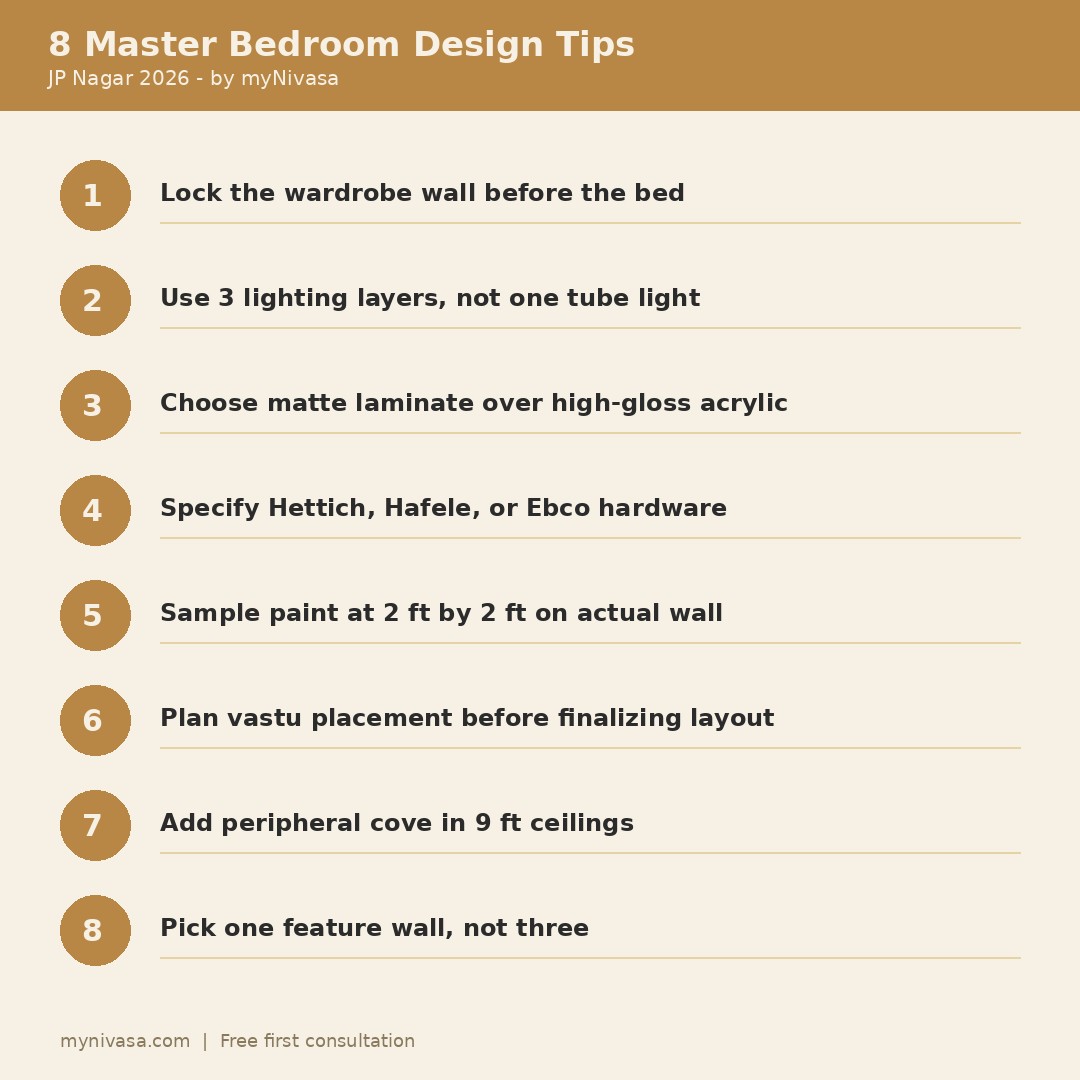
Mistake four is over-decorating the headboard wall. A fluted panel plus a statement painting plus a row of pendant lights plus a textured wallpaper border is too many ideas on one wall. Pick one feature and let it lead. Mistake five is forgetting the master bedroom toilet door swing direction; a wrong swing eats into the room and is expensive to correct after the door frame is set. Mistake six is treating the ceiling fan as a generic accessory; the fan diameter, blade colour, and mount height all matter once the false ceiling is installed.
The good news is that all six mistakes are avoided by a single discipline: lock decisions in the right order, on paper, before any carpenter starts work. The first design meeting should produce a written layout. The second meeting should produce written wardrobe internal bays and a lighting layer plan. The third meeting should produce written paint, fabric, and decor selections. After the third meeting, execution begins, and changes after this point should be the rare exception, not the routine.

Final Word
A master bedroom design works for a JP Nagar family when the layout fits the actual room shape, the wardrobe holds up to 10 years of daily use, the colors stay calm and timeless, and the lighting layers carry the room from bright mornings into quiet evenings. The choices made in the first two design meetings, before any carpenter starts work, decide whether the final room feels effortless or feels like a series of small compromises.
If you are planning a master bedroom interior in JP Nagar in 2026 and want a clear scope, a written 10-year plan, and a single point of contact for execution, we would be glad to help. The first consultation is on us. We listen to what the family wants, look at the actual room, and produce a written scope and budget before any contract is signed.
Free first consultation. Transparent scope. Branded hardware as default.
Book a Free Consultation
Also read from myNivasa: Smart Kids Room Design Ideas for HSR Layout Apartments 2026