
Last Updated: October 2026 | Reading time: about 9 minutes
Short answer: Correction: a pooja corner in a 2BHK does not need its own room, and it does not have to sit in the northeast corner of the flat. It needs a wall that passes six checks: not shared with a bathroom, the person praying facing east or north, a unit 45 to 60 cm wide and 25 to 35 cm deep, 300 mm clear around the diya, a 900 mm clear approach and closed storage below. In a Bengaluru 2BHK in 2026 we price a wall mounted, corner or niche unit at Rs 18,000 to Rs 90,000. Send us your floor plan and we will mark the wall.
What this guide covers
Where Can a Pooja Corner Go in a 2BHK With No Pooja Room?
Most Bengaluru 2BHK flats have no spare room for worship, so the pooja corner ends up on whichever wall is free. That is where it goes wrong. The free wall is often the one that backs onto a bathroom, carries the TV or sits beside the stove. Spacewood lists four workable spots in a small flat: a living room wall kept away from the TV, a foyer niche, an unused wall in the kitchen and dining area away from the sink and stove, and a bedroom corner only when a shutter screens it.
My first step is simple. I take the floor plan, mark a 60 cm square on each candidate wall and run the six checks in the next section. In a Marathahalli 2BHK we built a wall mounted acrylic mandir with a fluted back panel and warm LED backlighting for about Rs 32,000, and the money went into the panel and the light, not into extra carpentry.
Here is the floor arithmetic, which most guides skip. A floor standing unit 60 cm wide and 35 cm deep covers 0.21 sq m, about 2.3 sq ft. The 900 mm approach in front of it, at 600 mm wide, is another 0.54 sq m, about 5.8 sq ft that must stay clear. So a pooja corner claims roughly 8 sq ft of a 2BHK, and only the 2.3 sq ft is lost for good, because the approach doubles as a walkway. A wall mounted unit uses no floor at all but still needs the same clear approach.
My observation: families spend weeks choosing the mandir design and minutes choosing the wall. The wall decides whether the corner is used every morning.
- Pooja corner
- A pooja unit built into a wall, corner or niche of a flat that has no separate pooja room. It is typically 45 to 60 cm wide and 25 to 35 cm deep (Spacewood) and costs Rs 18,000 to Rs 90,000 in our 2026 Bengaluru bands.
- Size: 45 to 60 cm wide and 25 to 35 cm deep, per Spacewood, with idols no taller than 10 inches per the Casagrand Vastu guide.
- Floor use: a 60 by 35 cm floor standing unit is 2.3 sq ft, and the 900 by 600 mm approach is 5.8 sq ft that stays clear.
- Flame: keep at least 300 mm clear around the diya and 300 to 500 mm to decorative items (Homestyler).
- Direction: Vastu guides rank northeast first, then east, then north, and avoid a wall shared with a bathroom.
- Cost: Rs 18,000 to Rs 40,000 wall mounted, Rs 35,000 to Rs 70,000 corner, Rs 45,000 to Rs 90,000 niche, our 2026 bands.
- Timing: Deepavali is Sunday 8 November 2026, 24 days after 15 October, and our built-in pooja corner timeline is 3 to 5 weeks.
Free 15-Minute Design Consultation
Talk to our team about layout, style, and lifestyle fit.
WhatsApp UsCall +91 94499 00222Which Wall Passes the 6 Point Pooja Corner Checklist?
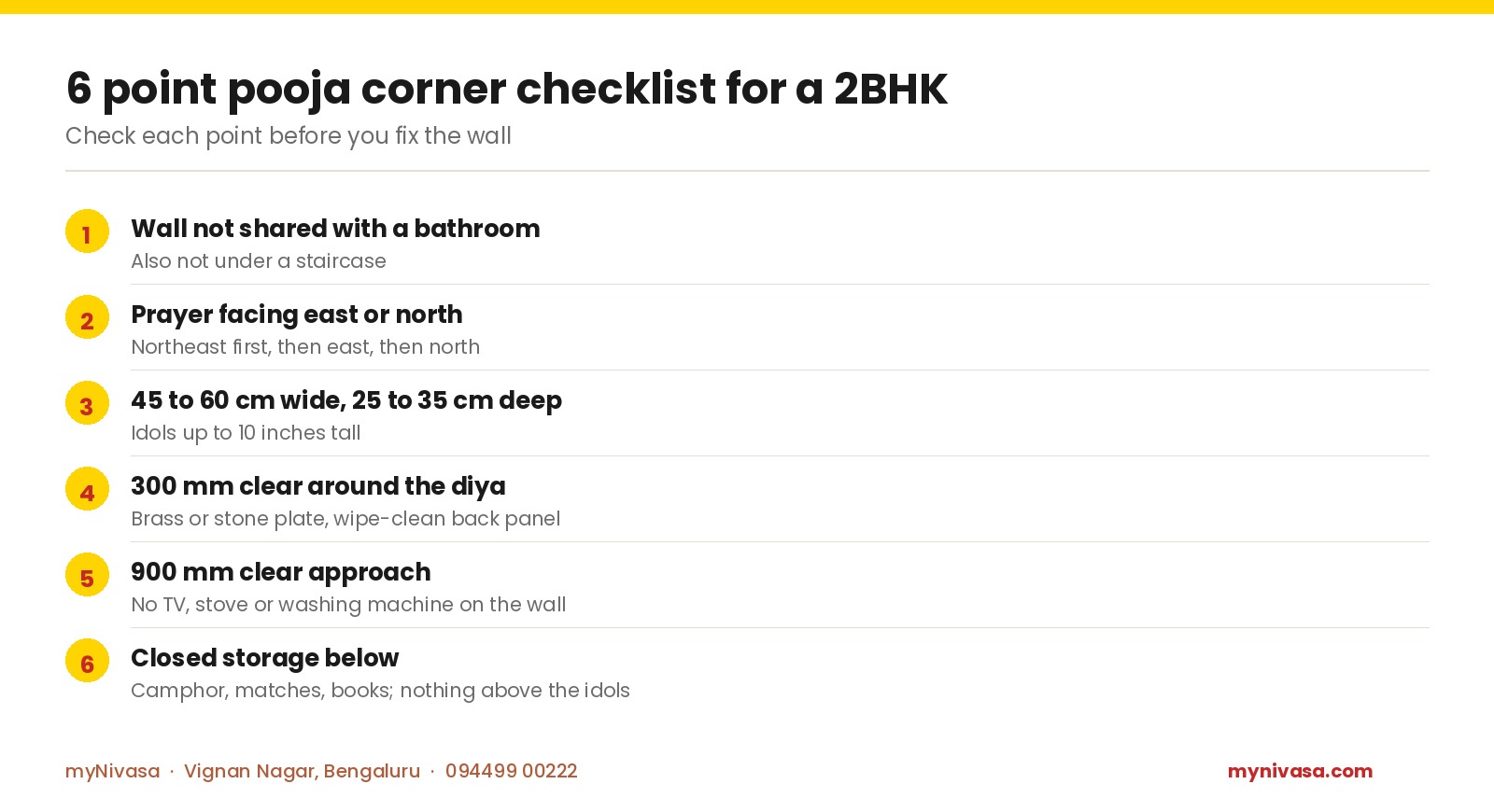
| # | Check | What to look for |
|---|---|---|
| 1 | Wall not shared with a bathroom | Also not under a staircase |
| 2 | Prayer facing east or north | Northeast first, then east, then north |
| 3 | 45 to 60 cm wide, 25 to 35 cm deep | Idols up to 10 inches tall |
| 4 | 300 mm clear around the diya | Brass or stone plate, wipe-clean back panel |
| 5 | 900 mm clear approach | No TV, stove or washing machine on the wall |
| 6 | Closed storage below | Camphor, matches, books; nothing above the idols |
The first check is the easiest to fail. A wall shared with a bathroom or toilet, or a space under a staircase, is on every Vastu avoid list I read, including Casagrand, and it is also a practical problem because a bathroom wall can carry damp and plumbing. The second check is the direction the person faces while praying. The sources I checked agree on east, with north as the fallback, but they differ on which way the idol faces and one contradicts itself, so I design for the person praying and suggest you confirm the idol direction with your family priest.
Checks 3 to 5 are measurements. The 45 to 60 cm by 25 to 35 cm footprint comes from Spacewood, the 300 mm flame clearance and the 900 mm approach from Homestyler. Check 6 is storage: camphor, agarbatti, matches and prayer books go in a closed drawer below, and nothing is stored above the idols.
Free Vastu Review of Your Home
Share your floor plan; we return Vastu-aligned corrections and layout tweaks.
WhatsApp UsCall +91 94499 00222Wall Mounted, Corner or Niche: Which Form Fits Which Wall?
Once the wall passes, the form follows from the wall. A plain wall with nothing behind it suits a wall mounted unit. A dead corner of the living room suits a corner unit. A niche only works where the wall has no pipes or conduit running through it, so I trace the electrical and plumbing lines before I promise one.
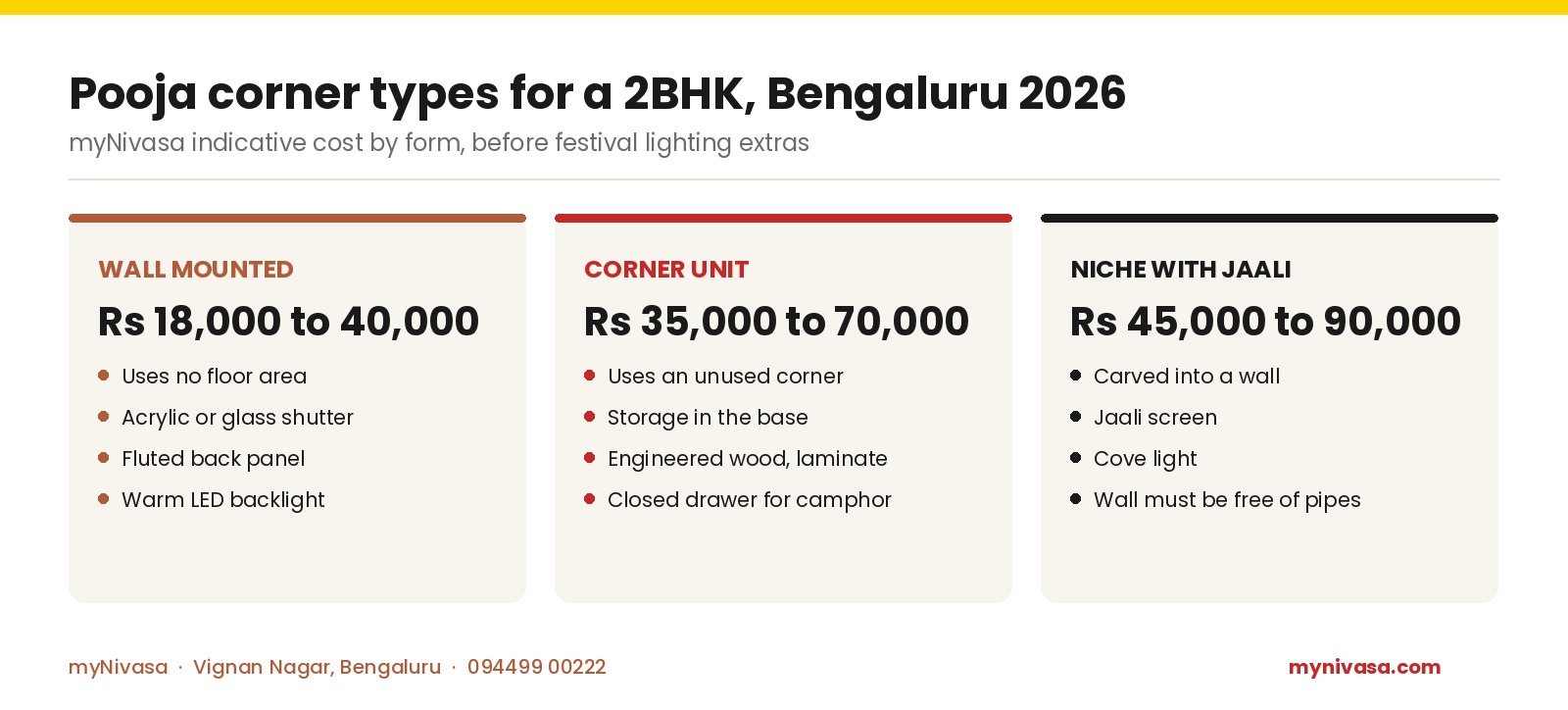
| Tier | Cost | What is included |
|---|---|---|
| Wall mounted | Rs 18,000 to 40,000 | Uses no floor area; Acrylic or glass shutter; Fluted back panel; Warm LED backlight |
| Corner unit | Rs 35,000 to 70,000 | Uses an unused corner; Storage in the base; Engineered wood, laminate; Closed drawer for camphor |
| Niche with jaali | Rs 45,000 to 90,000 | Carved into a wall; Jaali screen; Cove light; Wall must be free of pipes |
These are the same bands as in our pooja room design and cost guide, which also covers materials and a full separate room. What this guide adds is the choice of wall. If the wall you like is on the TV side of the living room, move the corner to the opposite wall before you compare quotes.
How Much Wall Does a Mandir Need, and How Far Should the Flame Be?
Plan the flame first and the carpentry second. Homestyler recommends at least 300 mm of space around the diya, which is about 12 inches, and 300 to 500 mm between the flame and decorative items. Spacewood adds a heat gap from any wooden shutter, a brass or stone plate under the lamp and a wipe-clean back panel, because oil and soot stain porous surfaces. In my own practice the diya stays on an open ledge and the shutter closes only after the flame is out.
Light the shelf, not the room. In a Whitefield apartment we hid one warm strip behind a fluted panel and added a single small spot, and the lighting cost under Rs 6,000. We use 2700K to 3000K warm white, which keeps the panel looking like brass and wood rather than an office shelf. Ask for a dedicated switch for the strip, and see our 2BHK rewiring cost guide for how electrical points are quoted.
Use a dedicated incense holder with an ash catcher, and snuff the flame with a cap rather than blowing on it, which can scatter embers (Homestyler).
Get a Free Layout Sketch
Send your floor plan; we return a custom layout in 3 working days.
WhatsApp UsCall +91 94499 00222What If the Northeast Corner Is a Bathroom Wall or the Kitchen?
In a flat the builder has already fixed the northeast corner, so it can land on a bedroom, a bathroom wall or the kitchen. Casagrand ranks the directions northeast first, east second and north third, and says to avoid south and southwest. It also says that without a separate room a northeast corner cabinet in the living room is the answer. When the northeast corner fails the wall checks, I move to the east wall of the living room before I accept a bathroom wall in the northeast.
That is a design trade-off, not a ruling. If your family follows a specific tradition, a Vastu consultant should confirm the final position. Our job is to make sure whichever wall you choose also passes the practical checks for heat, size and storage. A pooja corner in the foyer is a good example: Casagrand cautions against idols facing the entrance door directly, so a foyer niche works only on a side wall.
Can a Pooja Corner Be Ready Before Deepavali on 8 November?
Deepavali falls on Sunday 8 November 2026, which is 24 days after 15 October. Our published timeline for a built-in pooja corner is 3 to 5 weeks. The table puts the two together.
| Order confirmed | Build time | Ready on | Against Deepavali |
|---|---|---|---|
| Sunday 18 October | 3 weeks (fast end) | Sunday 8 November | On the day |
| Thursday 15 October | 3 weeks (fast end) | Thursday 5 November | 3 days before |
| Tuesday 20 October | 3 weeks (fast end) | Tuesday 10 November | 2 days after |
| Thursday 15 October | 5 weeks (slow end) | Thursday 19 November | 11 days after |
The honest reading is that a built-in unit confirmed by about 17 or 18 October can just make 8 November at the fast end, and anything later will miss it. If your date is tight, I would keep the existing prayer space for this year with a heat-safe plate and a clear approach, and build the proper corner after the festival rather than rush the carpentry.
See Real Bengaluru Projects Near You
Visit our finished projects, feel the space, verify the finish.
WhatsApp UsCall +91 94499 00222Frequently Asked Questions About a Pooja Corner in a 2BHK
Can I put a pooja corner in the bedroom of a 2BHK?
The guides I checked advise against it. Casagrand lists bedrooms among the places to avoid, and Spacewood allows a bedroom corner only when a shutter screens it. A living room or foyer wall is the better answer.
How wide should a wall mounted pooja unit be?
Spacewood puts a small wall mounted or corner mandir at about 45 to 60 cm wide and 25 to 35 cm deep. That is roughly 18 to 24 inches wide, so a 60 cm unit fits on almost any plain wall in a 2BHK.
How far should a diya be from the wooden shutter?
Homestyler advises at least 300 mm of space around the diya and 300 to 500 mm between the flame and decorative items. Spacewood adds a heat gap from any wooden shutter and a brass or stone plate under the lamp.
Can the pooja corner share a wall with the TV or the kitchen?
Avoid it. Spacewood says to keep the unit away from the TV and from the sink and stove, and Casagrand lists the TV, washing machine and kitchen stove as things to stay clear of. A plain living room wall, a foyer niche that does not face the main door, or an unused kitchen-dining wall away from the stove works better.
How much does a pooja corner cost in a Bengaluru 2BHK in 2026?
Our 2026 bands are Rs 18,000 to Rs 40,000 for a wall mounted unit, Rs 35,000 to Rs 70,000 for a corner unit and Rs 45,000 to Rs 90,000 for a niche with jaali and cove light. A wall mounted acrylic mandir with a fluted back panel and warm LED backlight in a Marathahalli 2BHK cost about Rs 32,000.
Visit Our Vignan Nagar Studio
See real samples, material palettes, and finished-project photos at our office.
WhatsApp UsCall +91 94499 00222Limitations: the 45 to 60 cm by 25 to 35 cm size comes from a manufacturer blog (Spacewood), the 300 mm clearance from a design site (Homestyler) and the Vastu rules from a developer blog (Casagrand), none of which is a building code. The Rs 32,000 Marathahalli figure and the Rs 6,000 Whitefield lighting figure are single published myNivasa projects, not quotes for your flat. The 3 to 5 week timeline is our published range and depends on your design and material. Vastu guidance varies between sources, so confirm your own tradition.
Sources
These sources informed the guide: Spacewood on small mandir design for flats, Casagrand on Vastu tips for pooja placement in Bangalore flats and Homestyler on diya placement in a pooja room. The first two are builder and manufacturer content, so treat their products and claims accordingly. Our own figures come from published myNivasa guides.
Final Word
Choose the wall before the mandir, and run it through the six checks. For related reading, see our pooja room design and cost guide, our L-shaped sofa size guide for planning the living room around it and our wall panelling cost guide for the back panel. To see samples and finished work, visit us at 2nd Floor, Sapthagiri Complex, 265/1, Kaggadasapura Main Rd, Vignan Nagar, Bengaluru, Karnataka 560075, call +91 94499 00222, or write to [email protected].