
Last Updated: September 2026 | Reading time: about 10 minutes
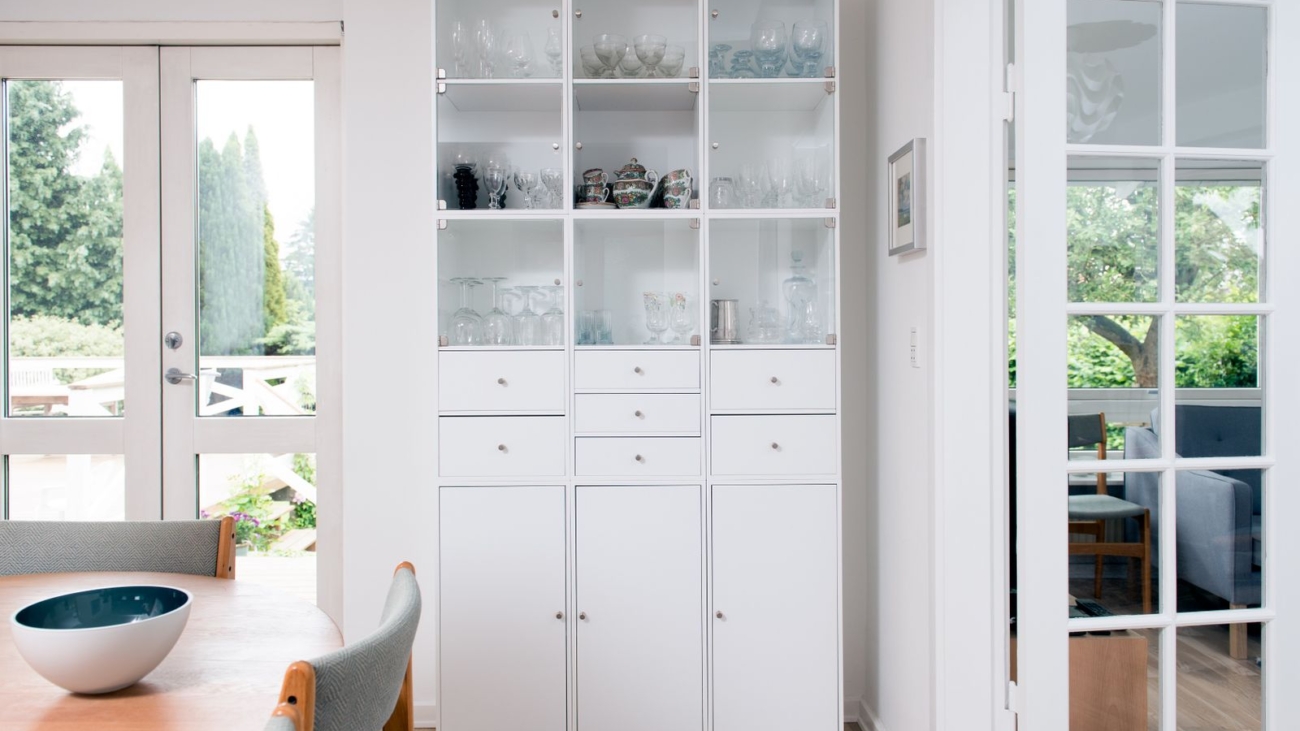
Set the crockery unit beside the other built-ins in a Bengaluru flat and it is the smallest line of the lot. On our published split for a mid-range 2BHK in Whitefield, the kitchen takes 28 percent of a Rs 7.4 lakh budget, wardrobes 22 percent, the TV unit 6 percent, and dining unit plus crockery 5 percent, or Rs 37,000. As a standalone piece it costs Rs 22,400 to Rs 70,000 for the standard 4 ft by 7 ft unit, 28 square feet of face, from Rs 800 per square foot in particle board with laminate to Rs 2,500 in premium plywood with PU. Send us your dining wall dimensions and we will price it line by line.
On this page
- What a crockery unit costs in Bengaluru in 2026
- Why the glass and the lighting decide the bill
- Floor-standing, wall-hung or a dining-side half wall
- Depth, span and plate weight
- Which plywood grade a dining room needs
- Built-in or a loose cabinet
- Frequently asked questions
- Limitations, sources and final word
What a Crockery Unit Costs in Bengaluru in 2026
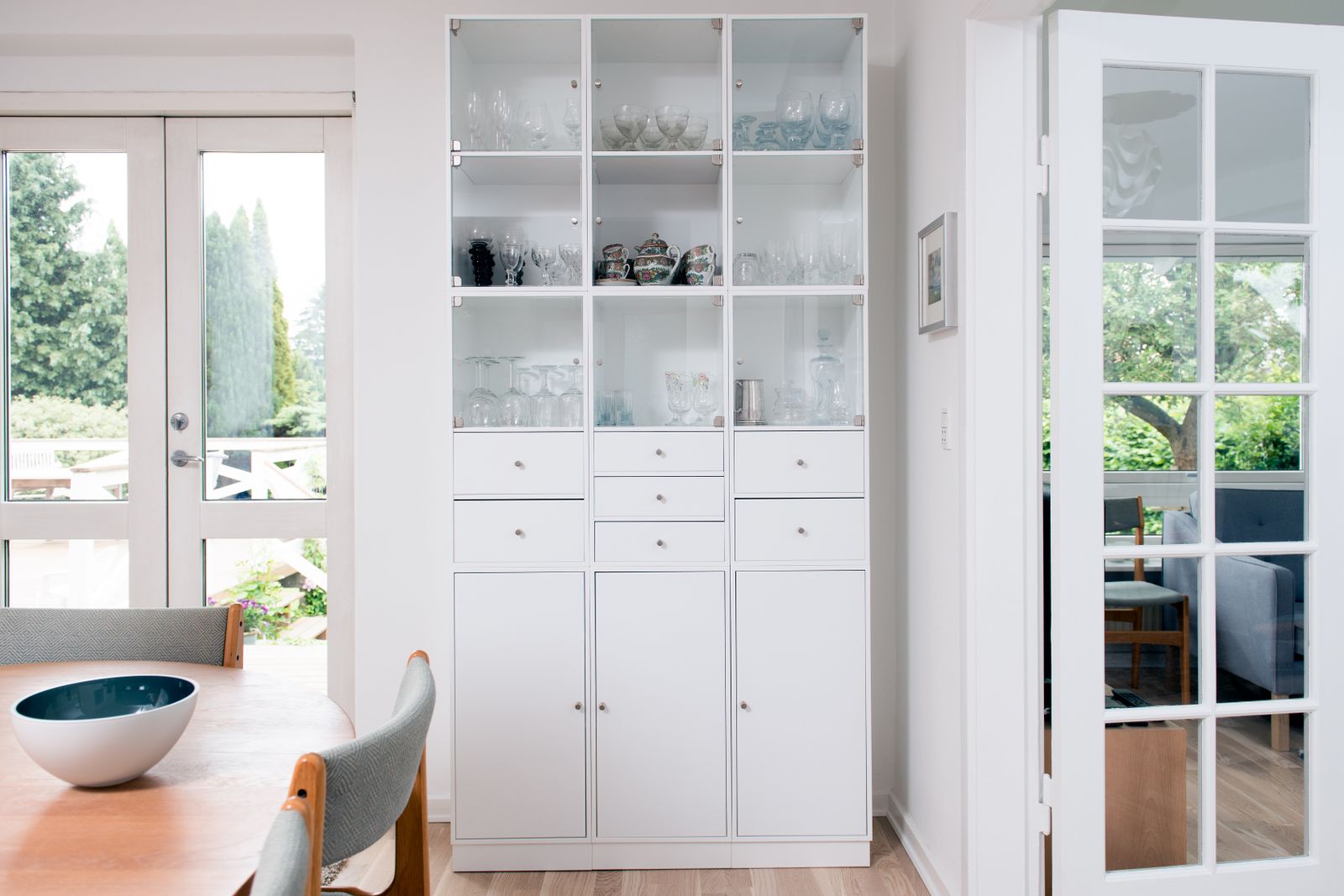
A crockery unit is priced by the square foot of face, not the running foot, because height varies so much. Multiply width by height in feet, then by your build rate. The reference unit is 4 ft by 7 ft, 28 square feet. At the four bands Bengaluru vendors list, that is Rs 22,400 to Rs 28,000 in particle board with laminate, Rs 30,800 to Rs 36,400 in commercial plywood, Rs 39,200 to Rs 47,600 in BWP plywood with acrylic, and Rs 50,400 to Rs 70,000 in premium plywood or MDF with PU.
Those are market rates. They do not show where this line sits in a real project. On our published allocation for a mid-range 2BHK in Whitefield, on a Rs 7.4 lakh budget, dining unit and crockery came to 5 percent, or Rs 37,000, on a Greenply BWR carcass. The same sheet gives the TV unit 6 percent at Rs 44,400 and the kitchen 28 percent at Rs 2,07,200. It is the smallest built-in line in the house, and it still earns its place: a built-in four seater with crockery saves 8 percent against a loose dining set plus a cabinet.
Home size moves it. In our Koramangala 3BHK guide, dining area crockery plus sideboard runs Rs 50,000 budget, Rs 1,00,000 mid-range, Rs 2,10,000 premium. In Marathahalli we publish TV unit and crockery as a combined head worth 8 to 10 percent, Rs 35,000 to Rs 1,90,000. Wall length moves this line more than anything.
Families over-specify this line and under-use it. They price it against the wardrobe next door and pay acrylic rates for a cabinet holding a dinner set they open four times a year.
- Crockery unit
- A built-in dining-room cabinet, glazed above and closed below, for displaying and storing tableware. In Bengaluru in 2026 it costs Rs 800 to Rs 2,500 per square foot of face installed, putting a 4 ft by 7 ft unit at Rs 22,400 to Rs 70,000.
- The reference unit is 4 ft by 7 ft, 28 square feet, at Rs 22,400 to Rs 70,000 installed in Bengaluru in 2026.
- Commercial plywood to BWP plywood with acrylic adds Rs 300 to Rs 400 per square foot, Rs 8,400 to Rs 11,200 on that unit.
- On our Whitefield 2BHK split, dining unit plus crockery is 5 percent of budget, Rs 37,000, against 28 percent for the kitchen.
- Roughly 43 percent of the unit is glazed and 57 percent closed, so one flat rate overcharges you.
- A 4 foot single-bay shelf spans 1,200 mm unsupported, which is where crockery shelves bow.
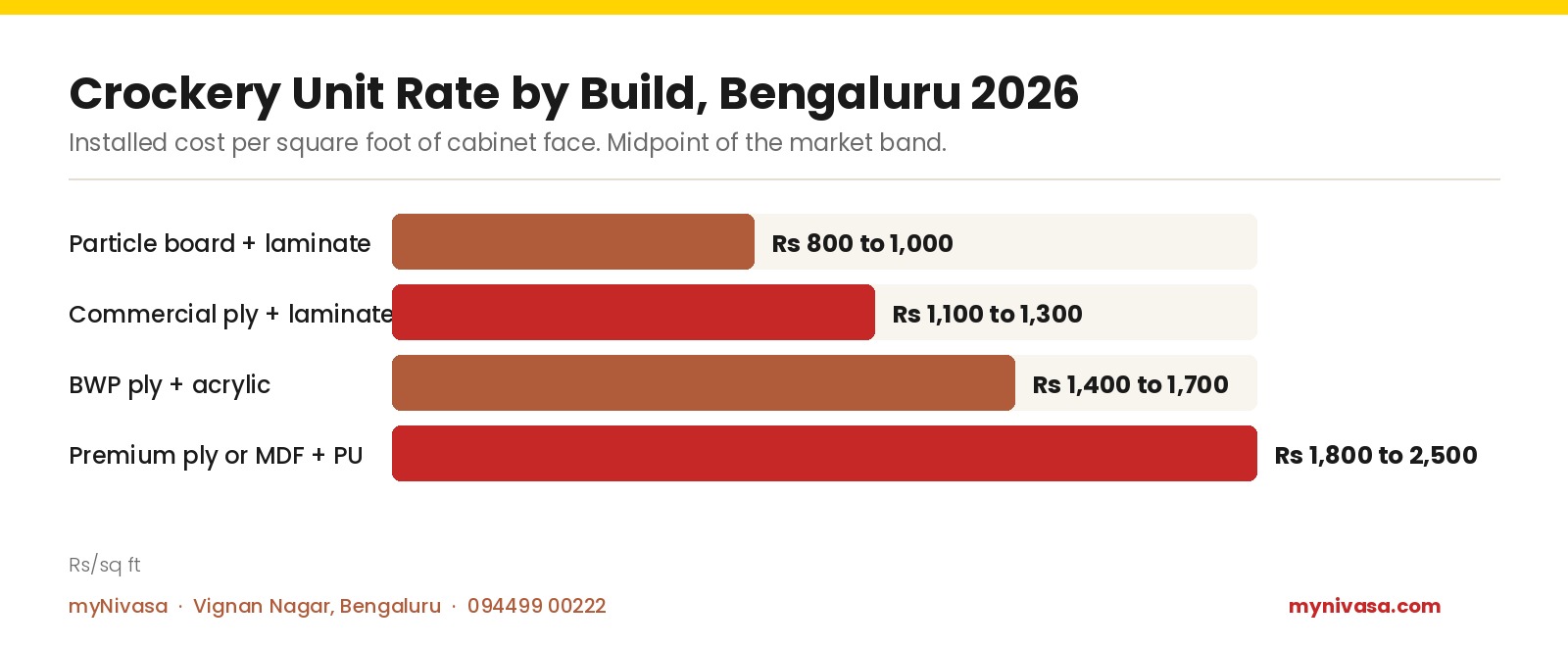
| Carcass and finish | Installed rate per sq ft |
|---|---|
| Particle board + laminate | Rs 800 to 1,000 |
| Commercial ply + laminate | Rs 1,100 to 1,300 |
| BWP ply + acrylic | Rs 1,400 to 1,700 |
| Premium ply or MDF + PU | Rs 1,800 to 2,500 |
Free Configuration Layout
Glass above or full height, wall-hung or floor-standing, tailored to your dining wall.
Why the Glass and the Lighting Decide the Bill
A crockery unit is not one material across its face, and that is where money leaks. On the 4 ft by 7 ft unit we build most often, the glazed section is the top 3 feet, 12 square feet, and the closed base the bottom 4 feet, 16 square feet. That is 43 percent glass, 57 percent solid. Applying the BWP-plus-acrylic rate of Rs 1,400 to Rs 1,700 across all 28 square feet charges a premium shutter finish over 12 square feet that has no shutter finish, only glass in a frame.
Ask for three lines: carcass and closed shutters by area, glazed shutters by area, lighting separately. Toughened glass is the Bengaluru norm at 5 mm and it is what you want, because it breaks into blunt granules rather than shards, which matters at chest height in a home with children. Framing it in an aluminium profile rather than a groove costs more, and it is what makes the unit read as designed.
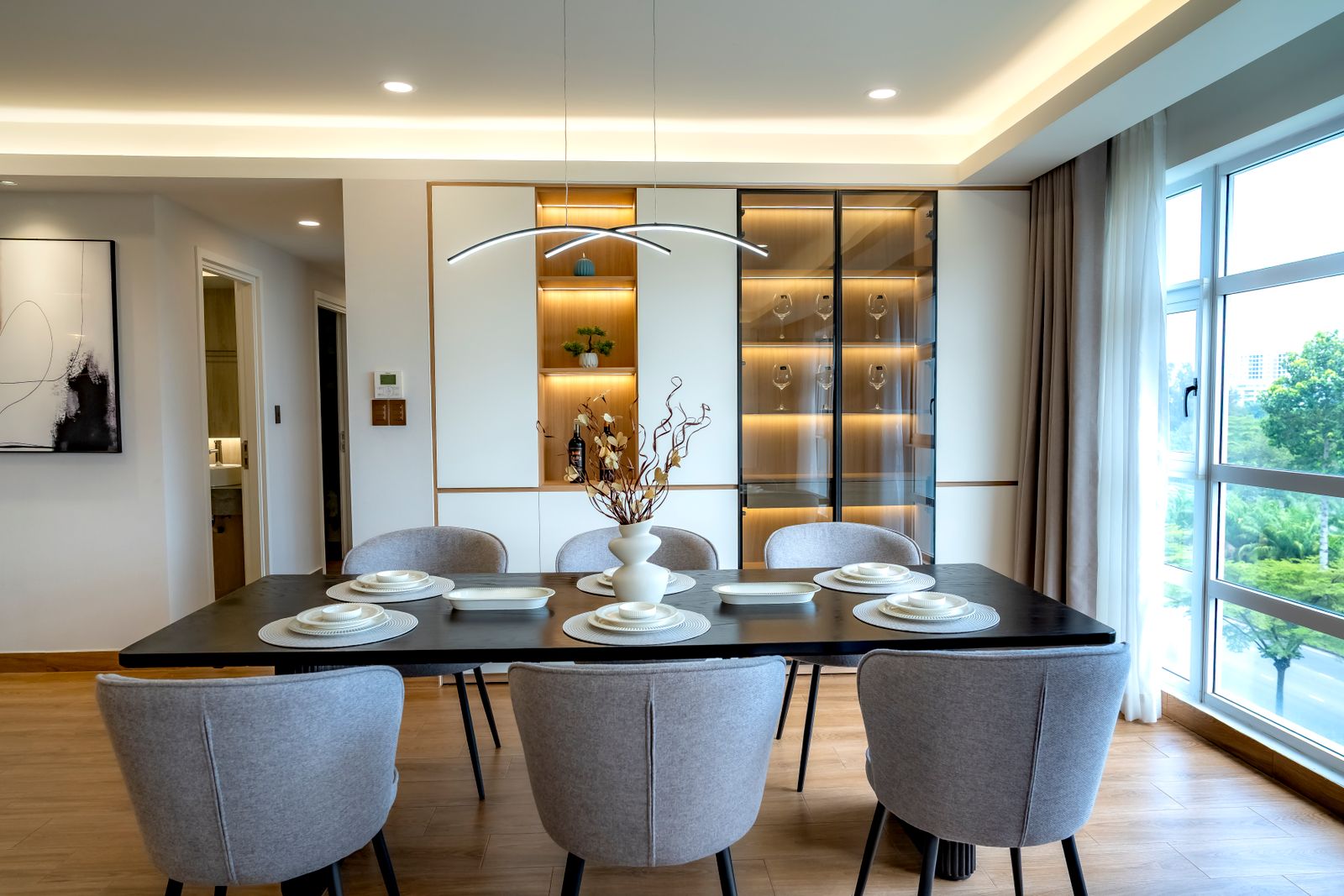
Lighting is worth arguing for. A strip of warm white profile light behind the glass shelves is what people notice, and it is priced per running foot by your electrician, so it never appears on the carpentry sheet unless you ask. If budget is tight, hold the carcass at commercial plywood and move the difference into glass and light. The carcass sits behind a closed door for fifteen years. The glass is at eye level at every meal.
Floor-Standing, Wall-Hung or a Dining-Side Half Wall
Three formats cover almost every Bengaluru dining zone, and floor area decides which. Full-height floor-standing is the default wherever you have a clear wall of 4 feet or more. The carcass runs to the ceiling, removing the dust ledge every loose cabinet leaves and gaining a closed loft for serving dishes used twice a year.
Wall-hung suits a dining zone under about 100 square feet, for one reason: the floor stays visible underneath, so a tight room reads larger and the mop passes through. The trade-off is load. The unit hangs off the wall rather than standing on it, so the fixing must reach solid masonry or an anchored batten. In a Bengaluru apartment with hollow block partition walls, a wall-hung unit carrying a full dinner set is a real risk.
A dining-side half wall is the option people forget. Where the dining zone opens to the living room and you want separation anyway, the storage sits inside the partition facing the dining side, with a console top on the living side. One piece of joinery, two jobs.
Free Material Sample Kit
Plywood, laminate, acrylic and glass samples, couriered to your door at no cost.
Depth, Span and Plate Weight
Two numbers decide whether the unit still looks right in year three, and both are settled before the carpenter cuts a sheet.
Depth. Market depth runs 300 mm to 450 mm. An Indian dinner plate is 255 mm to 280 mm across, so a 300 mm shelf holds a plate stack with nothing behind it and a 450 mm shelf holds two rows. Every millimetre comes out of the dining walkway. Measure the gap between your chair pulled back and the wall first.
Span. This is what actually breaks. A 4 foot unit built as a single bay gives a 1,200 mm unsupported shelf. Crockery is denser per square foot than anything you will put in a wardrobe, and an 18 mm shelf at that span takes a visible bow within about two years. Split it into two bays, specify 25 mm shelves, or add metal supports.
Which Plywood Grade a Dining Room Actually Needs
A dining room is a dry interior, so IS 303 covers you and marine plywood is unnecessary. IS 303 is the Bureau of Indian Standards specification covering MR grade, urea-formaldehyde bonded for dry interiors, and BWR grade with its fortified glue line. IS 710 is the separate marine standard, bonded with 100 percent phenol formaldehyde and tested through 72 hours of boiling water. Our Whitefield reference used a Greenply BWR carcass. Pay for IS 710 at the kitchen sink base and in the bathroom. Beside a dining table it buys nothing.
| Dimension | India market range | myNivasa default |
|---|---|---|
| Height | 5 ft to 6.5 ft standard, 7 ft to 8 ft full height | 7 ft, closed loft above |
| Width | 2 ft to 4 ft, two shutters; up to 6 ft with three | 4 ft, two bays |
| Depth | 300 mm to 450 mm | 350 mm |
| Glass | 5 mm clear, tinted or fluted | 5 mm toughened, aluminium profile |
Free Cost Estimate in 48 Hours
Share your dining wall width and ceiling height for a costed reply in two days.
Built-in or a Loose Cabinet
Retail crockery cabinets in India sell for roughly Rs 24,900 to Rs 59,990, overlapping almost exactly with the built-in band for the same face area. On price alone there is no winner, and any page telling you built-in is cheaper is not comparing like with like. The difference is wall height, grade, depth and the gap.
A loose cabinet stops around 6 feet and leaves a dust ledge on top and a gap behind. In Bengaluru, with construction dust off the next tower and traffic dust through open windows, that is a permanent chore. A built-in carcass scribes to the wall and runs to the ceiling, so there is nothing to clean and roughly a third more storage on the same footprint. A loose cabinet, though, moves with you. Our Whitefield position is that built-in wins on total spend once the dining table is counted with it, at 8 percent saved.
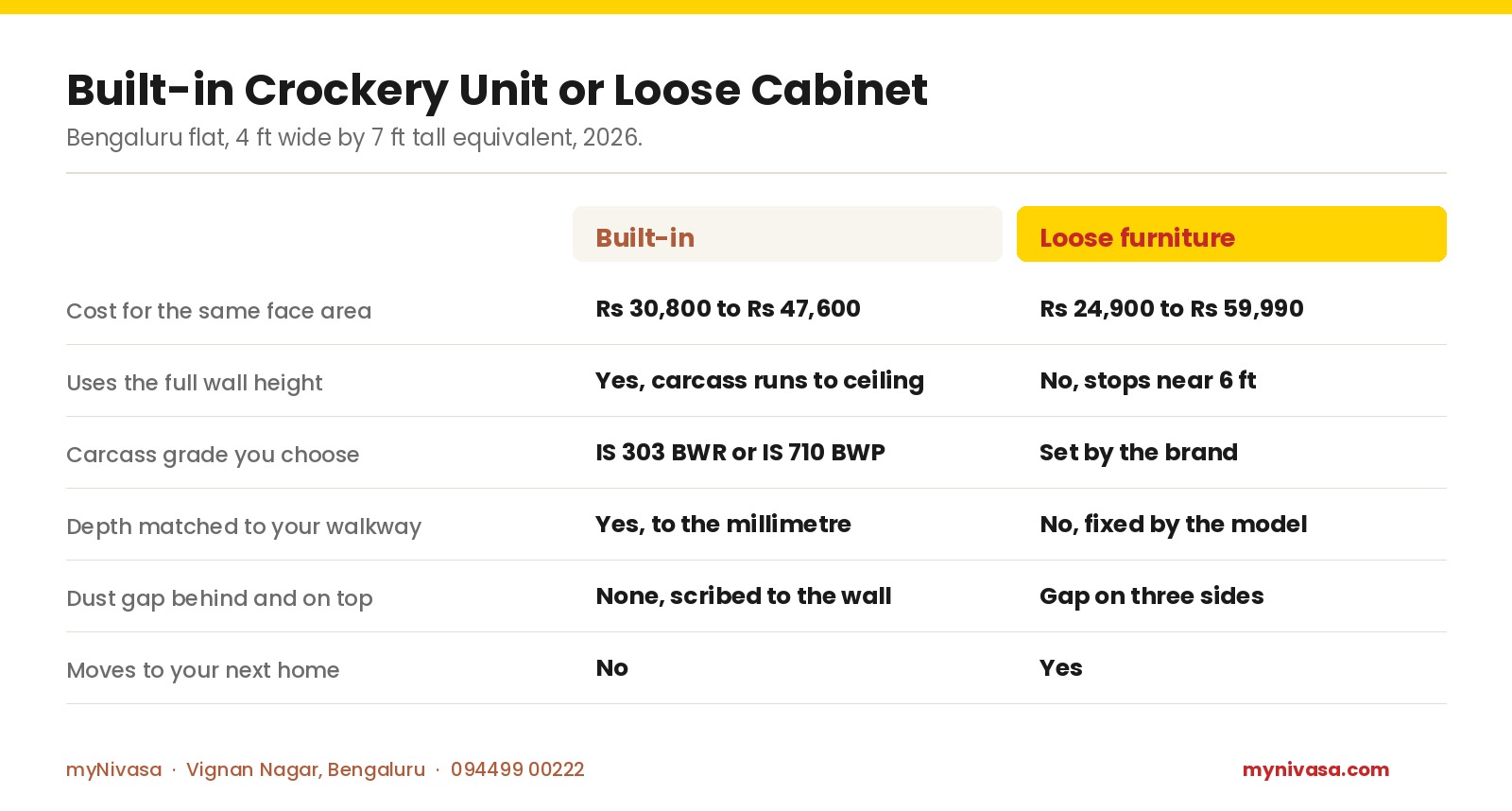
| Criterion | Built-in | Loose furniture |
|---|---|---|
| Cost for the same face area | Rs 30,800 to Rs 47,600 | Rs 24,900 to Rs 59,990 |
| Uses the full wall height | Yes, carcass runs to ceiling | No, stops near 6 ft |
| Carcass grade you choose | IS 303 BWR or IS 710 BWP | Set by the brand |
| Depth matched to your walkway | Yes, to the millimetre | No, fixed by the model |
| Dust gap behind and on top | None, scribed to the wall | Gap on three sides |
| Moves to your next home | No | Yes |
Get a Line-Item BOQ
Carcass, glazed shutters and lighting priced as three separate lines, not one.
Frequently Asked Questions
How much does a crockery unit cost in Bengaluru in 2026?
A standard 4 ft by 7 ft unit, 28 square feet of face, costs Rs 22,400 to Rs 70,000 installed in Bengaluru in 2026. Rates run Rs 800 to Rs 1,000 per square foot in particle board with laminate, Rs 1,100 to Rs 1,300 in commercial plywood, Rs 1,400 to Rs 1,700 in BWP plywood with acrylic, and Rs 1,800 to Rs 2,500 in premium plywood or MDF.
What percentage of an interior budget should a crockery unit take?
On myNivasa's published split for a mid-range 2BHK in Whitefield, dining unit and crockery take 5 percent of a Rs 7.4 lakh project, or Rs 37,000. In our Marathahalli guides TV unit and crockery are a combined head worth 8 to 10 percent. Above 10 percent, ask why.
What is the standard size of a crockery unit?
Common sizes in India are 5 ft to 6.5 ft tall standard and 7 ft to 8 ft full height, 2 ft to 4 ft wide with two shutters, and 300 mm to 450 mm deep. In a Bengaluru flat we default to 7 ft tall, 4 ft wide in two bays, 350 mm deep.
Do I need marine plywood for a crockery unit?
No. A dining room is a dry interior, so IS 303 plywood is sufficient, either MR or BWR. IS 710 marine plywood is bonded with 100 percent phenol formaldehyde and tested through 72 hours of boiling water, specification you need at the kitchen sink base and in a bathroom. Our Whitefield reference used Greenply BWR.
Why do crockery unit shelves sag?
Because crockery is dense and the span is long. A 4 foot unit built as one bay gives a 1,200 mm unsupported shelf, and an 18 mm board at that span bows visibly within about two years. Split it into two bays so no shelf spans over 600 mm, move to 25 mm shelves, or add metal supports.
Is a built-in crockery unit cheaper than a loose cabinet?
Not on cabinet price alone. Retail cabinets run roughly Rs 24,900 to Rs 59,990, overlapping the built-in band of Rs 30,800 to Rs 47,600 for the same face area. The built-in wins on storage per square foot, on dust, and on fixing depth to your walkway. On our Whitefield guidance it saves 8 percent overall.
Limitations, Sources and Final Word
Limitations: the per square foot bands are Bengaluru market listings collected in September 2026 and will move with plywood and laminate prices. Our percentage splits come from published myNivasa cost sheets for homes in Whitefield, Koramangala and Marathahalli, and your wall length changes the number. The 43 to 57 glazed split and the 350 mm depth are our standard specification, not a survey finding.
Sources: IS 303 and IS 710 plywood grades for the MR, BWR and BWP definitions and the 72 hour boiling water test; Saint-Gobain Glass India on toughened glass in crockery units; Interior Company and Design Cafe on dimensions and shutter widths. Rate bands and retail prices came from vendor listings on IndiaMART Bengaluru, Royaloak and Wooden Street in September 2026.
The crockery unit is the cheapest built-in in your home and the one looked at during every meal. Hold the carcass at a sensible grade, split the bays so shelves never bow, keep the depth off the walkway, and put what you save into toughened glass, a profile frame and a warm strip of light. For that priced line by line, we are at 2nd Floor, Sapthagiri Complex, 265/1, Kaggadasapura Main Rd, Vignan Nagar, Bengaluru 560075. Call +91 94499 00222 or [email protected].
Related guides: living and dining partition cost, the Whitefield 2BHK cost split behind the 5 percent figure, whether BWP marine plywood is worth it, and the Koramangala 3BHK guide.