
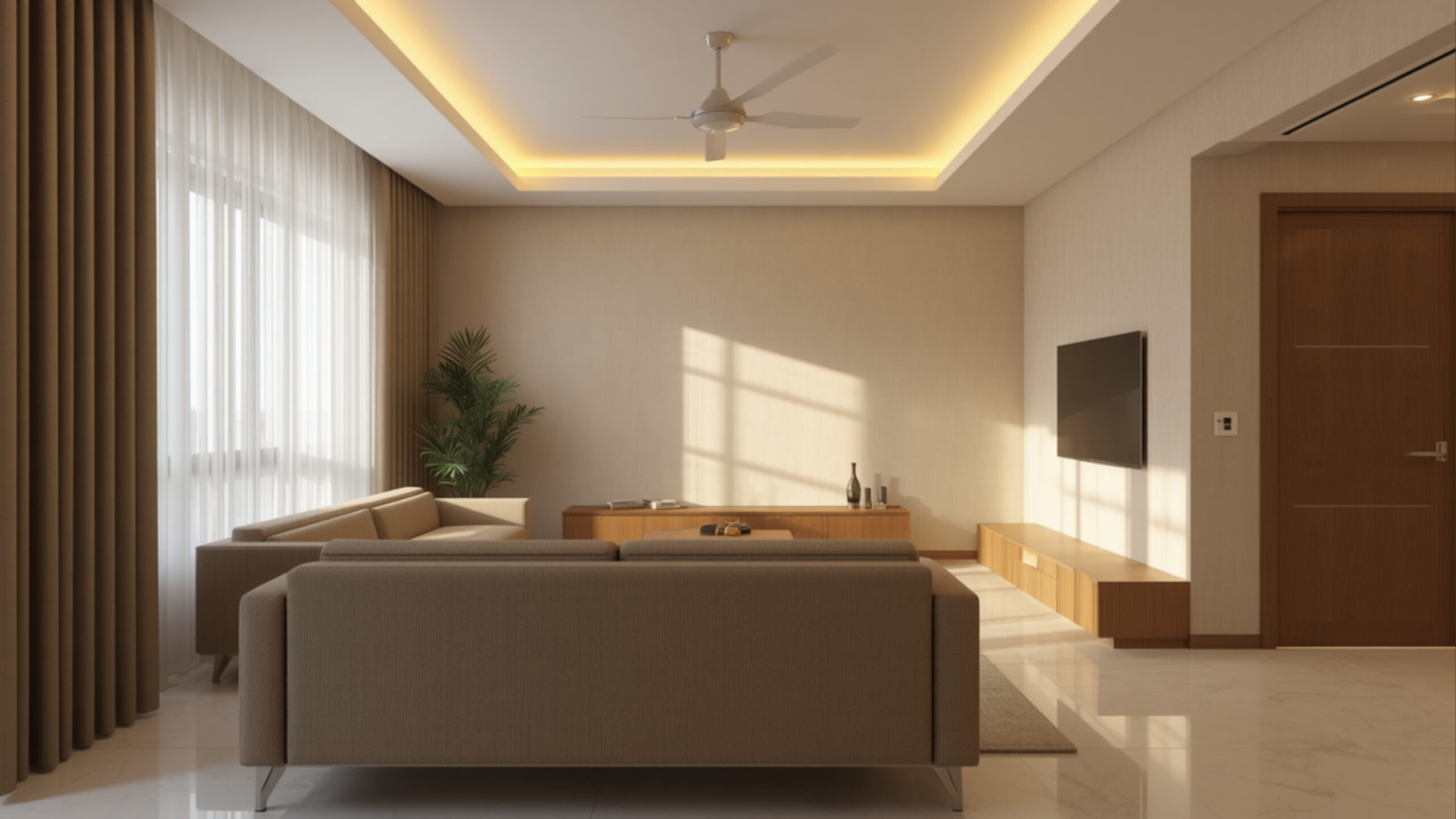
Last Updated: July 2026
Last Updated: July 2026
- What is 2 BHK interior design cost in Electronic City?
- The 2 BHK interior design cost in Electronic City for 2026 is the total budget to fit out a two-bedroom apartment with modular kitchen, wardrobes, false ceiling, painting, lighting, and finishes, and it usually ranges from Rs. 4.5 lakh to Rs. 11 lakh depending on the tier you choose. In design terms it covers how each room is laid out, which materials and hardware grades are used, and how storage, lighting, and aesthetics are planned to suit your family and your apartment size.
A 2 BHK interior design cost in Electronic City is about Rs. 4.5 lakh at the Essential tier, Rs. 7 lakh at the Comfort tier, and Rs. 10 lakh or more at the Signature tier for a typical 950 to 1,150 sq ft apartment. On the design side, the budget pays for a planned modular kitchen, two fitted wardrobes, false ceiling, painting, and lighting that are matched to your layout, your storage needs, and the finish quality you want to live with for the next ten years.
Quick Takeaways
- Typical 2 BHK interior design cost in Electronic City for 2026 is Rs. 4.5 lakh to Rs. 11 lakh across three tiers.
- Per sq ft rates run Rs. 1,200 to Rs. 1,800 Essential, Rs. 1,800 to Rs. 2,800 Comfort, and Rs. 2,800 to Rs. 4,500 plus Signature.
- The modular kitchen and two wardrobes usually take 45 to 55 percent of the full budget.
- Carcass material, shutter finish, and hardware brand (Hettich, Hafele, Blum) are the three biggest cost levers.
- False ceiling runs Rs. 75 to Rs. 125 per sq ft, and 18 percent GST applies on the full scope.
- Good design is about layout, storage planning, and lighting, not only about how much you spend.
- Electronic City apartments cost Rs. 65 lakh to Rs. 76 lakh, so a sensible interior budget is 10 to 15 percent of that.
How much does 2 BHK interior design cost in Electronic City?
For 2026, a 2 BHK interior in Electronic City costs between Rs. 4.5 lakh and Rs. 11 lakh, with most families spending around Rs. 7 lakh for a comfortable mid-range finish. That budget includes the modular kitchen, both bedroom wardrobes, false ceiling, painting, lighting, and basic loose furniture, all planned around your apartment layout and how your family uses each room.
2 BHK Interior Cost Tier Summary for Electronic City 2026
| Tier | Per sq ft | Typical 2 BHK total | What you get |
|---|---|---|---|
| Essential | Rs. 1,200 - Rs. 1,800 | Rs. 4.5 lakh - Rs. 6 lakh | Laminate finishes, MDF or HDHMR carcass, standard hardware, basic false ceiling in living and kitchen. |
| Comfort | Rs. 1,800 - Rs. 2,800 | Rs. 6.5 lakh - Rs. 8.5 lakh | BWP plywood carcass, acrylic or membrane shutters, branded Hettich or Hafele hardware, fuller false ceiling and lighting. |
| Signature | Rs. 2,800 - Rs. 4,500+ | Rs. 9.5 lakh - Rs. 12 lakh+ | Premium plywood, PU or lacquered glass shutters, full Blum fittings, designer lighting, custom wall and ceiling detailing. |
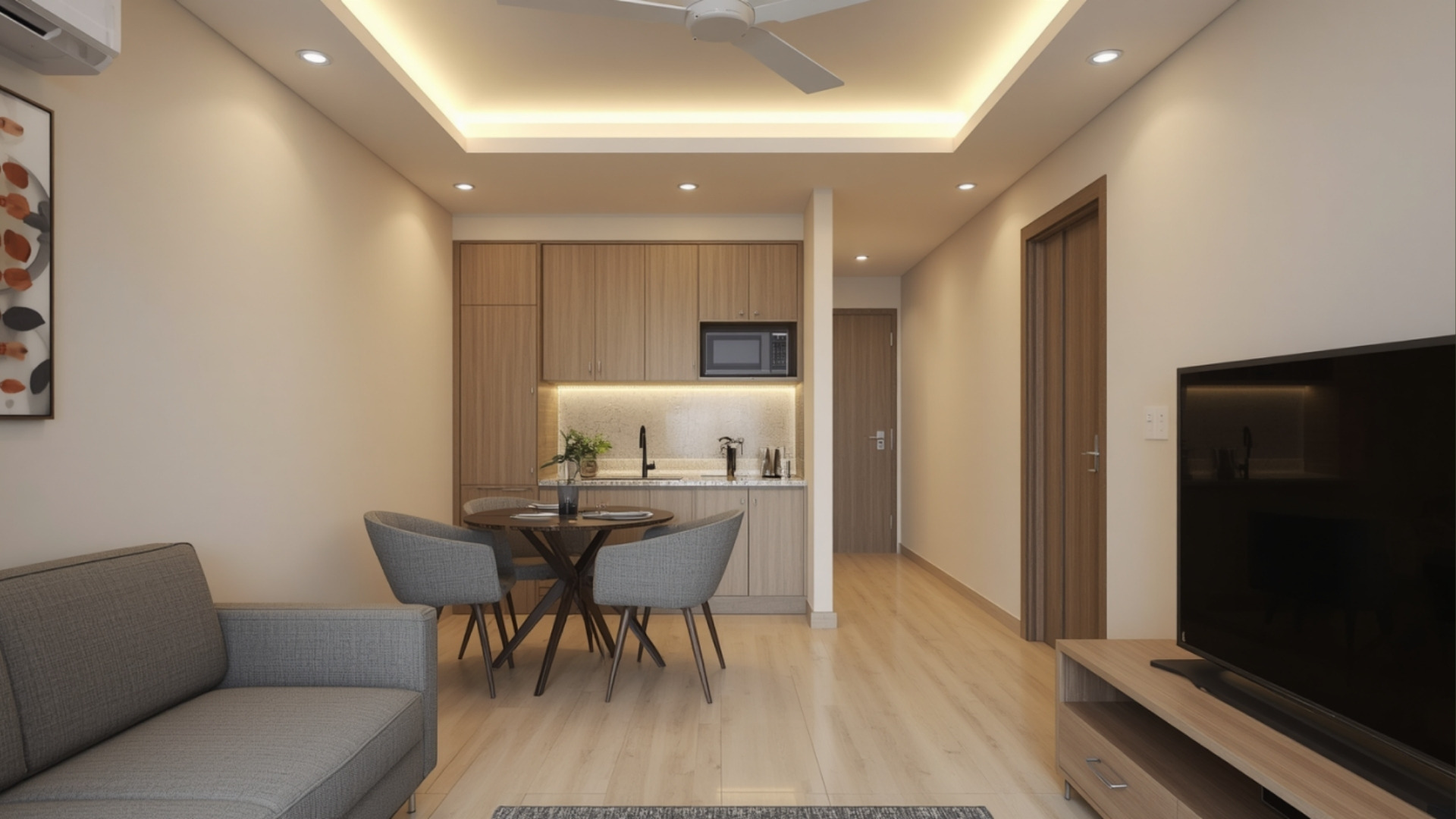
In my experience across Electronic City projects, the families who are happiest after two years are not the ones who spent the most. They are the ones who put their budget into the kitchen, the wardrobes, and good lighting first, and left the decorative extras for later. Spend where you touch the home every day. That is the myNivasa way of looking at a 2 BHK budget.
What does 2 BHK interior design include in Electronic City?
When a family in Electronic City asks me for a 2 BHK interior, they are usually picturing finished photos. What they are actually buying is a set of fixed and loose elements that together make an empty flat livable. Knowing what is inside the scope is the first step to understanding the cost, because every line you add or remove moves the final number.
The core scope of a 2 BHK interior covers the modular kitchen, wardrobes in both bedrooms, a TV unit in the living room, false ceiling, wall painting, electrical and lighting points, and the basic loose furniture like a dining set or a bed. These are the elements that turn a bare apartment into a home you can move into.
The modular kitchen is the heart of the scope. It includes base units, wall units, a tall unit if space allows, the countertop, the backsplash, and the internal accessories like cutlery trays and bottle pull-outs. The way these are configured decides both how the kitchen works and how much it costs.
Wardrobes are the second large block. A 2 BHK needs at least two wardrobes, one in the master bedroom and one in the second bedroom. The choice between hinged and sliding shutters, the internal layout, and the shutter finish all sit inside this part of the scope.
The living room usually carries the TV unit, a feature wall, and the main false ceiling with cove lighting. This is where most of the visible design statement lives, so families tend to invest a little extra here even on a tight budget.
False ceiling, painting, and lighting run across the whole home. These are the layers that tie the rooms together visually. A well-planned lighting layout makes even an Essential tier home feel finished, while poor lighting can make an expensive home feel flat.
What is usually not inside a standard 2 BHK interior quote is civil work like wall demolition, plumbing relocation, waterproofing, and major electrical rewiring. In most Electronic City apartments handed over by builders like Brigade, Puravankara, or Sobha, the base civil work is already done, so this keeps the interior scope cleaner. I always confirm this line by line so there are no surprises later.
What affects 2 BHK interior cost in Electronic City?
Two families in the same apartment block can get quotes that differ by three or four lakh, and both can be fair. The reason is that the cost of a 2 BHK interior is driven by a handful of decision factors, and each family weighs them differently. Understanding these factors helps you read any quote with confidence.
The first factor is apartment size. Electronic City 2 BHK units commonly range from 950 sq ft to 1,200 sq ft. More carpet area means more wardrobe running feet, more false ceiling area, and more painting, so the cost rises almost in step with the size. At a Comfort tier rate of about Rs. 2,200 per sq ft, a 100 sq ft difference is roughly Rs. 2.2 lakh.
The second factor is the carcass material. The box behind every cabinet can be MDF, HDHMR, or BWP plywood. Plywood costs more but handles Bengaluru humidity and water far better, which matters in the kitchen and in bathrooms. This single choice can shift the kitchen and wardrobe budget by 20 to 30 percent.
The third factor is the shutter finish. Laminate is the workhorse and the most affordable. Acrylic and membrane sit in the middle and give a richer look. PU paint and lacquered glass are premium and push the cost up sharply. The finish you pick for the kitchen and wardrobe fronts is one of the most visible and most expensive design decisions.
The fourth factor is hardware. Hinges, channels, and pull-out mechanisms from Hettich and Hafele are the dependable mid-range choice, while Blum sits at the premium end with the longest life. Hardware is invisible in photos but it is what you feel every single day, so I treat it as a core spend, not an extra.
The fifth factor is the amount of false ceiling, lighting, and decorative work. A simple peripheral cove in the living room costs far less than a full home false ceiling with profile lighting, panelling, and feature walls. This is the most flexible part of the budget and the easiest place to phase later.
The last factor is the locality premium itself. Electronic City labour and logistics are slightly easier than the central city, so rates here are usually a touch friendlier than Indiranagar or Koramangala. The difference is small, but on a full home it can mean a saving of Rs. 30,000 to Rs. 60,000.
Tier vs Tier: Essential, Comfort, and Signature for a 2 BHK
The clearest way to plan a 2 BHK budget is to pick a tier and then refine within it. I use three tiers at myNivasa, and almost every Electronic City family lands in one of them. The tier sets the material grade, the hardware brand, and the level of detailing, which together decide the final cost.
The Essential tier runs Rs. 1,200 to Rs. 1,800 per sq ft and a typical 2 BHK lands at Rs. 4.5 lakh to Rs. 6 lakh. Here the carcass is MDF or HDHMR, shutters are laminate, and hardware is standard branded. False ceiling is limited to the living room and kitchen. This tier is ideal for investors, first homes, and families who want a clean, functional finish without premium extras.
The Comfort tier runs Rs. 1,800 to Rs. 2,800 per sq ft and a 2 BHK lands at Rs. 6.5 lakh to Rs. 8.5 lakh. The carcass moves to BWP plywood, shutters are acrylic or membrane, and hardware is Hettich or Hafele. False ceiling and lighting cover more of the home, and the kitchen gets better accessories. This is where most Electronic City families settle, because it balances durability and looks.
The Signature tier runs Rs. 2,800 to Rs. 4,500 plus per sq ft and a 2 BHK starts around Rs. 9.5 lakh and rises past Rs. 12 lakh. Premium plywood, PU or lacquered glass shutters, full Blum fittings, quartz countertops, and designer lighting all come in. This tier suits families who want a long-term premium home and plan to stay for many years.
The jump from Essential to Comfort is mostly about durability and daily feel. The jump from Comfort to Signature is mostly about finish and aesthetics. Knowing which jump matters to you is the single most useful budgeting decision you can make, and it is the conversation I have with every family before a single drawing is made.
Material grade vs cost for a 2 BHK interior
Material grade is where design meets budget most directly. The same wardrobe in two different materials can differ by Rs. 40,000, yet look almost identical on day one. The difference shows up over years, in how the cabinet holds up to Bengaluru humidity and daily use. Here is how the main material decisions map to cost.
For the carcass, MDF is the lowest cost at roughly Rs. 90 to Rs. 130 per sq ft of board, HDHMR sits a little higher with better screw holding, and BWP plywood is the premium choice at Rs. 150 to Rs. 230 per sq ft of board. In a kitchen, I always recommend BWP plywood for the base units near water, even on a Comfort budget, because water damage is the number one reason kitchens fail early.
For shutters, laminate is Rs. 200 to Rs. 600 per sq ft installed depending on brand and thickness, acrylic and membrane run Rs. 600 to Rs. 1,100, and PU paint or lacquered glass can cross Rs. 1,200 to Rs. 1,800. Brands like Merino, Greenlam, and Century laminates cover the affordable and mid range well, which keeps the Essential and Comfort tiers sensible.
For countertops, granite is the value choice at Rs. 200 to Rs. 350 per sq ft, quartz is the durable mid to premium option at Rs. 450 to Rs. 900, and imported quartz or sintered stone sits above that. Quartz is stain resistant and low maintenance, which is why most Comfort and Signature kitchens use it.
For hardware, this is the grade decision I never let families skip. Mid range Hettich or Ebco hinges and channels last 8 to 12 years comfortably, while premium Blum soft close mechanisms last 15 years or more and feel smoother every day. The hardware in a single kitchen can range from Rs. 25,000 at the basic end to Rs. 1.2 lakh at the full Blum end.
The design lesson is simple. Put the better grade where water, weight, and daily motion are highest, which means the kitchen base units, the kitchen hardware, and the wardrobe channels. Save on the elements that only carry light loads or are rarely touched. This is how a Comfort tier home can feel almost like a Signature one for the parts you use most.
2 BHK interior cost breakdown by phase
To plan cash flow, it helps to see the budget split by work phase rather than by room. On a typical Comfort tier 2 BHK in Electronic City at about Rs. 7 lakh, here is how the money usually divides across the project.
The modular kitchen takes the largest single share, around Rs. 2 lakh to Rs. 2.8 lakh. This covers base and wall units, countertop, backsplash, chimney and hob provision, and internal accessories. At roughly 30 to 38 percent of the total, the kitchen is where careful material choices pay off most.
Wardrobes for both bedrooms come next at Rs. 1.5 lakh to Rs. 2.2 lakh combined. A master bedroom wardrobe of 7 to 8 ft and a second wardrobe of 5 to 6 ft is the common setup. Sliding shutters add about 10 to 15 percent over hinged for the same internal volume.
False ceiling and electrical work together run Rs. 90,000 to Rs. 1.4 lakh. False ceiling alone is Rs. 75 to Rs. 125 per sq ft of covered area, and the electrical and lighting points add to that. This phase sets the mood of the home through cove and profile lighting.
Painting across the home is Rs. 60,000 to Rs. 1 lakh depending on whether you use standard emulsion or premium and textured finishes. Emulsion adds about Rs. 8 to Rs. 15 per sq ft over the base putty coat, and texture or accent walls cost Rs. 20 to Rs. 40 per sq ft extra.
The TV unit, a study or crockery unit, and loose furniture provisions take the remaining Rs. 70,000 to Rs. 1.2 lakh. These are the items families most often phase out to a second stage if the budget is tight, which is a sensible way to manage cash flow without compromising the core home.
Across all phases, remember that 18 percent GST applies, and design and project management fees may be charged separately or built into the per sq ft rate. I always show families the pre-GST and post-GST number side by side so the budget they plan is the budget they pay.
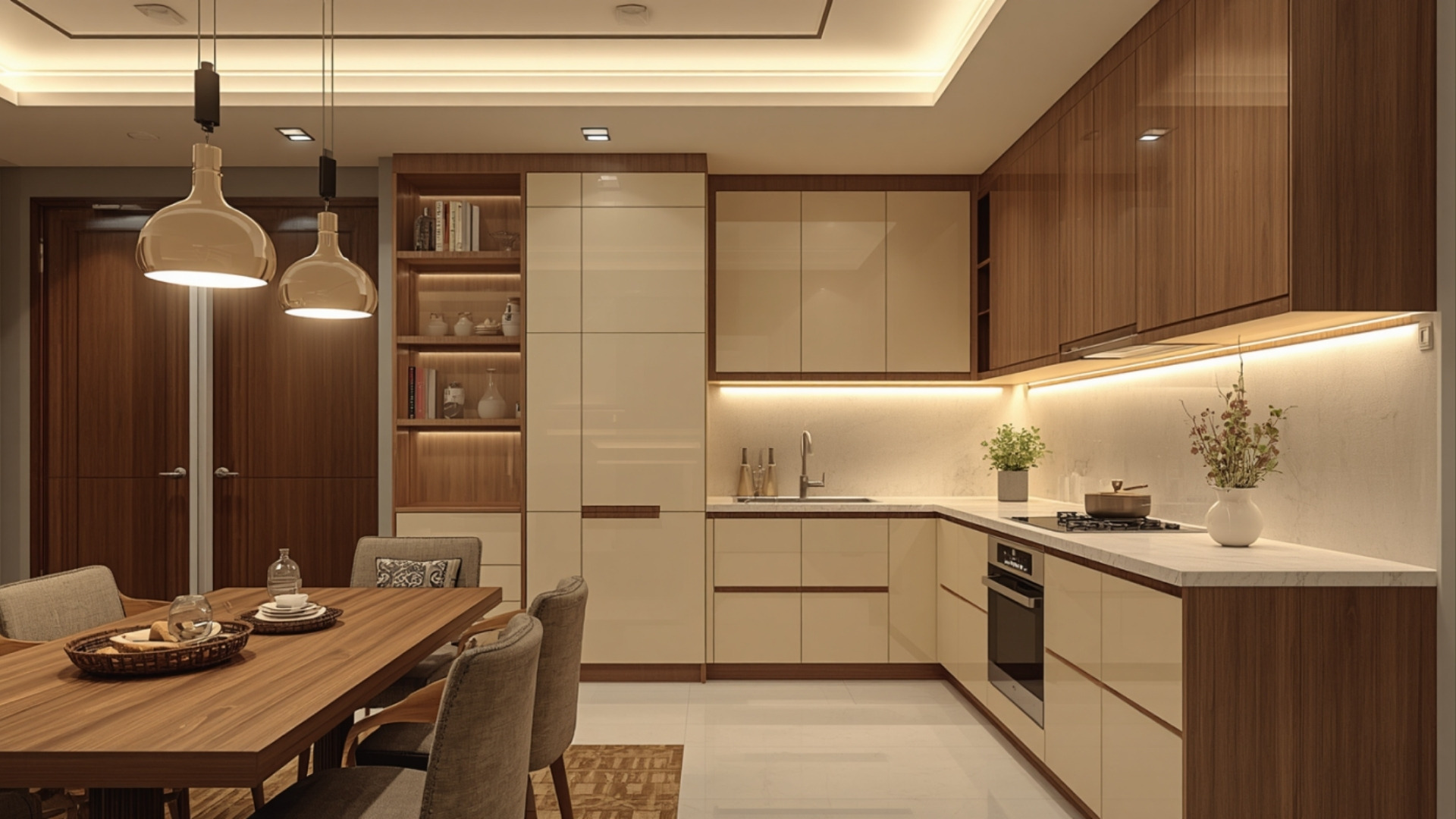
Layout variants for a 2 BHK in Electronic City
Cost is only half the story. How a 2 BHK is laid out decides whether the home feels open and easy or cramped and awkward, and layout choices are largely free at the design stage. Most Electronic City 2 BHK apartments fall into a few common layouts, and each one suggests a different design approach.
The most common is the rectangular layout with the living and dining in one connected zone, a kitchen along one wall, and two bedrooms off a short passage. Here the design goal is to keep the living and dining visually open while giving the kitchen enough working triangle space between sink, hob, and fridge.
A second common variant places the kitchen as a separate enclosed room. This suits families who cook heavily and want to contain smells and sounds. The design trade-off is that an enclosed kitchen needs careful lighting and ventilation planning so it does not feel boxed in.
Some newer towers offer an L-shaped living and dining space. This is a gift for design because it lets you create two distinct zones, a relaxed sofa area and a defined dining corner, without any walls. A rug, a pendant light, and a console are often enough to separate them.
The kitchen layout itself is usually straight, L-shaped, or parallel. A straight kitchen suits compact 2 BHK units, an L-shape is the most popular for the balance of counter and storage, and a parallel or galley kitchen works where the apartment has a long narrow kitchen room. The layout you have largely sets the kitchen cost, since more running feet means more cabinetry.
Good layout design also plans for circulation, the invisible paths people walk every day. I leave at least 900 mm of clear walkway in front of wardrobes and in kitchen aisles. This is a no-cost design principle that makes a small 2 BHK feel far more comfortable to live in.
Storage and configuration variants
For most families, storage is the real reason they invest in interiors. A 2 BHK has to hold everything a family owns, and smart configuration is what makes that possible without clutter. These choices are about design thinking more than money, though they do shape the final cost.
In the kitchen, the base units can be fitted with drawers or with shutters and shelves. Drawers cost more because of the channels, but they make deep storage usable, so I push for at least a bank of drawers near the hob for vessels. Tall units for groceries and a built-in provision for a microwave or oven keep the counter clear.
Wardrobe internals are where configuration really pays off. A master wardrobe usually needs a long hanging section, a few shelves, drawers for folded clothes, and a locker for valuables. The second bedroom, often a child or guest room, can use more open shelves and a study-friendly layout.
Loft storage above wardrobes and above the kitchen is an Electronic City favourite, because apartments here have generous ceiling heights. Lofts are a low-cost way to add seasonal and rarely-used storage, and they use space that would otherwise be wasted.
For the living room, storage can be hidden in the TV unit and in a slim console behind the sofa. A crockery unit near the dining doubles as display and storage. The design aim is to give every item a home so the visible surfaces stay calm and uncluttered.
The configuration principle I follow is to match storage to how each family actually lives, not to a template. A family that entertains needs more crockery and dining storage, while a young couple may want a study nook instead. Tailoring the configuration is what separates a designed home from a furnished one, and it usually costs nothing extra to plan well.
Material grades and brand options
Families often ask which brands they should insist on and which they can leave to the designer. Knowing the brand landscape helps you judge whether a quote is using dependable materials or cutting corners, and it connects directly to the cost tier you choose.
For plywood and boards, Century Ply, Greenply, and Action Tesa are the names I trust for BWP and HDHMR grades. A genuine BWP plywood with an IS 710 marking is what you want in the kitchen, and the small premium over commercial ply is worth every rupee in a humid city.
For laminates and shutter surfaces, Merino, Greenlam, and Century are reliable across the affordable and mid range, while acrylic options from brands like Senosan and Rehau give the high-gloss look for Comfort and Signature kitchens. The brand mainly affects the colour range, the scratch resistance, and the warranty.
For hardware, the three names that matter are Hettich, Hafele, and Blum. Hettich and Hafele cover the dependable mid range with hinges, channels, and baskets that last well. Blum is the premium benchmark, with soft-close motion and a long warranty that justify its cost in a long-stay home. Ebco is a solid value option for the Essential tier.
For countertops and surfaces, quartz from established brands resists stains and needs little maintenance, which is why it has become the default for Comfort kitchens. Granite remains a strong value option, and sintered stone is the premium frontier for Signature homes.
For paints and finishes, Asian Paints and Berger lead the market with the range of emulsions, textures, and warranties most families want. The grade you pick, from economy emulsion to premium washable finishes, affects both the look and the per sq ft cost. Choosing a washable premium emulsion in high-traffic areas is a small spend that pays back in easy cleaning for years.
Design principles behind a well-planned 2 BHK
Before any material is chosen, good interior design follows a few principles that decide whether a home feels right. These principles cost nothing, yet they shape every later decision. When families ask me what is the difference between a designed home and a furnished one, the answer is almost always these principles, not the budget.
The first principle is space planning. The design must respect how a family moves through the home each day, from the front door to the kitchen to the bedrooms. A layout that honours these daily paths feels effortless, while a layout that ignores them feels cramped even when it is expensive. This is why I begin every 2 BHK design with the movement plan, not the furniture.
The second principle is proportion. Furniture and cabinetry should match the scale of the room. A heavy sofa in a small living room, or a wardrobe that overpowers a compact bedroom, breaks the visual balance. The design approach is to size each element to its space so the room feels calm and open rather than full.
The third principle is function before decoration. Every element should earn its place by doing a job first, and looking good second. A TV unit should store as well as display, a dining console should serve as well as decorate. When function leads, the aesthetic follows naturally and the home stays useful for years.
The fourth principle is visual continuity. A 2 BHK feels larger and more restful when the colour palette, the flooring, and the finishes flow from room to room rather than changing abruptly. This does not mean every room is identical. It means the design speaks one language, with each room a variation on a shared theme.
The fifth principle is light and air. The design must work with the natural light each apartment receives and plan artificial lighting in layers. A room that is planned around its light, with the right balance of ambient, task, and accent layers, will always feel better than a room that simply spends more on fittings. This consideration matters as much as any material choice.
These principles are why two homes with the same budget can feel completely different. The rupees buy the materials, but the principles decide whether the home works. This is the part of design I care about most, because it is what families live inside every day long after the cost is forgotten.
Interior design styles for a 2 BHK in Electronic City
Once the layout and principles are set, the next design decision is style. Style is the visual personality of the home, and it shapes the palette, the finishes, and the mood. For a 2 BHK in Electronic City, a few styles suit the apartment scale and the way young families and professionals live here. Choosing a style early keeps every later choice consistent.
The contemporary style is the most popular approach. It uses clean lines, neutral palettes, and a mix of matte and subtle gloss finishes. The aesthetic is calm and uncluttered, which suits compact 2 BHK spaces and photographs beautifully. Contemporary design also ages well, so it remains relevant years after the home is done.
The minimal style takes this further, with even fewer elements, hidden storage, and a restrained palette of one or two main tones. The design principle here is that less visible clutter creates a more restful home. Minimal interiors suit busy professionals who want a serene space to return to, and they often need fewer decorative items, which can help the budget.
The modern Indian or fusion style blends contemporary layouts with warm Indian materials, textures, and accents. Think of clean cabinetry paired with a handcrafted console, a brass accent, or a textured feature wall. This approach gives a 2 BHK warmth and personality while keeping the practical benefits of a modern layout.
The transitional style sits between classic and contemporary, with soft detailing, gentle curves, and a layered palette. It suits families who find pure minimalism too stark but still want a current look. The aesthetic is comfortable and welcoming, and it carries decorative pieces gracefully.
Whatever the style, my design approach is to pick one direction and commit to it across the home. A 2 BHK is too compact to carry several competing styles, and visual consistency is what makes a small home feel considered. The style you choose is a design decision, not a cost decision, yet it influences every material and finish that follows.
Vastu and orientation considerations for a 2 BHK
Many Electronic City families ask me to plan their 2 BHK with vastu in mind, and it is a fair consideration that can sit comfortably inside good design. The aim is to align the home with light, air, and a sense of balance, which often overlaps with sound design principles anyway. Here is how I approach vastu within a practical 2 BHK layout.
The kitchen is the element families care about most. The traditional vastu preference places the kitchen in the south-east, with the cook facing east while working. In an apartment where the kitchen position is fixed by the builder, the design approach is to honour the intent where possible, for example by orienting the hob thoughtfully, rather than forcing changes that the structure does not allow.
For bedrooms, the common consideration is to place the master bedroom in the south-west for a sense of stability, and to position the bed so the head rests toward the south or east. These are layout decisions that cost nothing to plan and can be accommodated in most 2 BHK configurations without compromise.
Light and entry are the other vastu considerations that align neatly with design. Keeping the entrance and living areas bright and uncluttered, and allowing natural light deep into the home, is good vastu and good design at once. A clear, welcoming entry sets the tone for the whole apartment.
My honest guidance is to treat vastu as one input among several. Where a vastu preference and a practical layout agree, we follow it gladly. Where the apartment structure makes a preference impossible, we focus on the underlying intent, which is balance, light, and calm. That way the home respects the family's beliefs without sacrificing how well it functions day to day.
Lighting design approach for a 2 BHK
Lighting is the design layer that families underestimate most, yet it transforms a home more than almost any other element. A thoughtful lighting design can make an Essential tier 2 BHK feel warm and finished, while poor lighting can leave a Signature home feeling cold. The approach I follow is to plan light in three layers for every room.
The first layer is ambient light, the general illumination that fills a room. In a 2 BHK this usually comes from recessed ceiling lights or a central fixture. The design principle is to keep ambient light soft and even, avoiding harsh single sources that flatten a space and create glare.
The second layer is task light, focused illumination where work happens. In the kitchen this means under-cabinet lighting over the counter, in the study it means a focused desk light, and in the bedroom it means bedside reading lights. Task lighting is a functional consideration that makes the home genuinely easier to live in.
The third layer is accent light, the lighting that creates mood and highlights design features. Cove lighting in the false ceiling, a spotlight on a feature wall, or a warm pendant over the dining table all add depth and character. This layer is where a 2 BHK gains its evening warmth and its sense of being a designed home.
Colour temperature is the final consideration. I usually plan warm white light around 2700 to 3000 Kelvin for living and bedrooms to create a relaxed feel, and a slightly cooler, brighter light for the kitchen and study where clarity matters. Matching the light tone to the function of each room is a small design decision with a large effect on comfort.
The reason I dwell on lighting is that it is the cheapest way to lift a home and the easiest to get wrong. A good lighting layout is mostly about planning and placement, not expensive fittings, so it rewards design thinking far more than budget. This is a principle I urge every family to take seriously, whatever their tier.
Hidden costs in a 2 BHK interior project
The number that surprises families is rarely the headline quote. It is the set of costs that sit just outside the first estimate. I list these openly before signing, because a budget that ignores them is not a real budget. Here are the hidden costs to plan for in an Electronic City 2 BHK.
GST is the biggest one. Interior work attracts 18 percent GST, and many online rates and casual quotes are shown before tax. On a Rs. 7 lakh scope, that is about Rs. 1.26 lakh, so always confirm whether a quote is inclusive or exclusive of GST.
Electrical and plumbing modifications are the next surprise. Moving a switchboard, adding points for the chimney, hob, or geyser, or shifting a water line all cost extra over the base interior quote. In most builder-finished Electronic City flats this is modest, but it is rarely zero, and Rs. 20,000 to Rs. 50,000 is a fair buffer.
False ceiling finishing carries its own hidden layer. The per sq ft ceiling rate usually covers only the basic structure and a putty coat. Paint, cove profiles, and edge banding add Rs. 8 to Rs. 40 per sq ft on top, which adds up across a full home.
Loose furniture and soft furnishings are often left out of the core quote. Sofas, dining chairs, mattresses, curtains, and blinds can add Rs. 1 lakh to Rs. 2.5 lakh depending on taste. Families who forget this line end up with finished cabinetry but an empty-feeling home.
Appliances are another line that sits outside most interior quotes. The chimney, hob, built-in oven, refrigerator, and washing machine are usually bought separately. If you want a built-in look, the provisions must be designed in from the start, so flag this early.
The last hidden cost is the cost of delay and rework. Choosing materials late, changing the design mid-project, or hiring uncoordinated vendors all add time and money. A single planned scope with one accountable team is the cheapest way to build, which is exactly why a turnkey approach often costs less in the end than it appears to on paper.
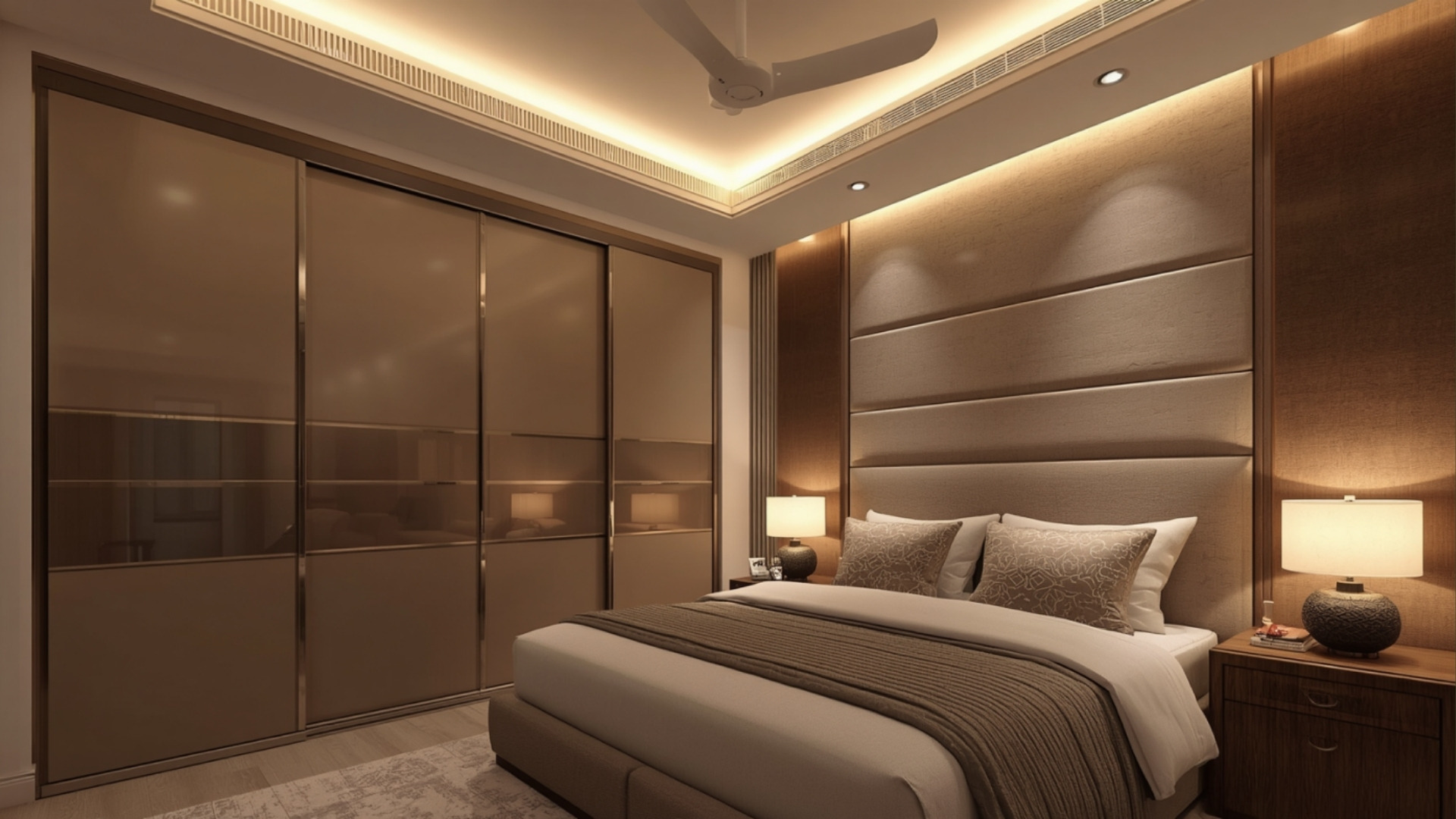
Why Electronic City families choose myNivasa
Electronic City has grown from an office-only zone into a genuine residential neighbourhood, with families moving into towers by Brigade, Puravankara, Sobha, and Nambiar. These are homes people intend to live in for years, not flip, and that changes what they want from an interior partner.
Families here tell me they want three things: an honest budget with no hidden surprises, materials that survive Bengaluru weather and daily family use, and a single team that takes responsibility from drawing to handover. That is the brief myNivasa is built around.
I plan every 2 BHK around how the family actually lives, not around a fixed package. We start with your layout and your storage needs, agree the tier and materials openly, and show the pre-GST and post-GST numbers together. The design is yours, the budget is clear, and the accountability sits in one place.
Because we work across many Electronic City projects, we know the common apartment layouts, the builder handover standards, and the practical issues like loft heights and balcony rules. That local knowledge means fewer surprises on site and a smoother project for your family.
If you want to compare how these numbers shift across the city, our guides on interior design cost in Bangalore for 2026 and on kitchen renovation cost and ideas in Bangalore are good companions to this Electronic City guide. For nearby localities you can also read our breakdowns for 2 BHK renovation cost in Indiranagar and 2 BHK interior cost in HSR Layout.
2 BHK Interior Cost Comparison Tables
The tables below put the numbers side by side so you can see how tier and room choices change the total. These are based on real myNivasa project medians for Electronic City and nearby South Bengaluru localities through 2025 and early 2026.
Room-wise cost by tier (typical 1,050 sq ft 2 BHK)
| Element | Essential | Comfort | Signature |
|---|---|---|---|
| Modular kitchen | Rs. 1.4 lakh | Rs. 2.4 lakh | Rs. 4.2 lakh |
| Master wardrobe | Rs. 70,000 | Rs. 1.1 lakh | Rs. 1.8 lakh |
| Second wardrobe | Rs. 50,000 | Rs. 80,000 | Rs. 1.3 lakh |
| TV unit and living | Rs. 45,000 | Rs. 85,000 | Rs. 1.6 lakh |
| False ceiling and lighting | Rs. 55,000 | Rs. 1.1 lakh | Rs. 1.9 lakh |
| Painting | Rs. 55,000 | Rs. 80,000 | Rs. 1 lakh |
| Approx total (pre-GST) | Rs. 5.1 lakh | Rs. 7.4 lakh | Rs. 11.8 lakh |
Electronic City vs nearby localities (Comfort tier 2 BHK)
| Locality | Per sq ft (Comfort) | Typical 2 BHK total |
|---|---|---|
| Electronic City | Rs. 1,800 - Rs. 2,700 | Rs. 6.5 lakh - Rs. 8.3 lakh |
| HSR Layout | Rs. 1,900 - Rs. 2,800 | Rs. 6.8 lakh - Rs. 8.6 lakh |
| Sarjapur Road | Rs. 1,850 - Rs. 2,750 | Rs. 6.6 lakh - Rs. 8.4 lakh |
| Bellandur | Rs. 1,900 - Rs. 2,850 | Rs. 6.9 lakh - Rs. 8.7 lakh |
| Koramangala | Rs. 2,100 - Rs. 3,100 | Rs. 7.5 lakh - Rs. 9.4 lakh |
The pattern is clear. Electronic City sits at the friendlier end of South Bengaluru rates, mainly because labour and logistics are a little easier here than in the central localities. The design quality you get for the rupee is among the best in the city, which is part of why the area is filling with long-stay families.
2 BHK interior design walkthrough
To see how these choices look in a real home, this video tour of a Bengaluru home interior delivered on a sensible budget is a useful reference. It shows how thoughtful layout and lighting can make a mid-budget 2 BHK feel complete, which is exactly the balance of cost and design this guide is about.
Frequently Asked Questions
How much does a 2 BHK interior design cost in Electronic City in 2026?
A 2 BHK interior in Electronic City costs Rs. 4.5 lakh to Rs. 11 lakh in 2026. The Essential tier is Rs. 4.5 lakh to Rs. 6 lakh, the Comfort tier is Rs. 6.5 lakh to Rs. 8.5 lakh, and the Signature tier starts around Rs. 9.5 lakh and rises past Rs. 12 lakh, all before GST.
What is the per sq ft interior rate in Electronic City?
Per sq ft rates run Rs. 1,200 to Rs. 1,800 for the Essential tier, Rs. 1,800 to Rs. 2,800 for the Comfort tier, and Rs. 2,800 to Rs. 4,500 plus for the Signature tier. Electronic City sits at the friendlier end of South Bengaluru rates because labour and logistics here are a little easier than in central localities.
How much does the modular kitchen alone cost in a 2 BHK?
The modular kitchen in a 2 BHK usually costs Rs. 1.4 lakh at the Essential tier, Rs. 2 lakh to Rs. 2.8 lakh at the Comfort tier, and Rs. 4 lakh plus at the Signature tier. It is the single largest line in the budget, taking 30 to 38 percent of the total, so material and hardware choices here matter most.
Is GST included in interior design quotes?
Often it is not. Interior work attracts 18 percent GST, and many online rates and casual quotes are shown before tax. On a Rs. 7 lakh scope that is about Rs. 1.26 lakh extra, so always confirm whether a quote is inclusive or exclusive of GST before you compare numbers.
What hidden costs should I plan for?
Plan for 18 percent GST, electrical and plumbing modifications of Rs. 20,000 to Rs. 50,000, false ceiling finishing over the basic rate, loose furniture and curtains of Rs. 1 lakh to Rs. 2.5 lakh, and appliances bought separately. A single planned scope with one accountable team is the cheapest way to avoid delay and rework costs.
Which carcass material is best for a Bengaluru kitchen?
BWP plywood with an IS 710 marking is the best choice for kitchen base units, because it handles Bengaluru humidity and water far better than MDF or HDHMR. Water damage is the main reason kitchens fail early, so I recommend plywood for the base units near water even on a Comfort budget.
What layout works best for an Electronic City 2 BHK?
Most Electronic City 2 BHK units suit an open living and dining zone with an L-shaped kitchen, which balances counter space and storage. The key design principle is to keep at least 900 mm of clear walkway in front of wardrobes and in kitchen aisles, which makes a compact home feel comfortable at no extra cost.
Should I do interiors in phases or all at once?
Do the fixed elements like kitchen, wardrobes, false ceiling, and painting in one go, because they involve dust, drilling, and coordination that is disruptive to repeat. Loose furniture, the TV unit, and decorative pieces can be phased to a second stage to manage cash flow without compromising the core home.
Three real budget scenarios for an Electronic City 2 BHK
Numbers make most sense when they are tied to a real family. Here are three budget scenarios I see often in Electronic City, each built around a different priority. They show how the same apartment can be designed at very different costs while still being done well.
The first scenario is the investor or rental finish at the Essential tier. A 1,000 sq ft 2 BHK is fitted with a compact L-shaped modular kitchen at Rs. 1.4 lakh, two laminate wardrobes at Rs. 1.2 lakh combined, a simple TV unit at Rs. 40,000, peripheral false ceiling and lighting at Rs. 55,000, and painting at Rs. 55,000. The total lands near Rs. 5 lakh before GST. The design goal here is a clean, durable, neutral finish that appeals to tenants and is easy to maintain.
The second scenario is the young family home at the Comfort tier. A 1,080 sq ft 2 BHK gets a fuller L-shaped kitchen with BWP plywood and Hettich hardware at Rs. 2.5 lakh, two acrylic-finish wardrobes at Rs. 1.9 lakh, a feature TV unit at Rs. 85,000, false ceiling and layered lighting across the home at Rs. 1.1 lakh, and premium emulsion painting at Rs. 80,000. With a study nook and accessories, the total sits around Rs. 7.5 lakh before GST. The design balances durability, storage, and a warm finished look.
The third scenario is the long-stay premium home at the Signature tier. A 1,150 sq ft 2 BHK receives a designer kitchen with full Blum fittings and a quartz countertop at Rs. 4.2 lakh, two PU-finish wardrobes at Rs. 3 lakh combined, a custom living wall and TV unit at Rs. 1.6 lakh, full home false ceiling with profile lighting at Rs. 1.9 lakh, and premium textured painting at Rs. 1 lakh. The total crosses Rs. 12 lakh before GST. The design priority is a premium, lasting aesthetic for a family that will live here for many years.
The lesson across all three is that the apartment is the same, but the priorities differ. The investor spends on durability and neutrality, the young family spends on balance, and the long-stay family spends on finish and feel. There is no single right number, only the right number for how you intend to live.
How to save money without cutting quality
Saving on a 2 BHK interior is not about choosing the cheapest of everything. It is about spending where it matters and economising where it does not. These are the strategies I share with every family who wants a quality home on a careful budget.
The first strategy is to put plywood and good hardware only where water and motion are highest, which is the kitchen base units and the wardrobe channels. Use sensible mid-grade materials elsewhere. This single principle protects the parts that fail early while keeping the overall cost in check.
The second strategy is to phase the decorative work. The fixed elements like kitchen, wardrobes, false ceiling, and painting should be done in one disruptive phase, but the TV feature wall, the second study unit, and loose furniture can wait. Phasing the aesthetic extras can defer Rs. 1 lakh to Rs. 2 lakh without affecting how the home functions.
The third strategy is to keep the false ceiling simple. A peripheral cove in the living room and kitchen gives most of the visual benefit at a fraction of the cost of a full home ceiling. You can always add more later, but a restrained ceiling design often looks cleaner anyway.
The fourth strategy is to choose laminate in low-touch areas and reserve acrylic or PU finishes for the one or two surfaces people see most, like the kitchen fronts or the master wardrobe. The eye notices the hero surfaces, not the inside of a utility cabinet, so this is an easy saving with no visible compromise.
The fifth strategy is to finalise the design and materials before work begins. The most expensive money in any project is the money spent on changes and rework. A locked scope, a clear drawing set, and a single accountable team save more than any material substitution, which is the quiet advantage of a planned turnkey approach.
Project timeline and what to expect
Understanding the process removes most of the stress from an interior project. A 2 BHK in Electronic City typically takes six to ten weeks from start to handover, and knowing the stages helps you plan your move and your payments. Here is how a well-run project unfolds.
The first stage is discovery and design, usually one to two weeks. We measure the apartment, understand how your family lives, agree the tier and style, and prepare the layout and drawings. This is the most important stage, because every decision made well here saves time and money later.
The second stage is material selection and finalisation, about one week. You choose the laminates, the shutter finishes, the countertop, the hardware, and the paint shades. Locking these before production begins is what keeps the timeline and the budget on track.
The third stage is production and factory work, around three to four weeks. The modular units are manufactured while any site preparation, electrical, and false ceiling work proceeds in parallel. Running factory and site work together is how a good team compresses the overall timeline.
The fourth stage is installation and finishing, about two to three weeks. The cabinetry is fitted, the countertop and backsplash go in, painting is completed, and lighting and accessories are installed. This is when the home visibly comes together room by room.
The final stage is quality check and handover, a few days. We inspect every hinge, drawer, and finish, fix any snags, and hand over a home that is ready to live in. A clear handover with a checklist is the mark of a project run with care, and it is the standard I hold every myNivasa project to.
Turnkey or individual contractors for your 2 BHK
One decision shapes the whole experience, which is whether to hire a single turnkey team or to coordinate individual contractors yourself. Both can work, but they suit different families. Understanding the trade-off helps you choose the approach that fits your time and temperament.
Hiring individual contractors, a carpenter, a painter, an electrician, and a false ceiling team separately, can look cheaper on paper. The catch is that you become the project manager, coordinating schedules, resolving clashes, and carrying the risk when one trade blames another. For families with time and site experience, this approach can save money, but it demands real involvement.
The turnkey approach gives you one team and one point of accountability from design to handover. The design, materials, production, and installation are coordinated under a single scope and a single timeline. You trade a small coordination premium for predictability, a clear budget, and someone who owns the outcome.
My honest view is that for most working families in Electronic City, the turnkey approach saves more than it costs. The hidden expenses of delay, rework, and uncoordinated vendors usually outweigh the apparent saving of managing trades yourself. A planned single scope is also where good design is protected, because no one is cutting corners to fit a separate trade's budget.
Whichever approach you choose, insist on a written scope, a clear material list, and a payment schedule tied to milestones. These protect you regardless of who does the work, and they turn a vague estimate into a budget you can trust. That clarity, more than any single material choice, is what makes a 2 BHK project go smoothly.
Common mistakes to avoid in a 2 BHK interior
Over the years I have seen the same avoidable mistakes drain budgets and spoil otherwise good homes. Knowing them in advance is one of the most valuable things a family can take into a project, because each mistake is easy to prevent at the design stage and expensive to fix later.
The first mistake is choosing materials by appearance alone. A laminate that looks like premium wood is fine on a wardrobe front, but the same shortcut on a kitchen base unit near water leads to early failure. The design principle is to match the material to the job, not only to the look. This single consideration prevents the most common kind of regret.
The second mistake is over-designing the false ceiling. Families often spend heavily on a full home ceiling with elaborate detailing, then find it makes the rooms feel lower and the budget tighter. A restrained ceiling design usually looks cleaner and leaves room in the budget for the elements that matter more.
The third mistake is ignoring lighting until the end. Lighting is treated as an afterthought far too often, yet it is the layer that decides how a home feels every evening. Planning the lighting layout alongside the layout, not after it, is a design approach that costs nothing extra and changes everything.
The fourth mistake is under-planning storage. A home that looks beautiful on handover day but cannot hold a family's belongings becomes cluttered within months. The configuration of wardrobes, lofts, and kitchen drawers should be planned around what you actually own, which is a design consideration, not a cost one.
The fifth mistake is changing decisions mid-project. Every change after production begins costs time and money and risks the overall finish. The remedy is to invest time in the design and material selection stage so the scope is locked before work starts. A little patience early is the cheapest saving in the whole project.
Avoiding these mistakes is less about spending more and more about thinking clearly at the start. Good design is mostly good decisions made in the right order, and a family that understands these pitfalls will get a far better home for the same budget.
Limitations and Assumptions
The figures in this guide are myNivasa project medians and market ranges for Electronic City and nearby South Bengaluru localities, gathered from projects through 2025 and early 2026. They are planning ranges, not fixed quotes. Your actual cost depends on your exact carpet area, the condition of the builder handover, your material and hardware choices, and the scope you finalise.
Costs are shown before 18 percent GST unless stated otherwise, and design or project management fees may be charged separately. Appliances, loose furniture, and soft furnishings are treated as separate lines. Prices for materials and hardware can shift with market conditions, so always confirm current rates at the time of your project. A detailed site measurement and a written scope are the only way to turn these ranges into a firm number for your home.
Sources and References
- NoBroker Interiors, Interior Design Cost in Bangalore 2026
- RERA Karnataka, project and builder registration
- Bureau of Indian Standards, IS 710 marine plywood specification
- Brigade Group, Apartments in Electronic City Phase 1 and Phase 2
Final Word
If you are planning a 2 BHK interior in Electronic City for 2026, hold two numbers in your mind. The first is the budget, which for most families lands around Rs. 7 lakh at the Comfort tier, between an Essential floor of Rs. 4.5 lakh and a Signature ceiling above Rs. 11 lakh before GST. The second is the design idea that matters more than the rupees, which is to spend where you touch the home every day, the kitchen, the wardrobes, and the lighting, and to phase the decorative extras for later.
A 2 BHK done well is not about the highest spend. It is about an honest budget, durable materials matched to Bengaluru weather, a layout that suits how your family lives, and one accountable team from drawing to handover. Get those right and your home will feel finished and comfortable for the next ten years. If you would like a clear tier-wise estimate for your exact Electronic City apartment, the myNivasa team is ready to measure your space and plan it with you.
Plan your 2 BHK interior with myNivasa
Get a transparent, tier-wise estimate for your Electronic City apartment, with materials, hardware, and the pre-GST and post-GST numbers shown clearly. Talk to the myNivasa team today.