
Interior Design Cost Breakdown in Bangalore 2026 Guide
- What is an interior design cost breakdown in Bangalore?
- An interior design cost breakdown Bangalore is a line-by-line split of a full home interior budget into its parts, such as modular kitchen, wardrobes, false ceiling, TV unit, painting, electrical work and design fees. In 2026 a complete home interior in Bangalore costs Rs 1,200 to Rs 5,000 per square foot, with a 2BHK landing between Rs 4 lakh and Rs 14 lakh and a 3BHK between Rs 6 lakh and Rs 22 lakh, before 18 percent GST.
A 2BHK interior in Bangalore in 2026 typically costs Rs 4 lakh to Rs 14 lakh and a 3BHK costs Rs 6 lakh to Rs 22 lakh, before 18 percent GST. The kitchen and wardrobes alone usually take 30 to 40 percent of the total budget, which is why a true cost breakdown, listing each element separately by material grade and hardware brand, is the only way to compare two quotations fairly.
Quick Takeaways
- Bangalore interior costs run Rs 1,200 to Rs 5,000 per square foot in 2026, set by material grade, hardware brand and finish.
- The modular kitchen is the single largest line item, at Rs 9,500 to Rs 28,000 per running foot depending on shutter finish.
- Wardrobes are the second largest line item, billed at Rs 800 to Rs 2,500 per square foot of carpentry.
- Material grade decides durability: commercial MR ply, BWR ply and BWP marine ply sit at clearly different price and moisture-resistance tiers.
- Hardware brand (Ebco, Hettich, Hafele, Blum) can be up to 25 percent of cabinetry cost and decides how the kitchen feels for the next 10 years.
- Hidden costs such as electrical points, civil work, painting beyond quoted areas and transport routinely add 10 to 15 percent.
- Almost every Bangalore quote is exclusive of 18 percent GST, so a Rs 7 lakh quote becomes Rs 8.26 lakh on the invoice.
- South Bangalore localities can price 20 to 35 percent higher per square foot than East Bangalore for the same scope.
How much does a full home interior cost in Bangalore in 2026?
A complete interior design cost breakdown Bangalore 2026 shows costs of Rs 1,200 to Rs 5,000 per square foot, so a mid-range 2BHK lands near Rs 6 lakh to Rs 9 lakh before GST. The cost depends on which material grade you choose, how much modular work the kitchen and wardrobes need, and the hardware brand fitted inside the cabinets.
Cost and Style Tier Summary
| Tier | Per sq ft (2026) | Typical 2BHK total | What you get |
|---|---|---|---|
| Budget | Rs 800 to Rs 1,500 | Rs 4 lakh to Rs 6 lakh | Commercial MR ply, laminate finish, gypsum ceiling in living only, Ebco hardware |
| Mid-range | Rs 1,500 to Rs 2,500 | Rs 6 lakh to Rs 9 lakh | BWR ply, premium laminate or acrylic, ceiling in 2 rooms, Hettich hardware |
| Premium | Rs 2,500 to Rs 6,000+ | Rs 9 lakh to Rs 14 lakh+ | BWP marine ply, veneer or PU, full false ceiling, Hafele or Blum hardware |
In my 8 years running interior projects across Bengaluru, the single most common reason a budget overshoots is not luxury taste. It is an itemless quote. When a quotation says "modular kitchen, 1 lump sum" instead of "12 running feet, BWR carcass, acrylic shutter, Hettich hinges", the homeowner has no way to see where the money goes, and no way to trim it safely.
What does an interior cost breakdown in Bangalore include?
A complete interior design cost breakdown Bangalore covers four families of cost. The first is modular and carpentry work, which covers the kitchen, wardrobes, TV unit, crockery unit, study tables, pooja unit and any loose or fitted woodwork. This family is almost always the largest, often 55 to 70 percent of the entire budget, because it is material heavy and labour heavy at the same time.
The second family is surface and ceiling work. This is false ceiling, wall painting, wallpaper, textured panels and flooring if you are changing it. The third family is services, meaning electrical points, light fixtures, plumbing changes for kitchen and bathrooms, and any civil work such as breaking or building a wall. The fourth family is professional and logistics cost, which covers the design fee, project management, transport, loading, installation and final site cleaning.
A good breakdown lists each of these families separately, and inside each family it lists quantity, material grade and brand. Without quantity and grade, a number is just a guess. The whole purpose of this guide is to give you the 2026 Bangalore rate for each line so you can rebuild any quotation yourself and check whether it is fair.
What affects interior design cost in Bangalore?
Five factors move an interior budget more than anything else, and four of them are choices you control. The first is carpet area and the amount of modular work. A larger home is not just more square feet of floor, it is more running feet of kitchen and more square feet of wardrobe shutter, and modular work is where the rupees concentrate.
The second factor is material grade. Moving a wardrobe carcass from commercial MR plywood at Rs 60 to Rs 110 per square foot up to BWP marine plywood at Rs 150 to Rs 250 per square foot can change a single wardrobe by Rs 20,000 or more. The third factor is finish. A laminate shutter is the entry point, acrylic sits in the middle, and PU paint or natural veneer sits at the top, and the gap between them on a full kitchen can be Rs 1 lakh or higher.
The fourth factor is hardware brand. Hinges, channels, tandem boxes and lift-up systems from Ebco, Hettich, Hafele or Blum can be up to a quarter of cabinetry cost. The fifth factor, which you do not fully control, is locality. South Bangalore neighbourhoods such as Koramangala and Indiranagar can run 20 to 35 percent higher per square foot than East Bangalore areas such as Whitefield and Marathahalli, partly due to access, parking and labour logistics in older, denser layouts.
Interior cost per square foot in Bangalore: budget, mid and premium
The per square foot number is the fastest way to sanity check any quotation. In 2026 a budget interior in Bangalore runs Rs 800 to Rs 1,500 per square foot, a mid-range interior runs Rs 1,500 to Rs 2,500 per square foot, and a premium interior runs Rs 2,500 to Rs 6,000 and above per square foot. The widely quoted band of Rs 1,200 to Rs 5,000 simply spans these tiers.
Translate that into homes and the picture sharpens. A 1,000 square foot 2BHK at a mid-range Rs 1,800 per square foot works out to roughly Rs 18 lakh if you carpet the full home, but most families do not do full modular everywhere, so the realistic mid-range 2BHK lands at Rs 6 lakh to Rs 9 lakh once you exclude floors and ceilings you keep. A 1,500 square foot 3BHK at the same grade lands at Rs 8 lakh to Rs 12 lakh. Premium grade pushes a 3BHK past Rs 15 lakh.
One caution on the per square foot method. It only works as a cross-check, never as a quote. Two homes of the same size can differ by Rs 5 lakh purely on how much modular work each one carries. Always return to the element-wise breakdown below for the real figure.
Modular kitchen cost breakdown in Bangalore 2026
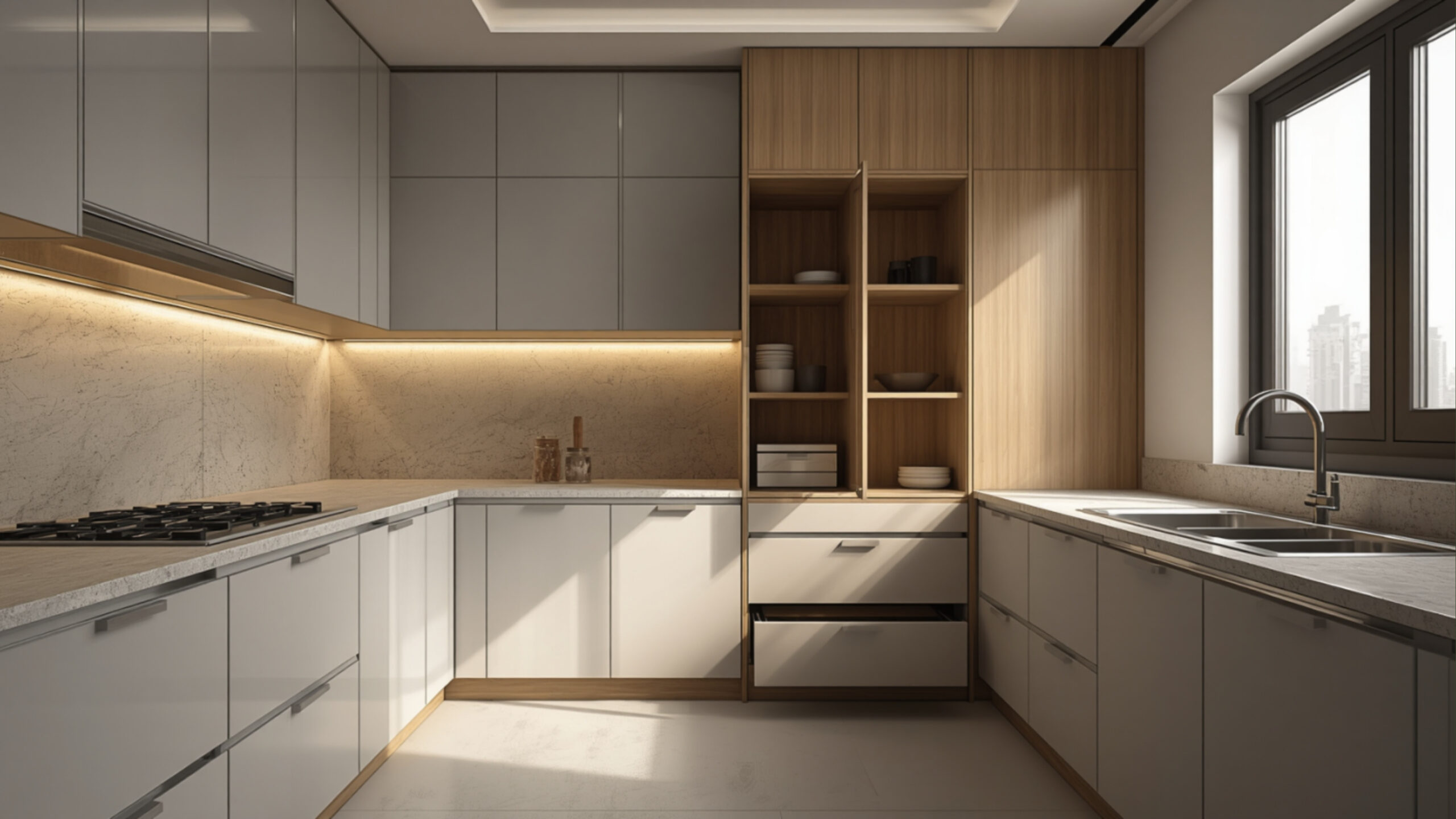
The modular kitchen is the largest single line in almost every Bangalore interior, usually 15 to 25 percent of the total budget. It is billed per running foot of cabinetry, and the rate is decided mostly by the shutter finish. In 2026 a laminate kitchen runs Rs 9,500 to Rs 14,000 per running foot, an acrylic kitchen runs Rs 15,000 to Rs 22,000 per running foot, and a PU painted kitchen runs Rs 18,000 to Rs 28,000 per running foot.
Work an example. A standard 12 running foot L-shaped kitchen with laminate shutters costs roughly Rs 96,000 to Rs 1,44,000 for the cabinetry alone. On top of that you add the countertop, which is Rs 25,000 to Rs 60,000 for granite or quartz depending on stone and length, plus installation and site adjustment at Rs 15,000 to Rs 30,000. So a real laminate kitchen with countertop and fitting lands near Rs 1.4 lakh to Rs 2.3 lakh.
Step up the grade and the same 12 running feet behaves very differently. A mid-range kitchen built on BWP plywood with Hettich hardware typically costs Rs 2.5 lakh to Rs 5 lakh once countertop and accessories are in. A premium kitchen on marine plywood with Blum soft-close fittings and a quartz top runs Rs 5 lakh to Rs 8 lakh and above. The carcass material and the hardware brand, not the visible shutter alone, are what separate these numbers.
Inside the kitchen line, hardware deserves its own attention because it is the part you touch every day. Hinges, drawer channels, tandem boxes, pull-out baskets and lift-up shutters from Hettich and Hafele can represent about 25 percent of cabinetry cost. Spending here is rarely wasted, since a hinge that fails in year 3 is far more expensive to replace than to fit correctly the first time.
Wardrobe cost breakdown in Bangalore 2026
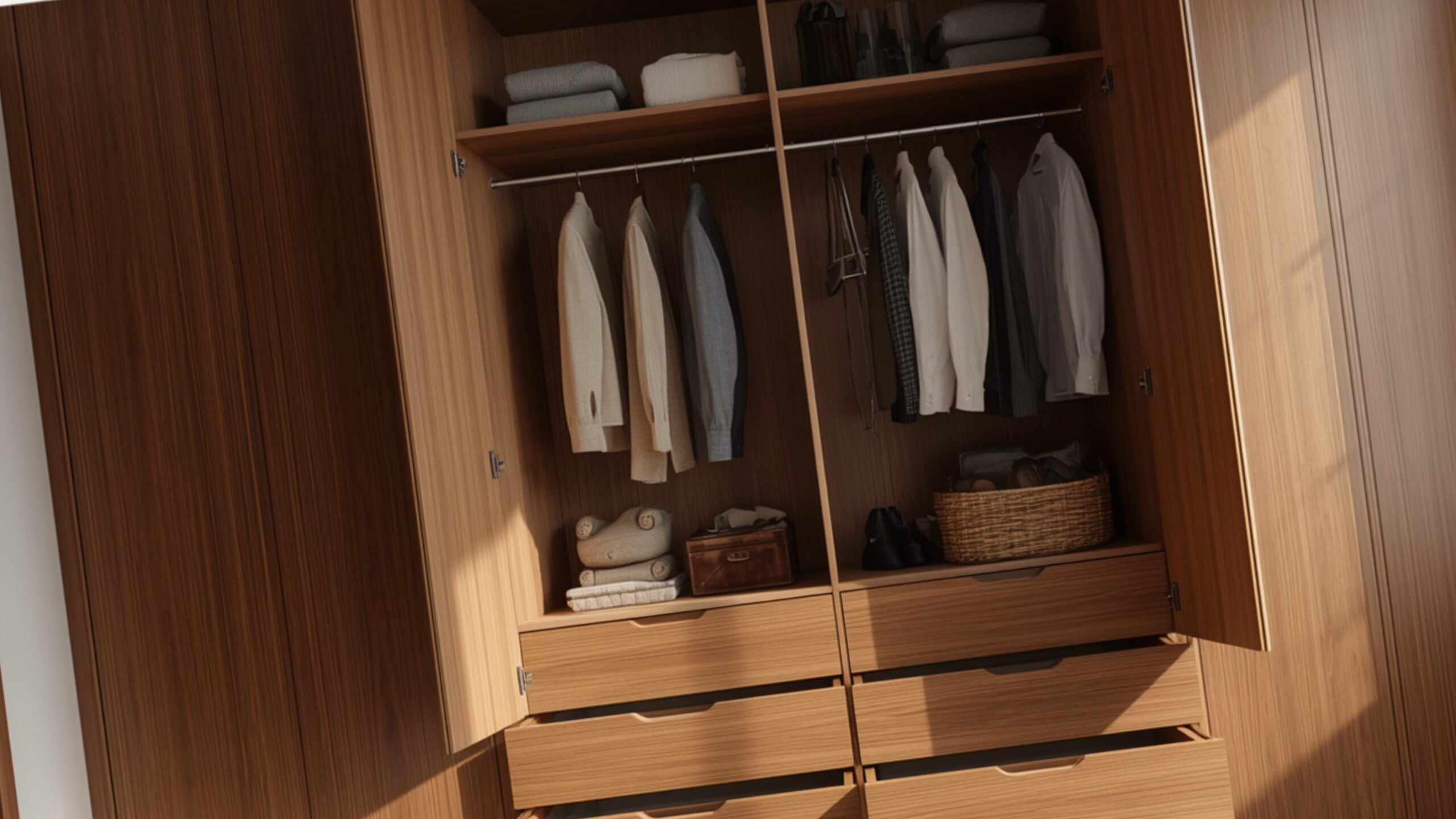
Wardrobes are the second largest line in a Bangalore interior, typically 12 to 18 percent of the budget. The honest way to price a wardrobe is per square foot of its front elevation, and Bangalore carpentry in 2026 runs Rs 800 to Rs 2,500 per square foot. Basic work using commercial plywood and laminate sits at Rs 800 to Rs 1,200, branded plywood and premium laminate sits at Rs 1,300 to Rs 1,800, and marine plywood with veneer or acrylic sits at Rs 2,000 to Rs 2,500 and above.
In rupee terms, an MDF wardrobe starts near Rs 36,000, while a plywood wardrobe of the same size starts near Rs 46,800, and a finished branded wardrobe in 2026 starts from about Rs 55,000. The gap between MDF and plywood is not only price, it is moisture behaviour and screw holding, which matter a great deal in Bangalore monsoon humidity.
The two big wardrobe decisions are sliding versus hinged, and the internal layout. Sliding shutters save floor swing space and suit narrow bedrooms but cost more per square foot due to the channel system, and they give you slightly less open access at any one time. Hinged shutters are cheaper, give full access, and allow loft storage above. Internally, the cost rises with the number of drawers, pull-outs, mirror units and lofts, so a plain shelf-and-rod wardrobe is always the most economical starting point.
False ceiling cost breakdown in Bangalore 2026
False ceiling is where many budgets quietly inflate, because lighting hides inside it. In 2026 a gypsum or POP false ceiling in Bangalore runs Rs 75 to Rs 125 per square foot, which makes it the most economical option, while a PVC ceiling runs Rs 160 to Rs 185 per square foot. Premium surface finishes change the maths sharply, with laminate ceilings at Rs 700 to Rs 800 per square foot and veneer ceilings at Rs 900 to Rs 1,200 per square foot.
For a room scale figure, a 10 foot by 10 foot room false ceiling costs roughly Rs 7,500 to Rs 13,000, depending on whether the layout is a simple peripheral cove or an elaborate multi-level design. Then comes lighting, which is a separate line and adds Rs 3,000 to Rs 15,000 per room depending on the count and type of fixtures. Electrical wiring and finishing inside the ceiling can add a further Rs 20 to Rs 40 per square foot.
My practical advice on ceilings is to be selective. A peripheral cove with concealed lighting in the living room and master bedroom delivers most of the visual effect at a fraction of the cost of ceiling every room. Spending Rs 40,000 on two well designed ceilings usually reads better than Rs 80,000 spread thin across the whole flat.
TV unit, crockery, pooja unit and other woodwork cost
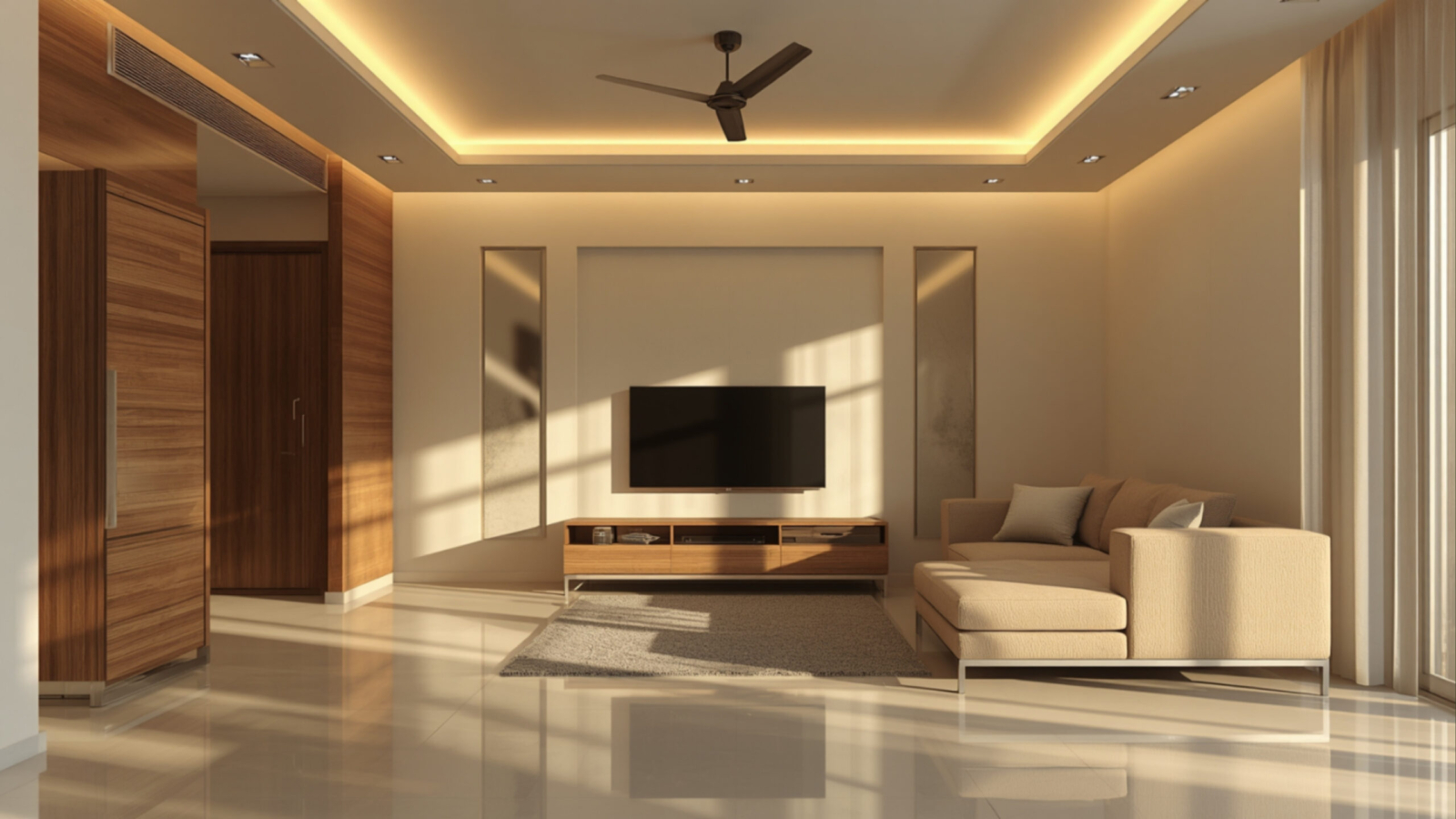
Beyond the kitchen and wardrobes, a Bangalore home carries a cluster of smaller woodwork lines that add up faster than people expect. A wall mounted TV unit with storage typically costs Rs 25,000 to Rs 70,000 depending on length, back panelling and whether it carries open shelves or closed cabinets. A floor to ceiling TV wall with veneer or fluted panelling can cross Rs 1 lakh on its own.
A crockery unit or display unit runs Rs 20,000 to Rs 60,000, a study table with overhead storage runs Rs 12,000 to Rs 35,000, and a pooja unit runs Rs 15,000 to Rs 60,000 depending on carving, jaali work and finish. A foyer or shoe unit near the entrance adds Rs 15,000 to Rs 40,000. None of these is large alone, but together they often add Rs 1 lakh to Rs 2 lakh to a 2BHK, which is exactly why they must each appear as a separate line in your breakdown rather than disappearing into a single woodwork total.
Painting cost breakdown in Bangalore 2026
Painting is a deceptively variable line because the same wall can be finished three different ways. In 2026, fresh painting in Bangalore runs Rs 14 to Rs 40 per square foot including labour and material, while repainting runs Rs 6 to Rs 35 per square foot. Labour only, where you supply the paint, runs Rs 18 to Rs 28 per square foot for a full job covering putty, primer and two topcoats.
At the home scale, a 2BHK paint job ranges from Rs 20,000 to Rs 30,000 for economy distemper up to Rs 50,000 to Rs 75,000 for a premium emulsion such as Asian Paints Royale with full surface preparation. A typical 900 square foot apartment finished in Asian Paints Royale Matt lands near Rs 35,000 to Rs 52,000 complete. Each deep accent wall adds Rs 1,000 to Rs 3,000 for masking and extra coats. One timing tip that saves money: Bangalore painting rates dip in summer from March to May when demand is lower, and peak from October to December before Diwali.
Electrical, plumbing and civil cost breakdown
Services are the lines that almost never appear correctly in a first quotation, and they are where overruns hide. Electrical changes, meaning extra points, switchboard relocation and wiring upgrades, run Rs 15,000 to Rs 40,000 for a typical flat. Plumbing changes for the kitchen and bathrooms, such as shifting an inlet or adding a point, run Rs 10,000 to Rs 30,000.
Civil work, which covers breaking or building a wall, waterproofing or floor levelling, runs Rs 20,000 to Rs 60,000 depending on scope. Appliance installation such as chimney, hob and built-in oven adds Rs 5,000 to Rs 15,000, and post-work deep cleaning adds Rs 3,000 to Rs 8,000. These four lines together commonly add Rs 50,000 to Rs 1.5 lakh on a 2BHK, so insist they are quoted up front rather than billed as surprises during execution.
Material grades and brand options in Bangalore
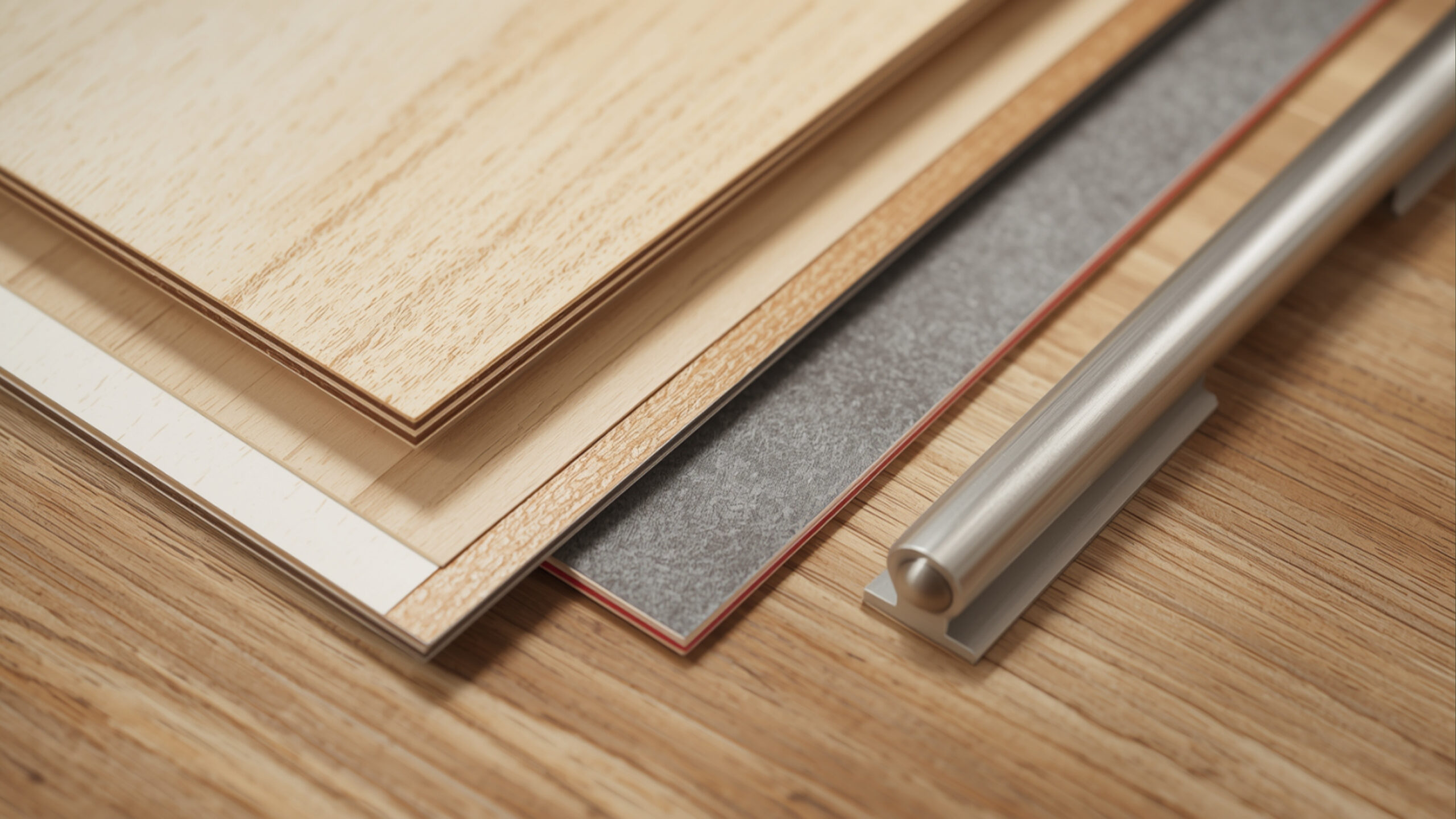
Material grade is the lever that quietly decides both your invoice and your home's lifespan, so it is worth understanding the ladder. For boards, commercial MR plywood is the entry grade at Rs 60 to Rs 110 per square foot for 18mm and suits dry-area furniture. BWR grade plywood at Rs 100 to Rs 160 per square foot is the sensible default for modular kitchens.
BWP marine plywood at Rs 150 to Rs 250 per square foot carries effectively zero delamination risk and is the right call for bathroom vanities and any moisture-prone zone. MDF is cheaper than all of these but holds screws and resists water less well, which matters in Bangalore humidity.
For finishes, decorative laminates from Greenlam, Merino and Century run Rs 1,000 to Rs 4,000 per 8 foot by 4 foot sheet, acrylic sits a step above for a glossy seamless look, and natural veneer or PU paint sits at the top for a wood-grain or solid-colour premium finish. For paint, Asian Paints anchors most Bangalore homes across its distemper, emulsion and Royale lines. The practical principle is to put your money into the boards and hardware that you cannot easily change later, and treat the visible finish as the layer you can choose by budget.
Hardware grade versus durability and cost
Hardware is the part of an interior you operate thousands of times a year, so its grade is a durability decision as much as a cost decision. The common ladder in Bangalore runs from Ebco at the value end, to Hettich and Hafele in the broad mid to upper band, to Blum at the premium end. Hinges, telescopic channels, tandem boxes and lift-up mechanisms from these brands can together be up to 25 percent of cabinetry cost.
Why pay more here. A soft-close Blum or Hettich hinge rated for a high open-close cycle simply outlives a generic hinge, and replacing failed hardware later means dismantling a finished cabinet, which costs far more in labour than the hinge itself. My standard guidance is to fit at least mid-grade Hettich or Hafele hardware in the kitchen, where daily load is highest, and you can economise to value hardware in low-use wardrobes if the budget is tight. Spending an extra Rs 15,000 to Rs 30,000 on kitchen hardware is one of the highest-return decisions in the whole project.
2BHK versus 3BHK full cost breakdown
Putting the lines together gives the totals families actually plan around using this interior design cost breakdown Bangalore 2026 guide. For a mid-range 2BHK, expect roughly Rs 6 lakh to Rs 9 lakh before GST, split approximately as kitchen Rs 1.5 lakh to Rs 2.5 lakh, wardrobes Rs 1.5 lakh to Rs 2.5 lakh, other woodwork Rs 1 lakh to Rs 1.5 lakh, false ceiling and painting Rs 1 lakh to Rs 1.5 lakh, and services plus logistics Rs 50,000 to Rs 1 lakh. Budget grade pulls this down toward Rs 4 lakh, premium grade pushes it past Rs 12 lakh.
For a 3BHK the same logic scales up to roughly Rs 8 lakh to Rs 12 lakh at mid-range and Rs 15 lakh and above at premium, because you add a third bedroom wardrobe, more ceiling area and usually a longer kitchen. The standard split holds: kitchen and wardrobes together remain 30 to 40 percent of the total. Use these splits as a template, then drop in the per-unit rates from the sections above to build your own number.
Locality-wise cost difference across Bangalore
Where your home sits changes the bill even when the design does not. South and central Bangalore localities such as Koramangala, Indiranagar and Jayanagar tend to price 20 to 35 percent higher per square foot than East Bangalore areas such as Whitefield, Marathahalli and Sarjapur Road for the same scope. The drivers are access and logistics, parking and material movement in dense older layouts, and local labour demand.
Newer corridors such as Electronic City, Hebbal and Yelahanka usually sit in the middle. None of this changes the element rates themselves, it changes the labour and handling component layered on top, which is one more reason to keep that component visible as its own line.
Hidden costs and GST you must budget for
The gap between a quote and a final invoice is almost always made of two things: hidden costs and GST. On the hidden side, plan for plumbing at Rs 10,000 to Rs 30,000, complete home painting beyond quoted areas at Rs 15 to Rs 35 per square foot, civil work at Rs 20,000 to Rs 60,000, transport and loading at Rs 8,000 to Rs 20,000, appliance installation at Rs 5,000 to Rs 15,000, cleaning at Rs 3,000 to Rs 8,000, and miscellaneous site issues at Rs 10,000 to Rs 25,000. The safe rule is to hold a 10 to 15 percent contingency.
On GST, most Bangalore interior quotes are exclusive of tax. Interior work is treated as a works contract and attracts 18 percent GST on the total contract value, so a Rs 7 lakh quote becomes Rs 8.26 lakh on the invoice. Always ask whether a quoted figure includes or excludes GST before you compare two firms, because a tax-inclusive quote and a tax-exclusive quote that look similar can be 18 percent apart in reality.
How to reduce interior cost without cutting quality
Trimming an interior budget well is about sequencing, not sacrifice. Spend first on the things you cannot change later: the kitchen carcass grade, the kitchen hardware and any waterproofing. Economise on the things you can upgrade later: loose furniture, decorative lighting, accent wallpaper and full-home ceilings. Choose laminate over acrylic where the surface is not at eye level, ceiling only your living room and master bedroom, and keep wardrobe internals simple with shelves and rods rather than many drawers.
The other big saving is planning. A finalised interior design cost breakdown Bangalore homeowners can review before execution starts prevents the costliest line of all, which is rework. Every wall opened twice, every point shifted after wiring, every shutter remade in a new colour, adds labour with no extra value. A clear, itemised plan is itself a cost-control tool.
Why Bangalore families choose myNivasa
At myNivasa we build our quotes using the same interior design cost breakdown Bangalore structure this guide follows: line by line, with quantity, material grade and hardware brand stated for every element. Families across Whitefield, HSR Layout, Sarjapur Road, Electronic City, Koramangala, Indiranagar, Marathahalli, Hebbal, JP Nagar, Yelahanka and Bannerghatta Road work with us because they can see exactly where every rupee goes and can trim with us safely rather than discovering surprises at handover. Since 2018 we have run turnkey interiors and renovations end to end, which means one accountable team from design to the final clean.
Bathroom vanity and sanitaryware cost breakdown
Bathrooms are small in area but dense in cost, and they are the one place where cutting the material grade backfires fastest because of constant water exposure. A bathroom vanity in Bangalore in 2026 runs Rs 12,000 to Rs 45,000 depending on size, finish and whether the carcass is in BWP marine plywood or a water-resistant board. Marine ply is not optional here, it is the difference between a vanity that lasts a decade and one that swells in two monsoons.
On the sanitaryware and fittings side, brand choice drives the spread. A basic faucet and health-faucet set sits at Rs 3,000 to Rs 8,000, while branded fittings from Jaquar or Kohler move a single bathroom up by Rs 15,000 to Rs 40,000 across taps, shower, diverter and accessories. A wall-hung WC with concealed cistern adds Rs 12,000 to Rs 35,000 over a standard floor-mounted unit. Mirror units, backlit mirrors and storage niches add Rs 5,000 to Rs 20,000 each.
For a full mid-range bathroom refresh, plan Rs 60,000 to Rs 1.2 lakh per bathroom once vanity, fittings, mirror and minor waterproofing are included. The key rule is to spend on the parts you cannot reach later, meaning waterproofing and concealed plumbing, and economise on the visible accessories you can swap any time.
Flooring cost breakdown if you are changing it
Most apartment interiors keep the developer flooring, but if you are upgrading, it is a large line that belongs in the breakdown. Vitrified tiles in Bangalore run Rs 60 to Rs 150 per square foot for the tile, plus Rs 30 to Rs 60 per square foot for laying with material. Engineered wooden flooring runs Rs 250 to Rs 600 per square foot laid, and laminate wooden flooring is cheaper at Rs 120 to Rs 300 per square foot laid. Italian marble sits at the top, from Rs 350 to Rs 1,500 and above per square foot depending on the stone.
For a 1,000 square foot home, replacing vitrified flooring lands near Rs 1 lakh to Rs 2 lakh including demolition and disposal of the old floor, which itself adds Rs 15 to Rs 30 per square foot. Because flooring change triggers demolition, debris removal and skirting rework, it carries hidden labour that a tile-only rate hides. My usual guidance is to keep good developer flooring and spend the saved Rs 1.5 lakh on better kitchen and wardrobe grades, since the floor is rarely what makes a home feel finished.
Lighting and electrical fixtures cost breakdown
Lighting is where a well-built interior either comes alive or stays flat, and it is almost always under-quoted. Profile lights and concealed LED strips inside a false ceiling run Rs 150 to Rs 400 per running foot installed. Recessed spotlights and downlights run Rs 350 to Rs 1,200 per fixture depending on brand and beam quality. Decorative pendant lights and chandeliers range from Rs 2,000 to Rs 50,000 and above per piece, which is entirely a taste and budget choice.
Across a 2BHK, a thoughtful lighting layer adds Rs 40,000 to Rs 1 lakh once profile lights, spots, a few statement fixtures and the extra wiring points are included. The information worth absorbing is the idea of layers: ambient light for the room, task light for the kitchen counter and study, and accent light for art or texture. Spending Rs 50,000 spread across these three layers reads far better than Rs 50,000 on one expensive chandelier in a room that is otherwise flatly lit.
Modular kitchen layout and configuration choices
The kitchen rate per running foot is only half the story, because the layout decides how many running feet you actually buy. An L-shaped kitchen is the Bangalore default, efficient for most apartment kitchens and economical on running feet. A U-shaped kitchen gives the most storage and counter space but adds running feet and therefore cost. A parallel or galley kitchen suits narrow utility-style kitchens. An island kitchen looks open but needs floor area most apartments do not have, and the island itself is extra running feet plus often an extra countertop.
Inside the kitchen, the configuration of accessories is the second cost lever. Tall units, pull-out pantry baskets, corner carousels, cutlery organisers and bottle pull-outs each add Rs 3,000 to Rs 25,000. A chimney and hob combination adds Rs 15,000 to Rs 60,000 depending on brand and suction. The decision framework I share with families is to fix the layout to the room first, then add only the accessories you will genuinely use daily, because an unused tall pantry unit is Rs 20,000 of storage that quietly went to waste.
Wardrobe internal layout and storage solutions
A wardrobe is priced on its front elevation, but lived in through its internals, and the internal plan changes both cost and daily comfort. A basic internal layout of shelves and a hanging rod is the most economical. Adding drawers, each at Rs 1,500 to Rs 4,000, gives folded-clothes storage. A pull-out trouser rack, a tie or belt organiser, a vanity drawer with a mirror, and a loft section above for luggage each add cost in small but real increments.
The configuration choice of sliding versus hinged also shapes the internal usable space. Sliding wardrobes lose a little internal depth to the channel track and only ever open half the wardrobe at once, while hinged wardrobes give full-width access and allow a loft. For most Bangalore bedrooms I recommend hinged shutters with a simple, well-planned internal grid, and reserve sliding shutters for rooms where the swing of a hinged door would block a bed or a walkway. Plan the internals around what you own, not around a showroom display, and the same wardrobe costs less and works harder.
Design fee, project management and what they cover
The professional fee is a line homeowners often resent until they understand what it prevents. Some Bangalore firms charge a separate design fee of 5 to 10 percent of project value, while turnkey firms fold design and project management into the per-element rates. Either way you are paying for drawings, material selection, vendor coordination, site supervision and a single point of accountability. The cost of skipping this is rarely visible in the quote, it shows up as rework, mismatched deliveries and a project that drifts for months.
A useful way to judge value here is the itemisation of the quote itself. A firm that hands you a line-by-line breakdown with quantity, grade and brand is doing the design and estimation work properly, and that document is worth real money because it protects you from the open-ended quotes that cause overruns. The information takeaway is that the cheapest design fee is not always the cheapest project, because weak planning is the most expensive line of all.
Project timeline and payment schedule in Bangalore
Cost and time are linked, so the schedule belongs in any honest breakdown. A 2BHK interior in Bangalore typically takes 50 to 65 days from design finalisation to handover, and a 3BHK takes 65 to 90 days. Factory-made modular work runs in parallel with on-site civil and electrical work, which is what keeps the timeline tight, and any change after wiring or factory cutting is what stretches it.
On payments, the common Bangalore structure is a booking advance of about 10 percent, a larger payment of 40 to 50 percent at production start, a further 30 to 40 percent at installation, and a final 5 to 10 percent at handover after a snag list is cleared. Never pay the full amount before handover, and always tie the final tranche to a walkthrough. The cost protection here is simple: holding a final 10 percent gives you leverage to get every snag fixed, which is worth far more than the small discount sometimes offered for full upfront payment.
Return on investment and resale value
An interior is partly a lifestyle spend and partly an asset decision, and the breakdown looks different through each lens. The elements that hold value at resale or on rent are the ones a future occupant also needs: a sound modular kitchen, durable wardrobes in every bedroom, and clean, well-finished walls. These justify mid to premium grade because they are used hard and judged immediately. The elements that rarely return their cost are the highly personal ones, such as a heavily themed feature wall, an oversized chandelier, or a bespoke colour scheme that the next family will simply repaint.
The practical return on investment rule I give families is to grade your spending by who benefits. Put premium money into the kitchen and wardrobes where both you and a future buyer gain, keep ceilings and lighting at a sensible mid grade, and treat purely decorative spends as personal indulgences to be budgeted last.
A Rs 8 lakh interior placed this way feels richer and resells better than a Rs 10 lakh interior that overspent on decoration and underspent on the boards inside the cabinets. In rental terms, a well-fitted kitchen and wardrobes can support a higher monthly rent and a faster tenant, which is a measurable return on the Rs 3 lakh to Rs 5 lakh those two lines usually cost.
Common costing mistakes Bangalore homeowners make
The most expensive mistakes are made before any wood is cut. The first is comparing two quotes on the headline number alone, when one is GST-inclusive and the other is not, or when one uses BWR ply and the other commercial MR ply at the same apparent price. The second is accepting a lump-sum line such as a full kitchen at Rs 2 lakh with no running feet, grade or hardware stated, which makes the quote impossible to verify and easy to inflate during execution.
The third mistake is ignoring the services and hidden lines until they arrive as surprises, which is why this guide insists on quoting electrical, plumbing, civil work and transport up front. The fourth is over-investing in finishes you can change later while under-investing in boards and hardware you cannot. Avoiding these four mistakes typically saves a Bangalore family Rs 50,000 to Rs 1.5 lakh on a 2BHK, with no loss of quality, purely by reading the breakdown correctly and grading the spend in the right order.
Package interiors versus custom interiors cost
Bangalore homeowners usually choose between a packaged interior and a custom one, and the cost behaves differently in each. Package interiors advertise a fixed per-square-foot or per-BHK price, for example a 2BHK package from Rs 3.5 lakh to Rs 6 lakh, which buys a defined scope with set materials and a limited choice of finishes. The advantage is predictability, and the risk is the asterisk, since anything beyond the listed scope, such as extra ceiling, additional points or a finish upgrade, is charged on top and can lift the final figure well past the headline.
Custom interiors are priced line by line from the start, which looks higher on first reading but contains fewer surprises because every element is already specified. For a family that wants exactly what they want, custom is often cheaper in the end because nothing is paid twice. The information takeaway is to read what a package excludes as carefully as what it includes, and to convert any package quote into a line-by-line breakdown using the rates in this guide before signing, so you are comparing the same scope on both sides.
Apartment versus villa interior cost differences
The same per-element rates apply whether you are doing an apartment or an independent house, but the totals diverge because the canvas is different. Apartments come with developer flooring, a fixed kitchen and bathroom layout and standard ceiling heights, so most apartment interiors are modular and surface work with little civil change. Villas and independent houses often involve more civil work, staircases, larger ceiling areas, more bathrooms and sometimes structural changes, all of which add to the services and civil families of cost.
As a rough guide, a 2BHK or 3BHK apartment interior follows the Rs 6 lakh to Rs 14 lakh band in this guide, while an independent house of similar bedroom count can run 20 to 40 percent higher once the extra civil, multiple bathrooms and larger surface areas are counted. If you are budgeting a villa, take the element rates here as your base and add a larger civil and services allowance, because that is where the difference concentrates rather than in the per-running-foot kitchen rate itself.
How to build your own interior cost breakdown
You can build an indicative budget for your own home in under an hour using the rates in this guide. Start with the kitchen: measure the running feet of cabinetry, pick a finish, and multiply by the per-running-foot rate, then add countertop and installation. Next, list every wardrobe, measure each front elevation in square feet, choose a grade, and multiply by the per-square-foot carpentry rate. Add the other woodwork units one by one at their per-unit ranges.
Then layer in surfaces: false ceiling area times the per-square-foot rate for your material, plus painting area times the painting rate. Add the services allowance for electrical, plumbing and any civil work. Add a logistics and design allowance. Sum the lines, then add a 10 to 15 percent contingency, and finally add 18 percent GST to reach the true out-the-door number. Doing this once, before you talk to any firm, turns you from a buyer who can be quoted anything into an owner who already knows roughly what the project should cost.
Smart home and add-on feature costs
Smart features are an increasingly common line in Bangalore interiors, and they range from inexpensive to substantial. Smart switches and app-controlled lighting for a 2BHK add Rs 25,000 to Rs 80,000 depending on how many circuits you automate. Motorised curtains add Rs 8,000 to Rs 25,000 per window. A video door phone adds Rs 8,000 to Rs 20,000, and a basic CCTV set adds Rs 15,000 to Rs 40,000. Sensor lighting in wardrobes and the kitchen toe-kick adds a few thousand rupees per zone.
None of these is essential, and all of them can be retrofitted later, which is exactly why they belong at the bottom of the priority list when the budget is tight. The information principle is to wire for the future even if you do not buy the device now, because leaving a neutral wire and a deeper switch box during execution costs almost nothing, while opening a finished wall later to add it costs far more. Decide your smart scope before wiring, and you keep the option open at minimal cost.
Balcony, utility and study nook costs
The spaces families forget in the first budget are the balcony, the utility area and any study nook, and they each carry real cost. A balcony makeover with deck flooring, a railing planter and a small seating unit runs Rs 20,000 to Rs 80,000 depending on area and materials. A utility area with a washing machine unit, a small sink and overhead storage runs Rs 15,000 to Rs 50,000. A study nook carved out of a bedroom or living corner, with a table, overhead unit and pinboard, runs Rs 15,000 to Rs 45,000.
These three lines often add Rs 50,000 to Rs 1.5 lakh that was not in the original mental budget, which is one more argument for the full element-wise breakdown approach. List every functional zone in the home, not only the headline rooms, and price each, so the final number is the real number rather than a pleasant underestimate that grows during the project.
Seasonal and timing factors that change cost
When you execute an interior in Bangalore quietly changes the bill. Painting and labour rates dip in summer from March to May when demand is lower, and peak from October to December as families finish homes before Diwali and after the monsoon. Material prices, particularly plywood and laminate, move with input costs through the year, so locking rates in your contract protects you from mid-project increases.
Timing also affects the hidden cost of delay. Starting a project so that the messy civil and electrical work avoids the heaviest monsoon weeks reduces the risk of damp-related rework. If your schedule is flexible, executing in the leaner months can save a measurable amount on labour-heavy lines such as painting and false ceiling, while a rushed festive-season project pays a premium for the same work. The practical move is to fix material rates in writing and, where you can, schedule the labour-intensive phases into the lower-demand months.
Comparison tables for quick reference
| Element | Unit | Budget | Premium |
|---|---|---|---|
| Modular kitchen | per running foot | Rs 9,500 | Rs 28,000 |
| Wardrobe | per sq ft | Rs 800 | Rs 2,500 |
| False ceiling (gypsum) | per sq ft | Rs 75 | Rs 125 |
| Painting (fresh) | per sq ft | Rs 14 | Rs 40 |
| TV unit | per unit | Rs 25,000 | Rs 70,000+ |
| Bathroom vanity | per unit | Rs 12,000 | Rs 45,000 |
| Vitrified flooring | per sq ft laid | Rs 90 | Rs 210 |
| Choice | Value grade | Mid grade | Premium grade |
|---|---|---|---|
| Board | Commercial MR ply (Rs 60 to Rs 110/sq ft) | BWR ply (Rs 100 to Rs 160/sq ft) | BWP marine ply (Rs 150 to Rs 250/sq ft) |
| Finish | Laminate | Acrylic | Veneer or PU |
| Hardware | Ebco | Hettich or Hafele | Blum |
| Sanitaryware | Standard local | Jaquar | Kohler |
| Line | 2BHK | 3BHK |
|---|---|---|
| Modular kitchen | Rs 1.5 lakh to Rs 2.5 lakh | Rs 2 lakh to Rs 3.5 lakh |
| Wardrobes | Rs 1.5 lakh to Rs 2.5 lakh | Rs 2.5 lakh to Rs 4 lakh |
| Other woodwork | Rs 1 lakh to Rs 1.5 lakh | Rs 1.5 lakh to Rs 2 lakh |
| Ceiling and painting | Rs 1 lakh to Rs 1.5 lakh | Rs 1.5 lakh to Rs 2 lakh |
| Services and logistics | Rs 0.5 lakh to Rs 1 lakh | Rs 0.75 lakh to Rs 1.5 lakh |
| Indicative total | Rs 6 lakh to Rs 9 lakh | Rs 8 lakh to Rs 12 lakh |
Watch: interior cost breakdown explained
Financing, EMI and payment options for interiors
Most Bangalore interior firms now offer financing, and understanding it is part of reading the true cost. Interior loans and no-cost EMI plans typically convert a Rs 6 lakh to Rs 9 lakh project into monthly instalments over 12 to 60 months, sometimes through a partner lender and sometimes through a card-based plan. A no-cost EMI means you pay the same total spread over months, while a standard interior loan adds interest, commonly in the 12 to 16 percent annual range, which can add Rs 50,000 or more to a Rs 6 lakh project over a longer tenure.
The information worth holding is that financing changes cash flow, not the underlying cost, and an interest-bearing plan genuinely increases the total. If you use EMI, read whether it is truly no-cost or interest-bearing, confirm any processing fee, and remember that the GST is calculated on the project value regardless of how you pay. Financing is a useful tool to phase a project you could not fund at once, but it should never be the reason a budget quietly inflates because the monthly figure looked small.
Frequently Asked Questions
How much does a 2BHK interior cost in Bangalore in 2026?
A 2BHK interior in Bangalore in 2026 costs Rs 4 lakh to Rs 14 lakh before 18 percent GST. Mid-range projects land near Rs 6 lakh to Rs 9 lakh, with the modular kitchen and wardrobes together taking 30 to 40 percent of that total.
What is the modular kitchen cost per running foot in Bangalore?
In 2026 a laminate kitchen costs Rs 9,500 to Rs 14,000 per running foot, acrylic costs Rs 15,000 to Rs 22,000, and PU finish costs Rs 18,000 to Rs 28,000. Countertop at Rs 25,000 to Rs 60,000 and installation at Rs 15,000 to Rs 30,000 are billed separately.
How much does a wardrobe cost in Bangalore?
Wardrobe carpentry in Bangalore runs Rs 800 to Rs 2,500 per square foot of front elevation in 2026. A finished branded wardrobe starts near Rs 55,000, an MDF unit from about Rs 36,000 and a plywood unit from about Rs 46,800, with sliding shutters costing more than hinged.
Is GST included in Bangalore interior quotes?
Usually not. Interior work is a works contract taxed at 18 percent GST on the total value, so a Rs 7 lakh quote becomes Rs 8.26 lakh on the invoice. Always confirm whether a quote is inclusive or exclusive of GST before comparing two firms.
What hidden costs should I budget for in a Bangalore interior?
Budget for electrical at Rs 15,000 to Rs 40,000, plumbing at Rs 10,000 to Rs 30,000, civil work at Rs 20,000 to Rs 60,000, plus transport, appliance fitting and cleaning. Hold a 10 to 15 percent contingency on top of the quoted figure.
Which plywood grade should I choose for the kitchen?
BWR grade plywood is the sensible default for a modular kitchen carcass, while BWP marine plywood suits bathroom vanities and any high-moisture zone. Commercial MR plywood is best kept to dry-area furniture because it resists water less well in Bangalore humidity.
Does locality change interior cost in Bangalore?
Yes. South and central areas such as Koramangala and Indiranagar can run 20 to 35 percent higher per square foot than East Bangalore areas such as Whitefield and Marathahalli, mostly due to access, parking and labour logistics rather than the element rates themselves.
How can I reduce interior cost without losing quality?
Spend on the kitchen carcass and hardware you cannot change later, economise on loose furniture and decorative lighting, ceiling only the key rooms, keep wardrobe internals simple, and finalise the design before execution to avoid the costliest line of all, which is rework.
Limitations and Assumptions
All figures in this guide are 2026 Bangalore market ranges for typical residential apartments and are exclusive of 18 percent GST unless stated otherwise. Actual costs vary with site condition, exact carpet area, design complexity, brand selection, vendor and timing. Per square foot figures are cross-checks, not quotations, and two homes of the same size can differ by several lakh purely on how much modular work each carries. Use the element-wise rates here to build an indicative budget and confirm a firm number through a site measurement and an itemised proposal.
Sources and References
- Asian Paints Paint Budget Calculator
- Houzz India, cost of making a wooden wardrobe
- Livspace Magazine, false ceiling cost guide
- CBIC GST, works contract tax reference
Final Word
A Bangalore home interior in 2026 is best understood not as one big number but as a stack of priced lines, and once you can read that stack, the Rs 4 lakh to Rs 14 lakh range for a 2BHK stops feeling random and starts feeling controllable. The two lessons that matter most are simple. The kitchen and wardrobes will take 30 to 40 percent of your money, so grade them carefully with the right board and hardware. And almost every quote excludes 18 percent GST, so always read the tax line and hold a 10 to 15 percent contingency. Build the breakdown yourself first, and no firm can quote you a number you cannot check.
Ready to see your home's full cost breakdown? Contact myNivasa for an itemised, no-surprise interior proposal for your Bangalore home, with material grade and hardware brand stated on every line. Visit mynivasa.com.
Checklist before you sign an interior contract
Before you sign, run every quotation through a short checklist that turns the breakdown in this guide into a contract you can trust. Confirm that the kitchen is stated in running feet with the carcass grade, shutter finish and hardware brand named, not as a single lump sum. Confirm each wardrobe is measured in square feet with its grade and shutter type. Confirm the false ceiling area and material, the painting scope and paint line, and the exact list of electrical and plumbing points, because these are the lines that grow silently if left vague.
Then confirm the commercial terms. Check whether the figure is inclusive or exclusive of 18 percent GST, because that single line can be Rs 1 lakh on a Rs 6 lakh project. Confirm the payment schedule ties the final 5 to 10 percent to a handover walkthrough. Confirm the timeline, the warranty on materials and workmanship, and what counts as an extra. A contract that survives this checklist is one where the final invoice will match the quotation, which is the entire point of insisting on a real cost breakdown rather than a headline price.
Material brand options worth knowing in Bangalore
Knowing the brands behind each line helps you read a quote and judge whether the grade matches the price. On boards and laminates, Greenlam, Merino and Century are the names you will see most often, and a quote that uses one of these branded boards justifies a higher rate than an unbranded board at the same number. On paint, Asian Paints anchors most Bangalore homes across its distemper, emulsion and Royale lines, and the line chosen, not just the brand, sets the per-square-foot painting rate.
On hardware, Ebco sits at the value end, Hettich and Hafele cover the broad mid to upper band, and Blum sits at the premium end, with each step up buying a longer open-close life and smoother soft-close action. On bathroom fittings, Jaquar is the common mid-range choice and Kohler the premium one. When two quotes differ on price, the explanation is very often hiding in these brand and grade choices, so ask which brand sits behind every major line, and the breakdown becomes genuinely comparable across firms.
A final note on reading any Bangalore quote
Whichever firm you choose, the skill that protects your money is reading a quote as a set of priced lines rather than a single figure. This interior design cost breakdown Bangalore guide gives you the 2026 rates to match every line, ask which brand and grade sits behind each one, confirm the GST treatment, and hold a contingency. A 2BHK at Rs 6 lakh to Rs 9 lakh and a 3BHK at Rs 8 lakh to Rs 12 lakh are fair mid-range numbers, and now you can verify them yourself, line by line, before a single rupee is paid.